
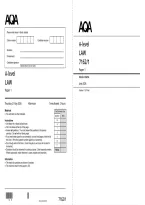
Please write clearly in block capitals.
Centre number Candidate number
A-level
Surname
Forename(s)
LAW
Candidate signature
I declare this is my own work.
7162/1
Paper 1
A-level Mark scheme
LAW June 2026
Paper 1 Version: 1.0 Final
Thursday 21 May 2026 Afternoon Time allowed: 2 hours
Materials For Examiner’s Use
• You will need no other materials.
Question Mark
Instructions 1–5
• Use black ink or black ball-point pen. 6
• Fill in the boxes at the top of this page. 7
• Answer all questions. You must answer the questions in the spaces
provided. Do not write on blank pages. 8
• If you need extra space for your answer(s), use the lined pages at the end of 9
this book. Write the question number against your answer(s). 10
• Do all rough work in this book. Cross through any work you do not want to
11
be marked.
• Questions should be answered in continuous prose. Give reasoned answers. TOTAL
Where appropriate, make reference to cases, statutes and examples.
Information
• The marks for questions are shown in brackets.
• The maximum mark for this paper is 100.
*JUN *
IB/G/Jun26/G4005/E7 7162/1
, 2
MARK SCHEME – A-LEVEL LAW – 7162/1 – JUNE 2026
Do not write
outside the
Answer all questions in the spaces provided. box
Mark schemes are prepared by the Lead Assessment Writer and considered, together with the relevant
questions, by a panel of subject teachers. This mark scheme includes any amendments made at the
Only one answer per question is allowed. standardisation events which all associates participate in and is the scheme which was used by them in
this examination. The standardisation process ensures that the mark scheme covers the students’
For each question completely fill in the circle alongside the appropriate answer. responses to questions and that every associate understands and applies it in the same correct way.
As preparation for standardisation each associate analyses a number of students’ scripts. Alternative
CORRECT METHOD WRONG METHODS
answers not already covered by the mark scheme are discussed and legislated for. If, after the
standardisation process, associates encounter unusual answers which have not been raised they are
If you want to change your answer you must cross out your original answer as shown. required to refer these to the Lead Examiner.
If you wish to return to an answer previously crossed out, ring the answer you now wish to select It must be stressed that a mark scheme is a working document, in many cases further developed and
as shown. expanded on the basis of students’ reactions to a particular paper. Assumptions about future mark
schemes on the basis of one year’s document should be avoided; whilst the guiding principles of
assessment remain constant, details will change, depending on the content of a particular examination
paper.
0 1 Select the true statement about the offence of unlawful and malicious wounding or No student should be disadvantaged on the basis of their gender identity and/or how they refer to the
inflicting grievous bodily harm under s20 of the Offences Against the Person Act 1861. gender identity of others in their exam responses.
[1 mark]
A consistent use of ‘they/them’ as a singular and pronouns beyond ‘she/her’ or ‘he/him’ will be credited in
A The defendant is required to commit an assault as part of the actus reus. exam responses in line with existing mark scheme criteria.
B The mens rea requires an intention to cause serious harm.
Further copies of this mark scheme are available from
C The offence requires the victim to suffer serious injury.
D Wounding requires a break in the continuity of the skin.
0 2 Select the true statement about the defence of voluntary intoxication.
[1 mark]
A Voluntary intoxication can be a defence to crimes of basic intent.
B Voluntary intoxication can be a defence to murder.
C Voluntary intoxication is a defence provided that the defendant had the required
mens rea.
D Voluntary intoxication requires the defendant to have consumed illegal drugs.
information
retains the on all its publications. However, registered schools/colleges for are permitted to copy material from this booklet for their own
internal use, with the following important exception: cannot give permission to schools/colleges to photocopy any material that is acknowledged to a third
party even for internal use within the centre.
and its licensors. All rights reserved.
*02*
2
IB/G/Jun26/7162/1
, 3
MARK SCHEME – A-LEVEL LAW – 7162/1 – JUNE 2026
Do not write
outside the
0 3 Which of the following statements about the role of a judge in a Crown Court trial is false? box
[1 mark]
Level of response marking instructions
A The judge decides all the pre-trial issues, including whether the defendant can Level of response mark schemes are broken down into levels, each of which has a descriptor. The
be released on bail. descriptor for the level shows the average performance for the level. There are marks in each level.
B The judge decides the defendant’s sentence, following a guilty verdict. Before you apply the mark scheme to a student’s answer read through the answer and annotate it (as
instructed) to show the qualities that are being looked for. You can then apply the mark scheme.
C The judge decides the verdict at the end of the trial.
Step 1 Determine a level
D The judge explains the law to the jury.
Start at the lowest level of the mark scheme and use it as a ladder to see whether the answer meets the
descriptor for that level. The descriptor for the level indicates the different qualities that might be seen in
0 4 Select the true statement about statutory interpretation. the student’s answer for that level. If it meets the lowest level then go to the next one and decide if it
[1 mark] meets this level, and so on, until you have a match between the level descriptor and the answer. With
practice and familiarity you will find that for better answers you will be able to quickly skip through the
lower levels of the mark scheme.
A The golden rule has both a broad (wide) and a narrow approach.
When assigning a level you should look at the overall quality of the answer and not look to pick holes in
B The literal rule allows the judge to modify a meaning of a word. small and specific parts of the answer where the student has not performed quite as well as the rest. If
the answer covers different aspects of different levels of the mark scheme you should use a best fit
C The mischief rule is not concerned with the true intentions of Parliament. approach for defining the level and then use the variability of the response to help decide the mark within
the level, ie if the response is predominantly level 3 with a small amount of level 4 material it would be
D The purposive approach is concerned only to ensure certainty within the law. placed in level 3 but be awarded a mark near the top of the level because of the level 4 content.
Step 2 Determine a mark
0 5 In relation to judicial precedent, select the false statement about obiter dicta. Once you have assigned a level you need to decide on the mark. The descriptors on how to allocate
[1 mark] marks can help with this. The exemplar materials used during standardisation will help. There will be an
answer in the standardising materials which will correspond with each level of the mark scheme. This
A Obiter dicta may be used as persuasive precedent. answer will have been awarded a mark by the Lead Examiner. You can compare the student’s answer
with the example to determine if it is the same standard, better or worse than the example. You can then
B Obiter dicta may be used to form the basis of a ratio decidendi in a later case. use this to allocate a mark for the answer based on the Lead Examiner’s mark on the example.
C Obiter dicta may offer guidance to judges in similar cases in the future. You may well need to read back through the answer as you apply the mark scheme to clarify points and
assure yourself that the level and the mark are appropriate.
D Obiter dicta must be followed by judges in lower courts in future cases. 5
Indicative content in the mark scheme is provided as a guide for examiners. It is not intended to be
exhaustive and you must credit other valid points. Students do not have to cover all of the points
mentioned in the Indicative content to reach the highest level of the mark scheme.
Turn over for the next question An answer which contains nothing of relevance to the question must be awarded no marks.
Turn over ►
*03*
3
IB/G/Jun26/7162/1
Centre number Candidate number
A-level
Surname
Forename(s)
LAW
Candidate signature
I declare this is my own work.
7162/1
Paper 1
A-level Mark scheme
LAW June 2026
Paper 1 Version: 1.0 Final
Thursday 21 May 2026 Afternoon Time allowed: 2 hours
Materials For Examiner’s Use
• You will need no other materials.
Question Mark
Instructions 1–5
• Use black ink or black ball-point pen. 6
• Fill in the boxes at the top of this page. 7
• Answer all questions. You must answer the questions in the spaces
provided. Do not write on blank pages. 8
• If you need extra space for your answer(s), use the lined pages at the end of 9
this book. Write the question number against your answer(s). 10
• Do all rough work in this book. Cross through any work you do not want to
11
be marked.
• Questions should be answered in continuous prose. Give reasoned answers. TOTAL
Where appropriate, make reference to cases, statutes and examples.
Information
• The marks for questions are shown in brackets.
• The maximum mark for this paper is 100.
*JUN *
IB/G/Jun26/G4005/E7 7162/1
, 2
MARK SCHEME – A-LEVEL LAW – 7162/1 – JUNE 2026
Do not write
outside the
Answer all questions in the spaces provided. box
Mark schemes are prepared by the Lead Assessment Writer and considered, together with the relevant
questions, by a panel of subject teachers. This mark scheme includes any amendments made at the
Only one answer per question is allowed. standardisation events which all associates participate in and is the scheme which was used by them in
this examination. The standardisation process ensures that the mark scheme covers the students’
For each question completely fill in the circle alongside the appropriate answer. responses to questions and that every associate understands and applies it in the same correct way.
As preparation for standardisation each associate analyses a number of students’ scripts. Alternative
CORRECT METHOD WRONG METHODS
answers not already covered by the mark scheme are discussed and legislated for. If, after the
standardisation process, associates encounter unusual answers which have not been raised they are
If you want to change your answer you must cross out your original answer as shown. required to refer these to the Lead Examiner.
If you wish to return to an answer previously crossed out, ring the answer you now wish to select It must be stressed that a mark scheme is a working document, in many cases further developed and
as shown. expanded on the basis of students’ reactions to a particular paper. Assumptions about future mark
schemes on the basis of one year’s document should be avoided; whilst the guiding principles of
assessment remain constant, details will change, depending on the content of a particular examination
paper.
0 1 Select the true statement about the offence of unlawful and malicious wounding or No student should be disadvantaged on the basis of their gender identity and/or how they refer to the
inflicting grievous bodily harm under s20 of the Offences Against the Person Act 1861. gender identity of others in their exam responses.
[1 mark]
A consistent use of ‘they/them’ as a singular and pronouns beyond ‘she/her’ or ‘he/him’ will be credited in
A The defendant is required to commit an assault as part of the actus reus. exam responses in line with existing mark scheme criteria.
B The mens rea requires an intention to cause serious harm.
Further copies of this mark scheme are available from
C The offence requires the victim to suffer serious injury.
D Wounding requires a break in the continuity of the skin.
0 2 Select the true statement about the defence of voluntary intoxication.
[1 mark]
A Voluntary intoxication can be a defence to crimes of basic intent.
B Voluntary intoxication can be a defence to murder.
C Voluntary intoxication is a defence provided that the defendant had the required
mens rea.
D Voluntary intoxication requires the defendant to have consumed illegal drugs.
information
retains the on all its publications. However, registered schools/colleges for are permitted to copy material from this booklet for their own
internal use, with the following important exception: cannot give permission to schools/colleges to photocopy any material that is acknowledged to a third
party even for internal use within the centre.
and its licensors. All rights reserved.
*02*
2
IB/G/Jun26/7162/1
, 3
MARK SCHEME – A-LEVEL LAW – 7162/1 – JUNE 2026
Do not write
outside the
0 3 Which of the following statements about the role of a judge in a Crown Court trial is false? box
[1 mark]
Level of response marking instructions
A The judge decides all the pre-trial issues, including whether the defendant can Level of response mark schemes are broken down into levels, each of which has a descriptor. The
be released on bail. descriptor for the level shows the average performance for the level. There are marks in each level.
B The judge decides the defendant’s sentence, following a guilty verdict. Before you apply the mark scheme to a student’s answer read through the answer and annotate it (as
instructed) to show the qualities that are being looked for. You can then apply the mark scheme.
C The judge decides the verdict at the end of the trial.
Step 1 Determine a level
D The judge explains the law to the jury.
Start at the lowest level of the mark scheme and use it as a ladder to see whether the answer meets the
descriptor for that level. The descriptor for the level indicates the different qualities that might be seen in
0 4 Select the true statement about statutory interpretation. the student’s answer for that level. If it meets the lowest level then go to the next one and decide if it
[1 mark] meets this level, and so on, until you have a match between the level descriptor and the answer. With
practice and familiarity you will find that for better answers you will be able to quickly skip through the
lower levels of the mark scheme.
A The golden rule has both a broad (wide) and a narrow approach.
When assigning a level you should look at the overall quality of the answer and not look to pick holes in
B The literal rule allows the judge to modify a meaning of a word. small and specific parts of the answer where the student has not performed quite as well as the rest. If
the answer covers different aspects of different levels of the mark scheme you should use a best fit
C The mischief rule is not concerned with the true intentions of Parliament. approach for defining the level and then use the variability of the response to help decide the mark within
the level, ie if the response is predominantly level 3 with a small amount of level 4 material it would be
D The purposive approach is concerned only to ensure certainty within the law. placed in level 3 but be awarded a mark near the top of the level because of the level 4 content.
Step 2 Determine a mark
0 5 In relation to judicial precedent, select the false statement about obiter dicta. Once you have assigned a level you need to decide on the mark. The descriptors on how to allocate
[1 mark] marks can help with this. The exemplar materials used during standardisation will help. There will be an
answer in the standardising materials which will correspond with each level of the mark scheme. This
A Obiter dicta may be used as persuasive precedent. answer will have been awarded a mark by the Lead Examiner. You can compare the student’s answer
with the example to determine if it is the same standard, better or worse than the example. You can then
B Obiter dicta may be used to form the basis of a ratio decidendi in a later case. use this to allocate a mark for the answer based on the Lead Examiner’s mark on the example.
C Obiter dicta may offer guidance to judges in similar cases in the future. You may well need to read back through the answer as you apply the mark scheme to clarify points and
assure yourself that the level and the mark are appropriate.
D Obiter dicta must be followed by judges in lower courts in future cases. 5
Indicative content in the mark scheme is provided as a guide for examiners. It is not intended to be
exhaustive and you must credit other valid points. Students do not have to cover all of the points
mentioned in the Indicative content to reach the highest level of the mark scheme.
Turn over for the next question An answer which contains nothing of relevance to the question must be awarded no marks.
Turn over ►
*03*
3
IB/G/Jun26/7162/1

