
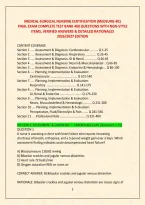
MEDICAL-SURGICAL NURSING CERTIFICATION (MEDSURG-BC)
FINAL EXAM COMPLETE TEST BANK 400 QUESTIONS WITH NGN-STYLE
ITEMS, VERIFIED ANSWERS & DETAILED RATIONALES
2026/2027 EDITION
CONTENT COVERAGE
Section 1 ..... Assessment & Diagnosis: Cardiovascular .......... Q 1-25
Section 2 ..... Assessment & Diagnosis: Respiratory ............. Q 26-45
Section 3 ..... Assessment & Diagnosis: GI & Renal ............... Q 46-65
Section 4 ..... Assessment & Diagnosis: Neuro & Musculoskeletal .. Q 66-85
Section 5 ..... Assessment & Diagnosis: Endocrine & Hematologic .. Q 86-100
Section 6 ..... Planning, Implementation & Evaluation:
Cardiovascular ................................ Q 101-140
Section 7 ..... Planning, Implementation & Evaluation:
Respiratory .................................... Q 141-175
Section 8 ..... Planning, Implementation & Evaluation:
GI, Renal & Endocrine .......................... Q 176-230
Section 9 ..... Planning, Implementation & Evaluation:
Neuro, Musculoskeletal & Hematologic .......... Q 231-280
Section 10 .... Planning, Implementation & Evaluation:
Perioperative, Fluid/Electrolyte & Pain ....... Q 281-330
Section 11 .... Professional Role ............................... Q 331-400
SECTION 1: ASSESSMENT & DIAGNOSIS — CARDIOVASCULAR (Questions 1-25)
QUESTION 1
A nurse is assessing a client with heart failure who reports increasing
shortness of breath, orthopnea, and a 5-pound weight gain over 3 days. Which
assessment finding indicates acute decompensated heart failure?
A) Blood pressure 138/82 mmHg
B) Bibasilar crackles and jugular venous distention
C) Heart rate 72 beats/min
D) Oxygen saturation 96% on room air
CORRECT ANSWER: B) Bibasilar crackles and jugular venous distention
RATIONALE: Bibasilar crackles and jugular venous distention are classic signs of
1
,fluid overload and acute decompensated heart failure. The weight gain of 5
pounds in 3 days reflects fluid retention. The other findings are within normal
limits and do not indicate decompensation.
NGN TIP: Recognize cues of fluid overload — crackles, JVD, weight gain, and
orthopnea.
QUESTION 2
A nurse is caring for a client with dilated cardiomyopathy. The nurse should
expect which finding?
A) Left ventricular failure
B) Peripheral vasodilation
C) Pericardial effusion
D) Decreased vascular volume
CORRECT ANSWER: A) Left ventricular failure
RATIONALE: Dilated cardiomyopathy is characterized by dilation of the
ventricles, particularly the left ventricle, leading to impaired systolic
function and left ventricular failure. Peripheral vasodilation, pericardial
effusion, and decreased vascular volume are not primary features of dilated
cardiomyopathy.
QUESTION 3
A client complains of crushing chest pain that radiates to the left arm. Which
action should the nurse take FIRST?
A) Administer nitroglycerin sublingually
B) Obtain a 12-lead ECG
C) Administer aspirin 325 mg chewed
D) Assess vital signs and oxygen saturation
CORRECT ANSWER: B) Obtain a 12-lead ECG
2
,RATIONALE: Obtaining a 12-lead ECG is the priority for a client with suspected
acute coronary syndrome. The ECG should be obtained within 10 minutes of
arrival to identify ST-elevation myocardial infarction (STEMI) and guide
reperfusion therapy. While oxygen, nitroglycerin, and aspirin are important,
the ECG provides critical diagnostic information that guides immediate
treatment.
HIGH-YIELD: "Time is muscle" — ECG within 10 minutes is the standard.
QUESTION 4
A nurse is assessing a client who has right-sided heart failure. Which finding
should the nurse expect?
A) Crackles in the lung bases
B) Jugular vein distension
C) Dry, nonproductive cough
D) Low oxygen saturation levels
CORRECT ANSWER: B) Jugular vein distension
RATIONALE: Right-sided heart failure causes systemic venous congestion because
the right ventricle is unable to pump blood effectively into the pulmonary
circulation. This leads to jugular vein distention, dependent peripheral
edema, hepatomegaly, and ascites. Crackles and a dry cough are classical
manifestations of left-sided heart failure.
QUESTION 5
A nurse is assessing a client with pericarditis. Which ECG finding is most
consistent with this diagnosis?
A) ST depression in leads V3 through V6
B) Diffuse ST elevation
C) Peaked T waves
3
, D) Prolonged QT interval
CORRECT ANSWER: B) Diffuse ST elevation
RATIONALE: Pericarditis is characterized by diffuse ST elevation on ECG, along
with PR segment depression. ST depression in specific leads suggests ischemia.
Peaked T waves suggest hyperkalemia. Prolonged QT interval suggests
hypocalcemia or medication effects.
QUESTION 6
A client with new-onset atrial fibrillation has a ventricular rate of 156/min
and is hemodynamically stable with blood pressure 128/78 mm Hg. The client
reports lightheadedness and palpitations. Which intervention should the nurse
anticipate?
A) Immediate synchronized cardioversion
B) Administration of intravenous amiodarone
C) Administration of intravenous diltiazem
D) Insertion of a temporary pacemaker
CORRECT ANSWER: C) Administration of intravenous diltiazem
RATIONALE: In hemodynamically stable atrial fibrillation with rapid ventricular
response, rate control with a calcium channel blocker (diltiazem) or beta-
blocker is indicated. Immediate synchronized cardioversion is indicated for
unstable patients.
QUESTION 7
A nurse is assessing a client who has peripheral arterial disease (PAD). Which
finding should the nurse expect?
A) Warm, moist skin
B) Bounding pulses
C) Intermittent claudication
4
FINAL EXAM COMPLETE TEST BANK 400 QUESTIONS WITH NGN-STYLE
ITEMS, VERIFIED ANSWERS & DETAILED RATIONALES
2026/2027 EDITION
CONTENT COVERAGE
Section 1 ..... Assessment & Diagnosis: Cardiovascular .......... Q 1-25
Section 2 ..... Assessment & Diagnosis: Respiratory ............. Q 26-45
Section 3 ..... Assessment & Diagnosis: GI & Renal ............... Q 46-65
Section 4 ..... Assessment & Diagnosis: Neuro & Musculoskeletal .. Q 66-85
Section 5 ..... Assessment & Diagnosis: Endocrine & Hematologic .. Q 86-100
Section 6 ..... Planning, Implementation & Evaluation:
Cardiovascular ................................ Q 101-140
Section 7 ..... Planning, Implementation & Evaluation:
Respiratory .................................... Q 141-175
Section 8 ..... Planning, Implementation & Evaluation:
GI, Renal & Endocrine .......................... Q 176-230
Section 9 ..... Planning, Implementation & Evaluation:
Neuro, Musculoskeletal & Hematologic .......... Q 231-280
Section 10 .... Planning, Implementation & Evaluation:
Perioperative, Fluid/Electrolyte & Pain ....... Q 281-330
Section 11 .... Professional Role ............................... Q 331-400
SECTION 1: ASSESSMENT & DIAGNOSIS — CARDIOVASCULAR (Questions 1-25)
QUESTION 1
A nurse is assessing a client with heart failure who reports increasing
shortness of breath, orthopnea, and a 5-pound weight gain over 3 days. Which
assessment finding indicates acute decompensated heart failure?
A) Blood pressure 138/82 mmHg
B) Bibasilar crackles and jugular venous distention
C) Heart rate 72 beats/min
D) Oxygen saturation 96% on room air
CORRECT ANSWER: B) Bibasilar crackles and jugular venous distention
RATIONALE: Bibasilar crackles and jugular venous distention are classic signs of
1
,fluid overload and acute decompensated heart failure. The weight gain of 5
pounds in 3 days reflects fluid retention. The other findings are within normal
limits and do not indicate decompensation.
NGN TIP: Recognize cues of fluid overload — crackles, JVD, weight gain, and
orthopnea.
QUESTION 2
A nurse is caring for a client with dilated cardiomyopathy. The nurse should
expect which finding?
A) Left ventricular failure
B) Peripheral vasodilation
C) Pericardial effusion
D) Decreased vascular volume
CORRECT ANSWER: A) Left ventricular failure
RATIONALE: Dilated cardiomyopathy is characterized by dilation of the
ventricles, particularly the left ventricle, leading to impaired systolic
function and left ventricular failure. Peripheral vasodilation, pericardial
effusion, and decreased vascular volume are not primary features of dilated
cardiomyopathy.
QUESTION 3
A client complains of crushing chest pain that radiates to the left arm. Which
action should the nurse take FIRST?
A) Administer nitroglycerin sublingually
B) Obtain a 12-lead ECG
C) Administer aspirin 325 mg chewed
D) Assess vital signs and oxygen saturation
CORRECT ANSWER: B) Obtain a 12-lead ECG
2
,RATIONALE: Obtaining a 12-lead ECG is the priority for a client with suspected
acute coronary syndrome. The ECG should be obtained within 10 minutes of
arrival to identify ST-elevation myocardial infarction (STEMI) and guide
reperfusion therapy. While oxygen, nitroglycerin, and aspirin are important,
the ECG provides critical diagnostic information that guides immediate
treatment.
HIGH-YIELD: "Time is muscle" — ECG within 10 minutes is the standard.
QUESTION 4
A nurse is assessing a client who has right-sided heart failure. Which finding
should the nurse expect?
A) Crackles in the lung bases
B) Jugular vein distension
C) Dry, nonproductive cough
D) Low oxygen saturation levels
CORRECT ANSWER: B) Jugular vein distension
RATIONALE: Right-sided heart failure causes systemic venous congestion because
the right ventricle is unable to pump blood effectively into the pulmonary
circulation. This leads to jugular vein distention, dependent peripheral
edema, hepatomegaly, and ascites. Crackles and a dry cough are classical
manifestations of left-sided heart failure.
QUESTION 5
A nurse is assessing a client with pericarditis. Which ECG finding is most
consistent with this diagnosis?
A) ST depression in leads V3 through V6
B) Diffuse ST elevation
C) Peaked T waves
3
, D) Prolonged QT interval
CORRECT ANSWER: B) Diffuse ST elevation
RATIONALE: Pericarditis is characterized by diffuse ST elevation on ECG, along
with PR segment depression. ST depression in specific leads suggests ischemia.
Peaked T waves suggest hyperkalemia. Prolonged QT interval suggests
hypocalcemia or medication effects.
QUESTION 6
A client with new-onset atrial fibrillation has a ventricular rate of 156/min
and is hemodynamically stable with blood pressure 128/78 mm Hg. The client
reports lightheadedness and palpitations. Which intervention should the nurse
anticipate?
A) Immediate synchronized cardioversion
B) Administration of intravenous amiodarone
C) Administration of intravenous diltiazem
D) Insertion of a temporary pacemaker
CORRECT ANSWER: C) Administration of intravenous diltiazem
RATIONALE: In hemodynamically stable atrial fibrillation with rapid ventricular
response, rate control with a calcium channel blocker (diltiazem) or beta-
blocker is indicated. Immediate synchronized cardioversion is indicated for
unstable patients.
QUESTION 7
A nurse is assessing a client who has peripheral arterial disease (PAD). Which
finding should the nurse expect?
A) Warm, moist skin
B) Bounding pulses
C) Intermittent claudication
4

