
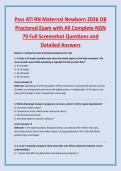
Pass ATI RN Maternal Newborn 2026 OB
Proctored Exam with All Complete NGN
70 Full Screenshot Questions and
Detailed Answers
Section 1: Antepartum Care and Fetal Development (1–25)
1. A client at 10 weeks' gestation asks when she should expect to feel fetal movement. The
nurse should respond that quickening is typically first felt at which time?
A. 8–10 weeks
B. 16–20 weeks
C. 24–28 weeks
D. 30–32 weeks
Correct Answer: B
Rationale: Quickening, the first perception of fetal movement, is typically felt between 16 and
20 weeks in a primigravida and may be felt slightly earlier in multigravidas. 8–10 weeks is too
early, and 24 weeks or later is beyond the usual range.
2. Which physiologic change in pregnancy increases a client's risk for supine hypotension?
A. Increased cardiac output
B. Compression of the inferior vena cava by the uterus
C. Decreased blood volume
D. Increased systemic vascular resistance
Correct Answer: B
Rationale: In the supine position, the gravid uterus can compress the inferior vena cava,
decreasing venous return and cardiac output, causing hypotension. This is why left lateral
positioning is encouraged.
3. A nurse is teaching a pregnant client about folic acid. Which statement indicates correct
understanding?
A. "I should take 400 mcg daily before and during early pregnancy."
,B. "I only need folic acid after 20 weeks."
C. "Folic acid prevents all birth defects."
D. "I should stop folic acid once I conceive."
Correct Answer: A
Rationale: 400 mcg of folic acid daily is recommended for most women before conception and
during early pregnancy to reduce the risk of neural tube defects. It does not prevent all birth
defects and should not be stopped at conception.
4. SATA: Which findings are expected physiologic changes of pregnancy? Select all that apply.
A. Leukorrhea
B. Decreased glomerular filtration rate
C. Nasal stuffiness
D. Increased basal metabolic rate
E. Decreased heart rate
Correct Answer: A, C, D
Rationale: Leukorrhea, nasal stuffiness (estrogen-related mucosal edema), and increased basal
metabolic rate are expected. GFR increases, not decreases, and heart rate typically increases
slightly.
5. A client at 28 weeks' gestation reports heartburn. Which instruction should the nurse
provide?
A. "Lie down immediately after eating."
B. "Eat small, frequent meals and avoid spicy foods."
C. "Drink large amounts of fluid with meals."
D. "Take sodium bicarbonate daily."
Correct Answer: B
Rationale: Small frequent meals, avoiding trigger foods, and remaining upright after meals
reduce reflux. Lying down worsens symptoms, and sodium bicarbonate can cause fluid retention
and electrolyte imbalance.
6. The nurse is calculating the estimated date of delivery (EDD) using Naegele's rule for a
client whose last menstrual period began March 10. What is the EDD?
A. December 3
B. December 17
,C. December 24
D. January 3
Correct Answer: B
Rationale: Naegele's rule: subtract 3 months and add 7 days. March 10 minus 3 months =
December 10; plus 7 days = December 17.
7. Which laboratory finding should the nurse report immediately in a pregnant client at 12
weeks?
A. Hemoglobin 11.5 g/dL
B. Rubella titer nonimmune
C. Platelet count 150,000/mm³
D. Blood type O positive
Correct Answer: B
Rationale: A nonimmune rubella titer requires postpartum vaccination and counseling to avoid
infection during pregnancy; it is an important finding to address. The other values are within
normal limits or expected.
8. A nurse is assessing a client at 36 weeks' gestation. Which finding should be reported to the
provider?
A. Fundal height 36 cm
B. Visual disturbances and epigastric pain
C. Braxton Hicks contractions
D. Mild ankle edema
Correct Answer: B
Rationale: Visual changes and epigastric pain are warning signs of preeclampsia with severe
features and require immediate evaluation. The other findings are expected.
9. Which screening test assesses for neural tube defects?
A. Alpha-fetoprotein (AFP)
B. Glucose tolerance test
C. Group B streptococcus culture
D. Nonstress test
, Correct Answer: A
Rationale: AFP is a maternal serum screening test used to assess risk for neural tube defects
and other anomalies.
10. A client asks about the purpose of the glucose tolerance test at 24–28 weeks. The nurse
explains it screens for:
A. Preeclampsia
B. Gestational diabetes
C. Anemia
D. Placenta previa
Correct Answer: B
Rationale: Routine screening for gestational diabetes is performed at 24–28 weeks using a
glucose challenge followed by a glucose tolerance test if indicated.
11. SATA: Which are warning signs of preterm labor? Select all that apply.
A. Regular uterine contractions
B. Low backache
C. Increased vaginal discharge
D. Pelvic pressure
E. Decreased fetal movement only
Correct Answer: A, B, C, D
Rationale: Regular contractions, low backache, change in discharge, and pelvic pressure are
warning signs. Decreased fetal movement is a concern but is not a classic preterm labor sign.
12. A nurse is teaching a client about fetal development. At which gestational age does the
fetus begin to produce surfactant?
A. 12 weeks
B. 20 weeks
C. 24 weeks
D. 36 weeks
Correct Answer: C
Rationale: Surfactant production begins around 24 weeks, improving lung compliance;
adequate levels are generally reached by 34–36 weeks.
Proctored Exam with All Complete NGN
70 Full Screenshot Questions and
Detailed Answers
Section 1: Antepartum Care and Fetal Development (1–25)
1. A client at 10 weeks' gestation asks when she should expect to feel fetal movement. The
nurse should respond that quickening is typically first felt at which time?
A. 8–10 weeks
B. 16–20 weeks
C. 24–28 weeks
D. 30–32 weeks
Correct Answer: B
Rationale: Quickening, the first perception of fetal movement, is typically felt between 16 and
20 weeks in a primigravida and may be felt slightly earlier in multigravidas. 8–10 weeks is too
early, and 24 weeks or later is beyond the usual range.
2. Which physiologic change in pregnancy increases a client's risk for supine hypotension?
A. Increased cardiac output
B. Compression of the inferior vena cava by the uterus
C. Decreased blood volume
D. Increased systemic vascular resistance
Correct Answer: B
Rationale: In the supine position, the gravid uterus can compress the inferior vena cava,
decreasing venous return and cardiac output, causing hypotension. This is why left lateral
positioning is encouraged.
3. A nurse is teaching a pregnant client about folic acid. Which statement indicates correct
understanding?
A. "I should take 400 mcg daily before and during early pregnancy."
,B. "I only need folic acid after 20 weeks."
C. "Folic acid prevents all birth defects."
D. "I should stop folic acid once I conceive."
Correct Answer: A
Rationale: 400 mcg of folic acid daily is recommended for most women before conception and
during early pregnancy to reduce the risk of neural tube defects. It does not prevent all birth
defects and should not be stopped at conception.
4. SATA: Which findings are expected physiologic changes of pregnancy? Select all that apply.
A. Leukorrhea
B. Decreased glomerular filtration rate
C. Nasal stuffiness
D. Increased basal metabolic rate
E. Decreased heart rate
Correct Answer: A, C, D
Rationale: Leukorrhea, nasal stuffiness (estrogen-related mucosal edema), and increased basal
metabolic rate are expected. GFR increases, not decreases, and heart rate typically increases
slightly.
5. A client at 28 weeks' gestation reports heartburn. Which instruction should the nurse
provide?
A. "Lie down immediately after eating."
B. "Eat small, frequent meals and avoid spicy foods."
C. "Drink large amounts of fluid with meals."
D. "Take sodium bicarbonate daily."
Correct Answer: B
Rationale: Small frequent meals, avoiding trigger foods, and remaining upright after meals
reduce reflux. Lying down worsens symptoms, and sodium bicarbonate can cause fluid retention
and electrolyte imbalance.
6. The nurse is calculating the estimated date of delivery (EDD) using Naegele's rule for a
client whose last menstrual period began March 10. What is the EDD?
A. December 3
B. December 17
,C. December 24
D. January 3
Correct Answer: B
Rationale: Naegele's rule: subtract 3 months and add 7 days. March 10 minus 3 months =
December 10; plus 7 days = December 17.
7. Which laboratory finding should the nurse report immediately in a pregnant client at 12
weeks?
A. Hemoglobin 11.5 g/dL
B. Rubella titer nonimmune
C. Platelet count 150,000/mm³
D. Blood type O positive
Correct Answer: B
Rationale: A nonimmune rubella titer requires postpartum vaccination and counseling to avoid
infection during pregnancy; it is an important finding to address. The other values are within
normal limits or expected.
8. A nurse is assessing a client at 36 weeks' gestation. Which finding should be reported to the
provider?
A. Fundal height 36 cm
B. Visual disturbances and epigastric pain
C. Braxton Hicks contractions
D. Mild ankle edema
Correct Answer: B
Rationale: Visual changes and epigastric pain are warning signs of preeclampsia with severe
features and require immediate evaluation. The other findings are expected.
9. Which screening test assesses for neural tube defects?
A. Alpha-fetoprotein (AFP)
B. Glucose tolerance test
C. Group B streptococcus culture
D. Nonstress test
, Correct Answer: A
Rationale: AFP is a maternal serum screening test used to assess risk for neural tube defects
and other anomalies.
10. A client asks about the purpose of the glucose tolerance test at 24–28 weeks. The nurse
explains it screens for:
A. Preeclampsia
B. Gestational diabetes
C. Anemia
D. Placenta previa
Correct Answer: B
Rationale: Routine screening for gestational diabetes is performed at 24–28 weeks using a
glucose challenge followed by a glucose tolerance test if indicated.
11. SATA: Which are warning signs of preterm labor? Select all that apply.
A. Regular uterine contractions
B. Low backache
C. Increased vaginal discharge
D. Pelvic pressure
E. Decreased fetal movement only
Correct Answer: A, B, C, D
Rationale: Regular contractions, low backache, change in discharge, and pelvic pressure are
warning signs. Decreased fetal movement is a concern but is not a classic preterm labor sign.
12. A nurse is teaching a client about fetal development. At which gestational age does the
fetus begin to produce surfactant?
A. 12 weeks
B. 20 weeks
C. 24 weeks
D. 36 weeks
Correct Answer: C
Rationale: Surfactant production begins around 24 weeks, improving lung compliance;
adequate levels are generally reached by 34–36 weeks.

