
• ¿Documento equivocado? Cámbialo gratis
  • Escrito por estudiantes que aprobaron
  • Inmediatamente disponible después del pago
  • Leer en línea o como PDF
Vender
¿Dónde estudias?
Tu idioma
Document preview thumbnail
Vista previa 4 fuera de 135 páginas
Examen

Test Bank for Starting Out With Java: Control Structures through Objects, 8th edition by Gaddis

Document preview thumbnail
Vista previa 4 fuera de 135 páginas

Prepare for assessments based on Starting Out with Java: From Control Structures through Objects, 8th Edition by Tony Gaddis with this comprehensive test bank study resource. WHAT'S INCLUDED: • Starting Out with Java 8th Edition test bank material • Chapter-by-chapter practice questions • Multiple-choice and conceptual questions • Java programming and object-oriented programming topics • Control structures and programming fundamentals • Classes and objects • Methods and constructors • Inheritance and other core Java concepts • Answers and explanations where provided • Comprehensive review for quizzes, tests, and exams IDEAL FOR: Java programming students Introductory programming courses Starting Out with Java 8e review Chapter-by-chapter exam preparation Quiz and test revision Computer science students Starting Out with Java 8th Edition, Starting Out with Java From Control Structures through Objects 8e, Tony Gaddis Java 8th Edition, Starting Out with Java Test Bank, Java 8e Test Bank, Java Test Bank Questions and Answers, Starting Out with Java Questions and Answers, Java Programming Test Bank, Java Programming Exam Questions, Gaddis Java Test Bank, Java Chapter Questions, Java Programming Study Guide, Object Oriented Programming Java, Java Exam Preparation.

Vista previa del contenido

Starting Out with Java: From Control Structures through Objects 8e
(Gaddis)
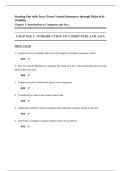
Chapter 1: Introduction to Computers and Java


CHAPTER 1: INTRODUCTION TO COMPUTERS AND JAVA


TRUE / FALSE

1. Logical errors are mistakes that cause the program to produce erroneous results.

ANS: T

2. The Java Virtual Machine is a program that reads Java byte code instructions and executes
them as they are read.

ANS: T

3. Colons are used to indicate the end of a Java statement.

ANS: F

4. Compiled byte code is also called source code.

ANS: F

5. Application software refers to programs that make the computer useful to the user.

ANS: T

6. Each byte is assigned a unique number known as an address.

ANS: T

,Starting Out with Java: From Control Structures through Objects 8e
(Gaddis)
Chapter 1: Introduction to Computers and Java


7. Encapsulation refers to the combining of data and code into a single object.

ANS: T

8. Java source files end with the .class extension.

ANS: F

9. A procedure is a set of programming language statements that, together, perform a specific
task.

ANS: T

10. A solid-state drive has no moving parts and operates faster than a traditional disk drive.

ANS: T

11. The computer is a tool used by so many professionals that it cannot be easily
categorized.

ANS: T

12. The CPU is the part of the computer that actually runs programs.

ANS: T

13. Main memory is volatile, meaning its contents are lost when the computer is turned off.

ANS: T

14. Secondary storage is non-volatile, meaning it retains data when the computer is turned
off.

ANS: T

,Starting Out with Java: From Control Structures through Objects 8e
(Gaddis)
Chapter 1: Introduction to Computers and Java


15. A compiler translates source code into machine language.

ANS: T

16. An interpreter translates and executes source code one line at a time.

ANS: T

17. Syntax errors are usually easier to find and correct than logical errors.

ANS: T

18. A runtime error is an error that occurs while the program is running.

ANS: T

19. Java was developed by Sun Microsystems (now Oracle).

ANS: T

20. Java is an object-oriented programming language.

ANS: T

21. The main method is the entry point of a Java application.

ANS: T

22. The println method is used to print a line of text to the console.

ANS: T

, Starting Out with Java: From Control Structures through Objects 8e
(Gaddis)
Chapter 1: Introduction to Computers and Java


23. In Java, the // symbols are used for multi-line comments.

ANS: F

24. Variables are named storage locations in the computer's memory.

ANS: T

25. You must declare a variable before you can use it in Java.

ANS: T

26. The int data type is used to store floating-point numbers.

ANS: F

27. The double data type is used to store real numbers with fractional parts.

ANS: T

28. The char data type is used to store a single character.

ANS: T

29. The boolean data type can hold only two values: true or false.

ANS: T

30. Java is a case-sensitive language.

ANS: T
Información del documento

Subido en
25 de septiembre de 2026
Número de páginas
135
Escrito en
2026/2027
Tipo
Examen
Contiene
Preguntas y respuestas
$28.99

¿Documento equivocado? Cámbialo gratis Dentro de los 14 días posteriores a la compra y antes de descargarlo, puedes elegir otro documento. Puedes gastar el importe de nuevo.
Escrito por estudiantes que aprobaron
Inmediatamente disponible después del pago
Leer en línea o como PDF

Seller avatar
Los indicadores de reputación están sujetos a la cantidad de artículos vendidos por una tarifa y las reseñas que ha recibido por esos documentos. Hay tres niveles: Bronce, Plata y Oro. Cuanto mayor reputación, más podrás confiar en la calidad del trabajo del vendedor.
TestBankDepotX
2.8
(11)
Vendido
103
Seguidores
18
Artículos
889
Última venta
18 horas hace


Por qué los estudiantes eligen Stuvia

Creado por compañeros estudiantes, verificado por reseñas

Calidad en la que puedes confiar: escrito por estudiantes que aprobaron y evaluado por otros que han usado estos resúmenes.

¿No estás satisfecho? Elige otro documento

¡No te preocupes! Puedes elegir directamente otro documento que se ajuste mejor a lo que buscas.

Paga como quieras, empieza a estudiar al instante

Sin suscripción, sin compromisos. Paga como estés acostumbrado con tarjeta de crédito y descarga tu documento PDF inmediatamente.

Student with book image

“Comprado, descargado y aprobado. Así de fácil puede ser.”

Alisha Student

Preguntas frecuentes
