
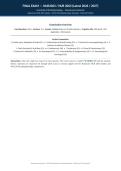
FINAL EXAM — NUR2063 / NUR 2063 (Latest )
Essentials of Pathophysiology · Rasmussen University
Aligned with NUR 2063 Syllabus · NCLEX-RN Pathophysiology Standards · 2026/2027 Edition
Examination Overview
Total Questions: 150 • Sections: 12 • Format: Multiple Choice (A–D) with rationale • Cognitive Mix: 20% Recall · 50%
Application · 30% Analysis
Section Composition:
1. Cellular Injury, Adaptation & Death (12) • 2. Inflammation & Wound Healing (12) • 3. Immunity & Immunopathology (12) • 4.
Infection & Infectious Disease (10)
5. Fluid, Electrolyte & Acid-Base (15) • 6. Cardiovascular (20) • 7. Respiratory (15) • 8. Renal & Genitourinary (12)
9. Endocrine & Metabolic (12) • 10. Neurological (10) • 11. Musculoskeletal & Integumentary (10) • 12. Hematological &
Oncological (10)
Instructions: Select the single best answer for each question. The correct answer is marked *[CORRECT]* and the rationale
follows. Questions are sequenced Q1 through Q150 across 12 sections aligned with the Rasmussen NUR 2063 syllabus and
NCLEX-RN pathophysiology competencies.
Rasmussen University · NUR 2063 Essentials of Pathophysiology · Final Exam (150 questions)
,FINAL EXAM — NUR2063 / NUR 2063 (Latest ) Page 2
Section 1: Cellular Injury, Adaptation, & Death | 12 Questions
Q1: A 24-year-old male has his lower leg casted for 6 weeks after a tibial fracture. After cast removal, the affected
gastrocnemius is visibly smaller than the contralateral side. Which cellular adaptation best explains this finding?
A. Hypertrophy of the unaffected limb
B. Atrophy due to decreased workload and disuse *[CORRECT]*
C. Metaplasia of skeletal muscle to fibrous tissue
D. Apoptosis induced by ischemic reperfusion
Correct Answer: B
Rationale: Disuse leads to cellular atrophy—a reversible decrease in cell size and number in response to reduced functional
demand, as covered in the NUR 2063 adaptation module. Hypertrophy is increased cell size from greater workload (e.g., cardiac
muscle in hypertension), metaplasia is reversible adult cell-type replacement (e.g., Barrett esophagus), and apoptosis is
programmed cell death, not a response to disuse.
Q2: A 58-year-old with long-standing hypertension has an echocardiogram showing increased left ventricular wall
thickness without chamber dilation. Which adaptive mechanism produced this finding?
A. Hyperplasia of cardiac myocytes
B. Hypertrophy of cardiac myocytes in response to pressure overload *[CORRECT]*
C. Metaplasia of myocardial fibers
D. Dysplastic changes in the conduction system
Correct Answer: B
Rationale: Pressure overload from chronic hypertension induces concentric hypertrophy—enlargement of individual cardiac
myocyte cell size to generate greater force. Cardiac myocytes are terminally differentiated and cannot undergo hyperplasia (a
response in dividing cells such as glandular epithelium). Metaplasia and dysplasia are epithelial phenomena, not myocardial
adaptations.
Q3: Following partial hepatectomy, the residual liver regrows to near-original volume within 6-8 weeks. Which
cellular process is the primary mechanism?
A. Hyperplasia of remaining hepatocytes *[CORRECT]*
B. Hypertrophy without cell division
C. Metaplasia of Kupffer cells into hepatocytes
D. Stem-cell differentiation only
Correct Answer: A
Rationale: Liver regeneration occurs predominantly through hyperplasia—an increase in cell number—of residual mature
hepatocytes that re-enter the cell cycle. Hypertrophy alone cannot restore organ mass, metaplasia is conversion to a different cell
type, and although progenitor cells contribute marginally, mature hepatocyte hyperplasia is the dominant mechanism in NUR 2063
pathophysiology content.
Rasmussen University · NUR 2063 Essentials of Pathophysiology · Final Exam (150 questions)
,FINAL EXAM — NUR2063 / NUR 2063 (Latest ) Page 3
Q4: A 52-year-old with 20 years of chronic GERD undergoes endoscopy showing salmon-colored mucosa proximal to
the GE junction. Biopsy confirms intestinal-type columnar epithelium replacing squamous epithelium. What is this
adaptation?
A. Hypertrophy of squamous epithelium
B. Hyperplasia of gastric cardia
C. Metaplasia (Barrett esophagus) due to chronic acid exposure *[CORRECT]*
D. Dysplasia progressing to invasive carcinoma
Correct Answer: C
Rationale: Chronic acid reflux induces squamous-to-columnar metaplasia, the hallmark of Barrett esophagus, an adaptive
substitution better able to withstand acidic injury. Hypertrophy and hyperplasia enlarge existing cell populations without changing
cell type. Dysplasia indicates disordered growth and is a premalignant change that may follow Barrett, but the biopsy described is
metaplasia, not dysplasia.
Q5: A 31-year-old woman's Pap smear shows cells with increased nuclear-to-cytoplasmic ratio, pleomorphic nuclei,
and disordered arrangement that does not invade the basement membrane. Which cellular change is described?
A. Atrophy of cervical epithelium
B. Metaplasia to columnar epithelium
C. Dysplasia (cervical intraepithelial neoplasia) *[CORRECT]*
D. Coagulative necrosis of squamous cells
Correct Answer: C
Rationale: Loss of normal maturation, pleomorphism, and increased N:C ratio without basement membrane invasion defines
dysplasia, a premalignant change often HPV-driven. Atrophy reduces cell size, metaplasia replaces one mature cell type with
another, and necrosis is cell death—not the disordered proliferation shown here.
Q6: A 65-year-old with an acute thrombotic occlusion of the LAD coronary artery develops irreversible myocardial
injury within 20-30 minutes. What is the dominant biochemical mechanism driving irreversible cell death in
ischemia?
A. Depletion of ATP leading to membrane pump failure, intracellular Ca2+ accumulation, and mitochondrial injury
*[CORRECT]*
B. Excessive ATP production causing oxidative phosphorylation overload
C. Alkalinization of the cytoplasm from bicarbonate retention
D. Activation of cyclic AMP stimulating mitosis
Correct Answer: A
Rationale: Ischemia deprives cells of oxygen and glucose, halting oxidative phosphorylation and depleting ATP; Na/K ATPase
failure, intracellular Na+ and Ca2+ accumulation, mitochondrial dysfunction, and membrane damage follow, producing
irreversible injury. ATP is depleted—not overproduced—and cytoplasm becomes acidic (lactate), not alkaline; cAMP is not the
relevant injury pathway.
Rasmussen University · NUR 2063 Essentials of Pathophysiology · Final Exam (150 questions)
, FINAL EXAM — NUR2063 / NUR 2063 (Latest ) Page 4
Q7: Reperfusion of ischemic tissue can paradoxically worsen injury. Which mechanism is most responsible for
reperfusion injury?
A. Restoration of aerobic glycolysis
B. Generation of reactive oxygen species (ROS) and intracellular Ca2+ overload upon oxygen return *[CORRECT]*
C. Inhibition of xanthine oxidase
D. Depletion of neutrophil chemotactic factors
Correct Answer: B
Rationale: Reperfusion delivers oxygen that partially reduces to superoxide and other ROS via xanthine oxidase and mitochondria;
concurrently, intracellular Ca2+ overload activates phospholipases and proteases, amplifying injury. ROS are generated—not
suppressed—and neutrophils recruited during reperfusion actually contribute to tissue damage via additional oxidants.
Q8: Histology of an infarcted myocardial segment 24 hours after coronary occlusion shows preserved cell outlines
with loss of nuclei and eosinophilic cytoplasm. Which type of necrosis is shown?
A. Liquefactive necrosis
B. Caseous necrosis
C. Coagulative necrosis *[CORRECT]*
D. Fat necrosis
Correct Answer: C
Rationale: Coagulative necrosis—the pattern in most solid organs except the brain—preserves tissue architecture with cell outlines
intact while proteins denature, producing firm, eosinophilic tissue. Liquefactive necrosis (brain, abscess) liquefies tissue, caseous
necrosis (TB) has a cheese-like amorphous appearance, and fat necrosis affects adipose tissue (e.g., pancreatitis).
Q9: A 76-year-old sustains an embolic middle cerebral artery occlusion. CT in 48 hours shows a sharply demarcated
area of parenchymal softening. What is the dominant necrosis pattern in the infarcted brain?
A. Coagulative necrosis
B. Liquefactive necrosis from enzymatic autolysis *[CORRECT]*
C. Caseous necrosis with granuloma formation
D. Fibrinoid necrosis of vessel walls
Correct Answer: B
Rationale: Brain tissue lacks substantial connective tissue stroma, so ischemic injury follows liquefactive necrosis—enzymatic
digestion by microglia and neutrophils produces cystic softening. Coagulative necrosis predominates in myocardium/kidney,
caseous is typical of TB, and fibrinoid necrosis involves vessel walls in malignant hypertension or vasculitis.
Q10: A 42-year-old recent immigrant from a TB-endemic region has a lung biopsy showing a granuloma with a
central amorphous, cheesy-appearing area surrounded by epithelioid macrophages and Langhans giant cells. What
is the necrosis pattern?
A. Caseous necrosis *[CORRECT]*
B. Fat necrosis
C. Gangrenous necrosis
D. Fibrinoid necrosis
Correct Answer: A
Rationale: Caseous necrosis—cheese-like, amorphous, structureless debris walled off by granulomatous inflammation—is the
pathognomonic pattern of Mycobacterium tuberculosis infection. Fat necrosis involves saponified adipose tissue (pancreatitis),
gangrenous necrosis is ischemic limb death, and fibrinoid necrosis affects vessel walls in immune-mediated vasculitis.
Rasmussen University · NUR 2063 Essentials of Pathophysiology · Final Exam (150 questions)
Essentials of Pathophysiology · Rasmussen University
Aligned with NUR 2063 Syllabus · NCLEX-RN Pathophysiology Standards · 2026/2027 Edition
Examination Overview
Total Questions: 150 • Sections: 12 • Format: Multiple Choice (A–D) with rationale • Cognitive Mix: 20% Recall · 50%
Application · 30% Analysis
Section Composition:
1. Cellular Injury, Adaptation & Death (12) • 2. Inflammation & Wound Healing (12) • 3. Immunity & Immunopathology (12) • 4.
Infection & Infectious Disease (10)
5. Fluid, Electrolyte & Acid-Base (15) • 6. Cardiovascular (20) • 7. Respiratory (15) • 8. Renal & Genitourinary (12)
9. Endocrine & Metabolic (12) • 10. Neurological (10) • 11. Musculoskeletal & Integumentary (10) • 12. Hematological &
Oncological (10)
Instructions: Select the single best answer for each question. The correct answer is marked *[CORRECT]* and the rationale
follows. Questions are sequenced Q1 through Q150 across 12 sections aligned with the Rasmussen NUR 2063 syllabus and
NCLEX-RN pathophysiology competencies.
Rasmussen University · NUR 2063 Essentials of Pathophysiology · Final Exam (150 questions)
,FINAL EXAM — NUR2063 / NUR 2063 (Latest ) Page 2
Section 1: Cellular Injury, Adaptation, & Death | 12 Questions
Q1: A 24-year-old male has his lower leg casted for 6 weeks after a tibial fracture. After cast removal, the affected
gastrocnemius is visibly smaller than the contralateral side. Which cellular adaptation best explains this finding?
A. Hypertrophy of the unaffected limb
B. Atrophy due to decreased workload and disuse *[CORRECT]*
C. Metaplasia of skeletal muscle to fibrous tissue
D. Apoptosis induced by ischemic reperfusion
Correct Answer: B
Rationale: Disuse leads to cellular atrophy—a reversible decrease in cell size and number in response to reduced functional
demand, as covered in the NUR 2063 adaptation module. Hypertrophy is increased cell size from greater workload (e.g., cardiac
muscle in hypertension), metaplasia is reversible adult cell-type replacement (e.g., Barrett esophagus), and apoptosis is
programmed cell death, not a response to disuse.
Q2: A 58-year-old with long-standing hypertension has an echocardiogram showing increased left ventricular wall
thickness without chamber dilation. Which adaptive mechanism produced this finding?
A. Hyperplasia of cardiac myocytes
B. Hypertrophy of cardiac myocytes in response to pressure overload *[CORRECT]*
C. Metaplasia of myocardial fibers
D. Dysplastic changes in the conduction system
Correct Answer: B
Rationale: Pressure overload from chronic hypertension induces concentric hypertrophy—enlargement of individual cardiac
myocyte cell size to generate greater force. Cardiac myocytes are terminally differentiated and cannot undergo hyperplasia (a
response in dividing cells such as glandular epithelium). Metaplasia and dysplasia are epithelial phenomena, not myocardial
adaptations.
Q3: Following partial hepatectomy, the residual liver regrows to near-original volume within 6-8 weeks. Which
cellular process is the primary mechanism?
A. Hyperplasia of remaining hepatocytes *[CORRECT]*
B. Hypertrophy without cell division
C. Metaplasia of Kupffer cells into hepatocytes
D. Stem-cell differentiation only
Correct Answer: A
Rationale: Liver regeneration occurs predominantly through hyperplasia—an increase in cell number—of residual mature
hepatocytes that re-enter the cell cycle. Hypertrophy alone cannot restore organ mass, metaplasia is conversion to a different cell
type, and although progenitor cells contribute marginally, mature hepatocyte hyperplasia is the dominant mechanism in NUR 2063
pathophysiology content.
Rasmussen University · NUR 2063 Essentials of Pathophysiology · Final Exam (150 questions)
,FINAL EXAM — NUR2063 / NUR 2063 (Latest ) Page 3
Q4: A 52-year-old with 20 years of chronic GERD undergoes endoscopy showing salmon-colored mucosa proximal to
the GE junction. Biopsy confirms intestinal-type columnar epithelium replacing squamous epithelium. What is this
adaptation?
A. Hypertrophy of squamous epithelium
B. Hyperplasia of gastric cardia
C. Metaplasia (Barrett esophagus) due to chronic acid exposure *[CORRECT]*
D. Dysplasia progressing to invasive carcinoma
Correct Answer: C
Rationale: Chronic acid reflux induces squamous-to-columnar metaplasia, the hallmark of Barrett esophagus, an adaptive
substitution better able to withstand acidic injury. Hypertrophy and hyperplasia enlarge existing cell populations without changing
cell type. Dysplasia indicates disordered growth and is a premalignant change that may follow Barrett, but the biopsy described is
metaplasia, not dysplasia.
Q5: A 31-year-old woman's Pap smear shows cells with increased nuclear-to-cytoplasmic ratio, pleomorphic nuclei,
and disordered arrangement that does not invade the basement membrane. Which cellular change is described?
A. Atrophy of cervical epithelium
B. Metaplasia to columnar epithelium
C. Dysplasia (cervical intraepithelial neoplasia) *[CORRECT]*
D. Coagulative necrosis of squamous cells
Correct Answer: C
Rationale: Loss of normal maturation, pleomorphism, and increased N:C ratio without basement membrane invasion defines
dysplasia, a premalignant change often HPV-driven. Atrophy reduces cell size, metaplasia replaces one mature cell type with
another, and necrosis is cell death—not the disordered proliferation shown here.
Q6: A 65-year-old with an acute thrombotic occlusion of the LAD coronary artery develops irreversible myocardial
injury within 20-30 minutes. What is the dominant biochemical mechanism driving irreversible cell death in
ischemia?
A. Depletion of ATP leading to membrane pump failure, intracellular Ca2+ accumulation, and mitochondrial injury
*[CORRECT]*
B. Excessive ATP production causing oxidative phosphorylation overload
C. Alkalinization of the cytoplasm from bicarbonate retention
D. Activation of cyclic AMP stimulating mitosis
Correct Answer: A
Rationale: Ischemia deprives cells of oxygen and glucose, halting oxidative phosphorylation and depleting ATP; Na/K ATPase
failure, intracellular Na+ and Ca2+ accumulation, mitochondrial dysfunction, and membrane damage follow, producing
irreversible injury. ATP is depleted—not overproduced—and cytoplasm becomes acidic (lactate), not alkaline; cAMP is not the
relevant injury pathway.
Rasmussen University · NUR 2063 Essentials of Pathophysiology · Final Exam (150 questions)
, FINAL EXAM — NUR2063 / NUR 2063 (Latest ) Page 4
Q7: Reperfusion of ischemic tissue can paradoxically worsen injury. Which mechanism is most responsible for
reperfusion injury?
A. Restoration of aerobic glycolysis
B. Generation of reactive oxygen species (ROS) and intracellular Ca2+ overload upon oxygen return *[CORRECT]*
C. Inhibition of xanthine oxidase
D. Depletion of neutrophil chemotactic factors
Correct Answer: B
Rationale: Reperfusion delivers oxygen that partially reduces to superoxide and other ROS via xanthine oxidase and mitochondria;
concurrently, intracellular Ca2+ overload activates phospholipases and proteases, amplifying injury. ROS are generated—not
suppressed—and neutrophils recruited during reperfusion actually contribute to tissue damage via additional oxidants.
Q8: Histology of an infarcted myocardial segment 24 hours after coronary occlusion shows preserved cell outlines
with loss of nuclei and eosinophilic cytoplasm. Which type of necrosis is shown?
A. Liquefactive necrosis
B. Caseous necrosis
C. Coagulative necrosis *[CORRECT]*
D. Fat necrosis
Correct Answer: C
Rationale: Coagulative necrosis—the pattern in most solid organs except the brain—preserves tissue architecture with cell outlines
intact while proteins denature, producing firm, eosinophilic tissue. Liquefactive necrosis (brain, abscess) liquefies tissue, caseous
necrosis (TB) has a cheese-like amorphous appearance, and fat necrosis affects adipose tissue (e.g., pancreatitis).
Q9: A 76-year-old sustains an embolic middle cerebral artery occlusion. CT in 48 hours shows a sharply demarcated
area of parenchymal softening. What is the dominant necrosis pattern in the infarcted brain?
A. Coagulative necrosis
B. Liquefactive necrosis from enzymatic autolysis *[CORRECT]*
C. Caseous necrosis with granuloma formation
D. Fibrinoid necrosis of vessel walls
Correct Answer: B
Rationale: Brain tissue lacks substantial connective tissue stroma, so ischemic injury follows liquefactive necrosis—enzymatic
digestion by microglia and neutrophils produces cystic softening. Coagulative necrosis predominates in myocardium/kidney,
caseous is typical of TB, and fibrinoid necrosis involves vessel walls in malignant hypertension or vasculitis.
Q10: A 42-year-old recent immigrant from a TB-endemic region has a lung biopsy showing a granuloma with a
central amorphous, cheesy-appearing area surrounded by epithelioid macrophages and Langhans giant cells. What
is the necrosis pattern?
A. Caseous necrosis *[CORRECT]*
B. Fat necrosis
C. Gangrenous necrosis
D. Fibrinoid necrosis
Correct Answer: A
Rationale: Caseous necrosis—cheese-like, amorphous, structureless debris walled off by granulomatous inflammation—is the
pathognomonic pattern of Mycobacterium tuberculosis infection. Fat necrosis involves saponified adipose tissue (pancreatitis),
gangrenous necrosis is ischemic limb death, and fibrinoid necrosis affects vessel walls in immune-mediated vasculitis.
Rasmussen University · NUR 2063 Essentials of Pathophysiology · Final Exam (150 questions)

