
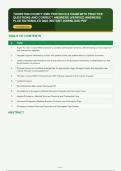
,This study document brings together 149 carefully worded exam questions drawn from Thurston
County EMS Protocols Exam With Practice Questions And Correct Answers (Verified Answers)
Plus Rationales Q&A Instant Download Pdf, with the strongest emphasis placed on Apply Thurston
County EMS protocols to complex prehospital scenarios, demonstrating correct sequence and
intervention selection, Integrate regional destination policies with patient acuity and system status
to optimize outcomes, Justify medication administration and dosing decisions using protocol
indications, contraindications and and weight-based calculations. Every item follows the wording
style and level of reasoning you meet in the real paper, and each one is paired with a clear
rationale so the correct choice is never a guess. Work through the set at your own pace, mark the
questions that slow you down, then come back to them until the reasoning feels automatic.
Learners who revise this way walk into the exam room recognising the pattern behind the
questions instead of meeting them for the first time. Keep going - steady, honest practice is what
turns a difficult paper into a comfortable pass.
Q1 APPLY THURSTON COUNTY EMS PROTOCOLS TO COMPLEX PREHOSPITAL
SCENARIOS, DEMONSTRATING CORRECT SEQUENCE AND INTERVENTION SELECTION
A patient in refractory ventricular fibrillation has received three defibrillation
attempts, epinephrine, and amiodarone. According to Thurston County EMS
protocols, which intervention is indicated next if the rhythm remains shockable?
A. Administer a 300 mg bolus of amiodarone
B. Administer 1 mg/kg lidocaine IV/IO CORRECT
C. Administer 2 g magnesium sulfate IV/IO
D. Administer 1 mEq/kg sodium bicarbonate IV/IO
RATIONALE: Thurston County protocols follow ACLS guidelines where lidocaine is an alternative
antiarrhythmic after amiodarone, and 1 mg/kg is the correct initial dose. Amiodarone is typically
capped at 450 mg total, and magnesium is for torsades. Sodium bicarbonate is not routine for
VF/VT.
Page 2
,Q2 APPLY THURSTON COUNTY EMS PROTOCOLS TO COMPLEX PREHOSPITAL
SCENARIOS, DEMONSTRATING CORRECT SEQUENCE AND INTERVENTION SELECTION
A trauma patient with a gunshot wound to the abdomen is hypotensive and
tachycardic. Per Thurston County trauma triage protocols, which destination
decision is most appropriate?
A. Transport to the closest Level III trauma center for stabilization
B. Transport to the closest Level I or Level II trauma center, bypassing closer facilities if
necessary CORRECT
C. Transport to the closest emergency department regardless of trauma designation
D. Transport to a Level IV trauma center for initial evaluation
RATIONALE: Thurston County protocols direct major trauma with hemodynamic instability to the
highest-level trauma center within the region, even if it requires bypassing closer hospitals. Level
III and IV centers lack immediate surgical capability. Transport to a non-trauma center delays
definitive care.
Q3 APPLY THURSTON COUNTY EMS PROTOCOLS TO COMPLEX PREHOSPITAL
SCENARIOS, DEMONSTRATING CORRECT SEQUENCE AND INTERVENTION SELECTION
A patient with severe respiratory distress from an asthma exacerbation is not
responding to albuterol. According to Thurston County protocols, which adjunct
medication is indicated next?
A. Methylprednisolone 125 mg IV
B. Ipratropium bromide 0.5 mg nebulized CORRECT
C. Epinephrine 0.3 mg IM
D. Magnesium sulfate 2 g IV
RATIONALE: Thurston County protocols recommend adding ipratropium to albuterol for severe
asthma not responding to beta-agonists alone. Corticosteroids are indicated but may be given
later; IM epinephrine is for anaphylaxis. IV magnesium is reserved for refractory cases per
medical direction.
Page 3
, Q4 APPLY THURSTON COUNTY EMS PROTOCOLS TO COMPLEX PREHOSPITAL
SCENARIOS, DEMONSTRATING CORRECT SEQUENCE AND INTERVENTION SELECTION
A patient with suspected opioid overdose has been given naloxone with
improvement in respirations but remains unresponsive. Per Thurston County
protocol, what is the appropriate next action?
A. Administer an additional 2 mg naloxone IV/IO
B. Begin bag-valve-mask ventilation and transport CORRECT
C. Administer flumazenil 0.2 mg IV
D. Place the patient in the recovery position and monitor
RATIONALE: Thurston County protocol emphasizes that naloxone reverses respiratory
depression, not sedation; if respirations are adequate, further naloxone is unnecessary. BVM
support and transport are indicated for persistent unresponsiveness. Flumazenil is
contraindicated in opioid co-ingestion due to seizure risk.
Q5 APPLY THURSTON COUNTY EMS PROTOCOLS TO COMPLEX PREHOSPITAL
SCENARIOS, DEMONSTRATING CORRECT SEQUENCE AND INTERVENTION SELECTION
A patient with a suspected cervical spine injury requires airway management.
According to Thurston County EMS protocols, which technique is preferred to
maintain spinal motion restriction during intubation?
A. Manual in-line stabilization with video laryngoscopy CORRECT
B. Direct laryngoscopy with cricoid pressure
C. Blind nasotracheal intubation
D. Retrograde intubation
RATIONALE: Thurston County protocols endorse manual in-line stabilization with video
laryngoscopy to minimize cervical movement. Cricoid pressure is no longer routinely
recommended. Blind nasotracheal and retrograde intubation are not first-line and carry higher
risk.
Page 4
County EMS Protocols Exam With Practice Questions And Correct Answers (Verified Answers)
Plus Rationales Q&A Instant Download Pdf, with the strongest emphasis placed on Apply Thurston
County EMS protocols to complex prehospital scenarios, demonstrating correct sequence and
intervention selection, Integrate regional destination policies with patient acuity and system status
to optimize outcomes, Justify medication administration and dosing decisions using protocol
indications, contraindications and and weight-based calculations. Every item follows the wording
style and level of reasoning you meet in the real paper, and each one is paired with a clear
rationale so the correct choice is never a guess. Work through the set at your own pace, mark the
questions that slow you down, then come back to them until the reasoning feels automatic.
Learners who revise this way walk into the exam room recognising the pattern behind the
questions instead of meeting them for the first time. Keep going - steady, honest practice is what
turns a difficult paper into a comfortable pass.
Q1 APPLY THURSTON COUNTY EMS PROTOCOLS TO COMPLEX PREHOSPITAL
SCENARIOS, DEMONSTRATING CORRECT SEQUENCE AND INTERVENTION SELECTION
A patient in refractory ventricular fibrillation has received three defibrillation
attempts, epinephrine, and amiodarone. According to Thurston County EMS
protocols, which intervention is indicated next if the rhythm remains shockable?
A. Administer a 300 mg bolus of amiodarone
B. Administer 1 mg/kg lidocaine IV/IO CORRECT
C. Administer 2 g magnesium sulfate IV/IO
D. Administer 1 mEq/kg sodium bicarbonate IV/IO
RATIONALE: Thurston County protocols follow ACLS guidelines where lidocaine is an alternative
antiarrhythmic after amiodarone, and 1 mg/kg is the correct initial dose. Amiodarone is typically
capped at 450 mg total, and magnesium is for torsades. Sodium bicarbonate is not routine for
VF/VT.
Page 2
,Q2 APPLY THURSTON COUNTY EMS PROTOCOLS TO COMPLEX PREHOSPITAL
SCENARIOS, DEMONSTRATING CORRECT SEQUENCE AND INTERVENTION SELECTION
A trauma patient with a gunshot wound to the abdomen is hypotensive and
tachycardic. Per Thurston County trauma triage protocols, which destination
decision is most appropriate?
A. Transport to the closest Level III trauma center for stabilization
B. Transport to the closest Level I or Level II trauma center, bypassing closer facilities if
necessary CORRECT
C. Transport to the closest emergency department regardless of trauma designation
D. Transport to a Level IV trauma center for initial evaluation
RATIONALE: Thurston County protocols direct major trauma with hemodynamic instability to the
highest-level trauma center within the region, even if it requires bypassing closer hospitals. Level
III and IV centers lack immediate surgical capability. Transport to a non-trauma center delays
definitive care.
Q3 APPLY THURSTON COUNTY EMS PROTOCOLS TO COMPLEX PREHOSPITAL
SCENARIOS, DEMONSTRATING CORRECT SEQUENCE AND INTERVENTION SELECTION
A patient with severe respiratory distress from an asthma exacerbation is not
responding to albuterol. According to Thurston County protocols, which adjunct
medication is indicated next?
A. Methylprednisolone 125 mg IV
B. Ipratropium bromide 0.5 mg nebulized CORRECT
C. Epinephrine 0.3 mg IM
D. Magnesium sulfate 2 g IV
RATIONALE: Thurston County protocols recommend adding ipratropium to albuterol for severe
asthma not responding to beta-agonists alone. Corticosteroids are indicated but may be given
later; IM epinephrine is for anaphylaxis. IV magnesium is reserved for refractory cases per
medical direction.
Page 3
, Q4 APPLY THURSTON COUNTY EMS PROTOCOLS TO COMPLEX PREHOSPITAL
SCENARIOS, DEMONSTRATING CORRECT SEQUENCE AND INTERVENTION SELECTION
A patient with suspected opioid overdose has been given naloxone with
improvement in respirations but remains unresponsive. Per Thurston County
protocol, what is the appropriate next action?
A. Administer an additional 2 mg naloxone IV/IO
B. Begin bag-valve-mask ventilation and transport CORRECT
C. Administer flumazenil 0.2 mg IV
D. Place the patient in the recovery position and monitor
RATIONALE: Thurston County protocol emphasizes that naloxone reverses respiratory
depression, not sedation; if respirations are adequate, further naloxone is unnecessary. BVM
support and transport are indicated for persistent unresponsiveness. Flumazenil is
contraindicated in opioid co-ingestion due to seizure risk.
Q5 APPLY THURSTON COUNTY EMS PROTOCOLS TO COMPLEX PREHOSPITAL
SCENARIOS, DEMONSTRATING CORRECT SEQUENCE AND INTERVENTION SELECTION
A patient with a suspected cervical spine injury requires airway management.
According to Thurston County EMS protocols, which technique is preferred to
maintain spinal motion restriction during intubation?
A. Manual in-line stabilization with video laryngoscopy CORRECT
B. Direct laryngoscopy with cricoid pressure
C. Blind nasotracheal intubation
D. Retrograde intubation
RATIONALE: Thurston County protocols endorse manual in-line stabilization with video
laryngoscopy to minimize cervical movement. Cricoid pressure is no longer routinely
recommended. Blind nasotracheal and retrograde intubation are not first-line and carry higher
risk.
Page 4

