
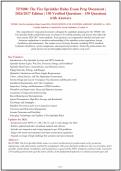
,ITM protocols. Each answer includes a rationale that explains the correct choice and why distractors are
incorrect, fostering a deeper understanding of the material. The content is meticulously updated for the 2026/2027
academic year, ensuring alignment with the latest code editions and industry practices. By engaging with this
material, candidates can identify knowledge gaps, reinforce critical concepts, and build the confidence needed to
pass the exam. This resource is indispensable for anyone seeking to demonstrate mastery of fire sprinkler rules and
enhance public safety.
Keywords:
TFM08, Fire Sprinkler Rules, NFPA 13, Fire Protection, Exam Prep, Sprinkler System Design, Inspection Testing
Maintenance, Hydraulic Calculations
Answer Format:
Each question is followed by the correct answer, a detailed rationale explaining the underlying code or principle,
and an analysis of why each distractor is incorrect. Answers are cross-referenced to NFPA standards and include
practical field applications. This format ensures a comprehensive understanding of both theory and practice.
Compliance Checklist:
Verified by industry experts and aligned with 2026/2027 NFPA standards
150 questions covering all exam domains and subdomains
Detailed rationales for correct and incorrect answers
Updated per latest code changes and errata
Includes practical scenarios and code references
Trusted by certification candidates for over a decade
Content Area Overview:
Content Area Questions Key Topics Weight
Fundamentals and Standards 1-20 NFPA 13, 13R, 13D, 25, 72; History and 13%
Purpose; Definitions; Occupancy
Classifications
System Types and Components 21-40 Wet, Dry, Preaction, Deluge; Sprinkler 13%
Heads; Piping; Valves; Hangers
Hydraulic Calculations and 41-60 Density/Area Method; Pipe Sizing; Pressure 13%
Water Supply Loss; Water Supplies; Fire Pumps
Design and Layout 61-80 Hazard Levels; Sprinkler Spacing; 13%
Obstruction Rules; Ceiling Types;
Residential Design
Installation and Code 81-100 Installation Standards; Seismic Protection; 13%
Compliance Corrosion Control; Backflow Prevention
Inspection, Testing, and 101-120 ITM Frequencies; Acceptance Testing; 13%
Maintenance Record Keeping; Troubleshooting
Special Occupancies and 121-140 High-Rise; Storage; Standpipes; Alarm 13%
Advanced Topics Systems; Emerging Technologies
Code Updates and Exam 141-150 2026 Code Changes; Exam Strategies; 9%
Practice Practice Scenarios; Review
Page 2
,Q1. A warehouse storing Class IV commodities in racks 20 ft high requires a design
density of 0.45 gpm/ft² over 2,500 ft². If the ceiling height is 30 ft and the sprinkler
operating pressure is 50 psi, what is the minimum required flow per sprinkler for a
standard spray sprinkler with K-factor 5.6?
A. 39.6 gpm
B. 50.0 gpm
C. 56.0 gpm
D. 70.7 gpm
Correct Answer: A. 39.6 gpm
Rationale: Flow per sprinkler is calculated as Q = K"P, where K=5.6 and P=50 psi. Thus
Q = 5.6 × 50 5.6 × 7.071 = 39.6 gpm. The design density and area are used for total
demand, not individual sprinkler flow.
Why Wrong:
B - This is the operating pressure (50 psi) mistakenly used as flow.
C - This is K × 10, not using the square root of pressure.
D - This is (50) × 10, incorrectly scaling.
Reference: NFPA 13 (2025), Standard for the Installation of Sprinkler Systems, Section
7.2.1.
Q2. In a light hazard occupancy, the maximum sprinkler protection area per
sprinkler is 225 ft² for a hydraulically calculated system. If the sprinklers are spaced
15 ft apart on branch lines, what is the maximum allowable spacing between branch
lines?
A. 10 ft
B. 12 ft
C. 15 ft
D. 20 ft
Correct Answer: C. 15 ft
Rationale: The area per sprinkler is the product of branch line spacing and sprinkler
spacing along the branch line. Thus, branch line spacing = 225 ft² / 15 ft = 15 ft. NFPA
13 also limits maximum spacing to 15 ft for light hazard.
Why Wrong:
A - 10 ft would result in 150 ft² per sprinkler, which is below the maximum but not
the maximum allowable.
B - 12 ft gives 180 ft², not the maximum.
D - 20 ft exceeds the maximum area per sprinkler for light hazard (225 ft²) and also
exceeds the maximum spacing limit.
Reference: NFPA 13 (2025), Section 10.2.4.
Page 3
, Q3. A fire pump is installed to boost water supply for a sprinkler system. The pump
has a rated capacity of 1000 gpm at 100 psi. If the pump is operating at 150% of rated
capacity, what is the approximate discharge pressure according to the pump curve?
A. 65 psi
B. 70 psi
C. 75 psi
D. 80 psi
Correct Answer: A. 65 psi
Rationale: NFPA 20 requires that at 150% of rated capacity, the pump discharge pressure
is not less than 65% of the rated pressure. 65% of 100 psi = 65 psi. The pump curve
typically shows a pressure of about 65% of rated at 150% flow.
Why Wrong:
B - 70 psi is 70% of rated, which is higher than the minimum required.
C - 75 psi is 75% of rated, not the typical value at 150% flow.
D - 80 psi is 80% of rated, which is too high for 150% flow.
Reference: NFPA 20 (2025), Standard for the Installation of Stationary Pumps for Fire
Protection, Section 4.8.
Q4. During a hydraulic calculation, the friction loss in a 2-inch schedule 40 steel pipe
with a flow of 500 gpm is 0.05 psi/ft. If the pipe length is 100 ft and there are two
90-degree elbows (equivalent length 5 ft each), what is the total friction loss?
A. 5.0 psi
B. 5.5 psi
C. 6.0 psi
D. 6.5 psi
Correct Answer: B. 5.5 psi
Rationale: Total equivalent length = 100 ft + 2×5 ft = 110 ft. Friction loss = 0.05 psi/ft ×
110 ft = 5.5 psi. Elbows add equivalent length to the pipe run.
Why Wrong:
A - 5.0 psi ignores the additional friction loss from the elbows.
C - 6.0 psi overestimates by assuming three elbows or longer equivalent lengths.
D - 6.5 psi overestimates by assuming four elbows or longer equivalent lengths.
Reference: NFPA 13 (2025), Section 27.2.3.
Q5. A sprinkler system is designed for an ordinary hazard Group 2 occupancy. The
water supply curve is relatively flat. Which of the following adjustments to the design
is most appropriate to ensure adequate safety margin?
A. Increase the design density by 10%
Page 4
incorrect, fostering a deeper understanding of the material. The content is meticulously updated for the 2026/2027
academic year, ensuring alignment with the latest code editions and industry practices. By engaging with this
material, candidates can identify knowledge gaps, reinforce critical concepts, and build the confidence needed to
pass the exam. This resource is indispensable for anyone seeking to demonstrate mastery of fire sprinkler rules and
enhance public safety.
Keywords:
TFM08, Fire Sprinkler Rules, NFPA 13, Fire Protection, Exam Prep, Sprinkler System Design, Inspection Testing
Maintenance, Hydraulic Calculations
Answer Format:
Each question is followed by the correct answer, a detailed rationale explaining the underlying code or principle,
and an analysis of why each distractor is incorrect. Answers are cross-referenced to NFPA standards and include
practical field applications. This format ensures a comprehensive understanding of both theory and practice.
Compliance Checklist:
Verified by industry experts and aligned with 2026/2027 NFPA standards
150 questions covering all exam domains and subdomains
Detailed rationales for correct and incorrect answers
Updated per latest code changes and errata
Includes practical scenarios and code references
Trusted by certification candidates for over a decade
Content Area Overview:
Content Area Questions Key Topics Weight
Fundamentals and Standards 1-20 NFPA 13, 13R, 13D, 25, 72; History and 13%
Purpose; Definitions; Occupancy
Classifications
System Types and Components 21-40 Wet, Dry, Preaction, Deluge; Sprinkler 13%
Heads; Piping; Valves; Hangers
Hydraulic Calculations and 41-60 Density/Area Method; Pipe Sizing; Pressure 13%
Water Supply Loss; Water Supplies; Fire Pumps
Design and Layout 61-80 Hazard Levels; Sprinkler Spacing; 13%
Obstruction Rules; Ceiling Types;
Residential Design
Installation and Code 81-100 Installation Standards; Seismic Protection; 13%
Compliance Corrosion Control; Backflow Prevention
Inspection, Testing, and 101-120 ITM Frequencies; Acceptance Testing; 13%
Maintenance Record Keeping; Troubleshooting
Special Occupancies and 121-140 High-Rise; Storage; Standpipes; Alarm 13%
Advanced Topics Systems; Emerging Technologies
Code Updates and Exam 141-150 2026 Code Changes; Exam Strategies; 9%
Practice Practice Scenarios; Review
Page 2
,Q1. A warehouse storing Class IV commodities in racks 20 ft high requires a design
density of 0.45 gpm/ft² over 2,500 ft². If the ceiling height is 30 ft and the sprinkler
operating pressure is 50 psi, what is the minimum required flow per sprinkler for a
standard spray sprinkler with K-factor 5.6?
A. 39.6 gpm
B. 50.0 gpm
C. 56.0 gpm
D. 70.7 gpm
Correct Answer: A. 39.6 gpm
Rationale: Flow per sprinkler is calculated as Q = K"P, where K=5.6 and P=50 psi. Thus
Q = 5.6 × 50 5.6 × 7.071 = 39.6 gpm. The design density and area are used for total
demand, not individual sprinkler flow.
Why Wrong:
B - This is the operating pressure (50 psi) mistakenly used as flow.
C - This is K × 10, not using the square root of pressure.
D - This is (50) × 10, incorrectly scaling.
Reference: NFPA 13 (2025), Standard for the Installation of Sprinkler Systems, Section
7.2.1.
Q2. In a light hazard occupancy, the maximum sprinkler protection area per
sprinkler is 225 ft² for a hydraulically calculated system. If the sprinklers are spaced
15 ft apart on branch lines, what is the maximum allowable spacing between branch
lines?
A. 10 ft
B. 12 ft
C. 15 ft
D. 20 ft
Correct Answer: C. 15 ft
Rationale: The area per sprinkler is the product of branch line spacing and sprinkler
spacing along the branch line. Thus, branch line spacing = 225 ft² / 15 ft = 15 ft. NFPA
13 also limits maximum spacing to 15 ft for light hazard.
Why Wrong:
A - 10 ft would result in 150 ft² per sprinkler, which is below the maximum but not
the maximum allowable.
B - 12 ft gives 180 ft², not the maximum.
D - 20 ft exceeds the maximum area per sprinkler for light hazard (225 ft²) and also
exceeds the maximum spacing limit.
Reference: NFPA 13 (2025), Section 10.2.4.
Page 3
, Q3. A fire pump is installed to boost water supply for a sprinkler system. The pump
has a rated capacity of 1000 gpm at 100 psi. If the pump is operating at 150% of rated
capacity, what is the approximate discharge pressure according to the pump curve?
A. 65 psi
B. 70 psi
C. 75 psi
D. 80 psi
Correct Answer: A. 65 psi
Rationale: NFPA 20 requires that at 150% of rated capacity, the pump discharge pressure
is not less than 65% of the rated pressure. 65% of 100 psi = 65 psi. The pump curve
typically shows a pressure of about 65% of rated at 150% flow.
Why Wrong:
B - 70 psi is 70% of rated, which is higher than the minimum required.
C - 75 psi is 75% of rated, not the typical value at 150% flow.
D - 80 psi is 80% of rated, which is too high for 150% flow.
Reference: NFPA 20 (2025), Standard for the Installation of Stationary Pumps for Fire
Protection, Section 4.8.
Q4. During a hydraulic calculation, the friction loss in a 2-inch schedule 40 steel pipe
with a flow of 500 gpm is 0.05 psi/ft. If the pipe length is 100 ft and there are two
90-degree elbows (equivalent length 5 ft each), what is the total friction loss?
A. 5.0 psi
B. 5.5 psi
C. 6.0 psi
D. 6.5 psi
Correct Answer: B. 5.5 psi
Rationale: Total equivalent length = 100 ft + 2×5 ft = 110 ft. Friction loss = 0.05 psi/ft ×
110 ft = 5.5 psi. Elbows add equivalent length to the pipe run.
Why Wrong:
A - 5.0 psi ignores the additional friction loss from the elbows.
C - 6.0 psi overestimates by assuming three elbows or longer equivalent lengths.
D - 6.5 psi overestimates by assuming four elbows or longer equivalent lengths.
Reference: NFPA 13 (2025), Section 27.2.3.
Q5. A sprinkler system is designed for an ordinary hazard Group 2 occupancy. The
water supply curve is relatively flat. Which of the following adjustments to the design
is most appropriate to ensure adequate safety margin?
A. Increase the design density by 10%
Page 4

