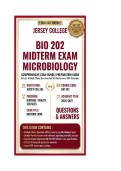
,BIO 202 Midterm Exam Microbiology Questions And Answers
2026/2027 Jersey College
Q1. Which statement best describes the field of microbiology?
A) It examines organisms and infectious agents too small to be studied
adequately without magnification
B) It studies only human anatomy
C) It is limited exclusively to bacterial diseases
D) It examines only multicellular parasites
Correct Answer: A) It examines organisms and infectious agents too small to
be studied adequately without magnification
Rationale: Microbiology encompasses bacteria, archaea, fungi, protozoa,
microscopic algae, viruses, and other microscopic biological agents.
Q2. Which scientist is strongly associated with experiments that
helped disprove spontaneous generation?
A) Robert Koch
B) Louis Pasteur
C) Alexander Fleming
D) Edward Jenner
Correct Answer: B) Louis Pasteur
Rationale: Pasteur's experiments demonstrated that microbial growth arose
from microorganisms already present in the environment rather than
spontaneous generation.
Q3. Koch's postulates were developed primarily to establish:
A) How antibiotics inhibit bacteria
B) How cells produce ATP
C) A relationship between a particular microorganism and a particular
disease
D) How viruses replicate
Correct Answer: C) A relationship between a particular microorganism and a
particular disease
Rationale: Koch's postulates provided a systematic framework for linking
specific microorganisms with specific infectious diseases.
, Q4. Which action is most appropriate after an accidental microbial
spill occurs in a laboratory?
A) Continue working until the experiment is complete
B) Wipe it immediately with bare hands
C) Ignore it if the organism is believed to be harmless
D) Follow the laboratory spill procedure and notify the appropriate instructor
or supervisor
Correct Answer: D) Follow the laboratory spill procedure and notify the
appropriate instructor or supervisor
Rationale: Laboratory spills require established containment and
decontamination procedures to reduce exposure and environmental
contamination.
Q5. Why should food and beverages be prohibited in a microbiology
laboratory?
A) They can provide a route for accidental ingestion of microorganisms or
chemicals
B) They increase microscope magnification
C) They prevent microorganisms from growing in culture
D) They interfere with bacterial staining only
Correct Answer: A) They can provide a route for accidental ingestion of
microorganisms or chemicals
Rationale: Eating or drinking in laboratory areas creates an avoidable
pathway for exposure to biological or chemical hazards.
CHAPTER 2 — CHEMISTRY OF LIFE AND CELL STRUCTURE
Q6. Which type of chemical bond forms when atoms share
electrons?
A) Ionic bond
B) Covalent bond
C) Hydrogen ion
D) Peptide ion
Correct Answer: B) Covalent bond
Rationale: Covalent bonds form when atoms share one or more pairs of
electrons.
2026/2027 Jersey College
Q1. Which statement best describes the field of microbiology?
A) It examines organisms and infectious agents too small to be studied
adequately without magnification
B) It studies only human anatomy
C) It is limited exclusively to bacterial diseases
D) It examines only multicellular parasites
Correct Answer: A) It examines organisms and infectious agents too small to
be studied adequately without magnification
Rationale: Microbiology encompasses bacteria, archaea, fungi, protozoa,
microscopic algae, viruses, and other microscopic biological agents.
Q2. Which scientist is strongly associated with experiments that
helped disprove spontaneous generation?
A) Robert Koch
B) Louis Pasteur
C) Alexander Fleming
D) Edward Jenner
Correct Answer: B) Louis Pasteur
Rationale: Pasteur's experiments demonstrated that microbial growth arose
from microorganisms already present in the environment rather than
spontaneous generation.
Q3. Koch's postulates were developed primarily to establish:
A) How antibiotics inhibit bacteria
B) How cells produce ATP
C) A relationship between a particular microorganism and a particular
disease
D) How viruses replicate
Correct Answer: C) A relationship between a particular microorganism and a
particular disease
Rationale: Koch's postulates provided a systematic framework for linking
specific microorganisms with specific infectious diseases.
, Q4. Which action is most appropriate after an accidental microbial
spill occurs in a laboratory?
A) Continue working until the experiment is complete
B) Wipe it immediately with bare hands
C) Ignore it if the organism is believed to be harmless
D) Follow the laboratory spill procedure and notify the appropriate instructor
or supervisor
Correct Answer: D) Follow the laboratory spill procedure and notify the
appropriate instructor or supervisor
Rationale: Laboratory spills require established containment and
decontamination procedures to reduce exposure and environmental
contamination.
Q5. Why should food and beverages be prohibited in a microbiology
laboratory?
A) They can provide a route for accidental ingestion of microorganisms or
chemicals
B) They increase microscope magnification
C) They prevent microorganisms from growing in culture
D) They interfere with bacterial staining only
Correct Answer: A) They can provide a route for accidental ingestion of
microorganisms or chemicals
Rationale: Eating or drinking in laboratory areas creates an avoidable
pathway for exposure to biological or chemical hazards.
CHAPTER 2 — CHEMISTRY OF LIFE AND CELL STRUCTURE
Q6. Which type of chemical bond forms when atoms share
electrons?
A) Ionic bond
B) Covalent bond
C) Hydrogen ion
D) Peptide ion
Correct Answer: B) Covalent bond
Rationale: Covalent bonds form when atoms share one or more pairs of
electrons.