
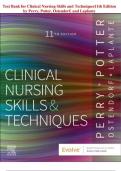
Clinical Nursing Skills & Techniques, 11th Edition – Nursing Study Guide & Practice Questions
Clinical Nursing Skills & Techniques, 11th Edition – Nursing Study Guide & Practice Questions Strengthen your nursing knowledge and clinical skills with a comprehensive study resource based on Clinical Nursing Skills & Techniques, 11th Edition by Perry, Potter, Ostendorf, and LaPlante. Designed to complement textbook study, this resource can help nursing students review essential clinical concepts, practice applying nursing knowledge to patient-care situations, and prepare for classroom examinations and clinical assessments. Clinical nursing skills are an essential component of nursing education. Students must understand not only how a procedure is performed, but also why it is performed, when it is appropriate, what safety precautions are required, how to assess the patient before and after the procedure, and how to evaluate the outcome. Practice questions can provide an effective way to reinforce these concepts and identify areas that require additional review. This study resource is suitable for nursing students enrolled in fundamentals of nursing, clinical nursing skills, medical-surgical nursing, practical nursing, registered nursing, and related healthcare programs. It can be used for individual study, classroom review, study groups, or preparation for nursing examinations. The resource can help learners review important areas of clinical nursing practice, including patient assessment, infection prevention, safety, communication, documentation, medication administration, vital signs, hygiene, mobility, nutrition, elimination, wound care, specimen collection, oxygenation, respiratory care, and other fundamental nursing procedures. Students can use practice questions to develop active-learning habits rather than relying exclusively on passive reading. After completing a chapter or skills unit, learners can answer questions, identify incorrect responses, review the underlying concept, and return to the relevant textbook material for further clarification. Clinical Assessment and Patient Care A strong foundation in patient assessment is critical to safe nursing practice. Students can review concepts involving health histories, physical assessment, vital signs, pain assessment, neurological observations, respiratory assessment, cardiovascular assessment, and recognition of changes in patient condition. Questions based on clinical situations can encourage students to think about what information is most important, which assessment should be performed first, what findings require follow-up, and how the nurse should communicate significant findings to the healthcare team. Infection Prevention and Patient Safety Infection control and patient safety are fundamental components of nursing practice. Study topics may include hand hygiene, personal protective equipment, standard precautions, transmission-based precautions, aseptic technique, environmental safety, fall prevention, patient identification, and prevention of healthcare-associated infections. Practice questions can help students understand the rationale behind safety procedures and apply appropriate precautions to different clinical situations. Medication Administration Medication administration requires careful attention to patient identification, medication rights, dosage calculations, routes of administration, documentation, monitoring, and prevention of medication errors. Practice questions can help students reinforce these principles and understand the nurse's responsibilities before, during, and after medication administration. Students may also review oral, topical, enteral, parenteral, and other medication-administration concepts as covered in their authorized course materials. Basic Nursing Skills Fundamental nursing procedures form the foundation of clinical practice. Students can review topics such as bathing, oral hygiene, grooming, positioning, transferring, ambulation, range-of-motion exercises, bed making, patient comfort, and activities of daily living. These skills require attention to patient dignity, privacy, safety, infection prevention, communication, and individualized care. Nutrition and Elimination Nursing students can also use practice questions to review nutritional assessment, feeding assistance, enteral nutrition concepts, hydration, intake and output, urinary elimination, bowel elimination, catheter care, and related nursing responsibilities. Understanding these skills enables students to recognize potential complications and provide appropriate patient-centered care. Respiratory and Oxygenation Skills Respiratory care is another important area of clinical nursing. Students can reinforce concepts involving oxygen therapy, respiratory assessment, airway management, pulse oximetry, positioning, coughing and deep-breathing exercises, suctioning concepts, and patient monitoring. Practice questions can help learners connect respiratory assessment findings with appropriate nursing interventions while emphasizing patient safety. Wound and Skin Care Skin integrity and wound management are important aspects of nursing care. Study topics may include pressure injury prevention, wound assessment, dressing changes, skin care, documentation, positioning, and factors that influence wound healing. Students can use clinical scenarios to practice recognizing risks to skin integrity and selecting appropriate nursing interventions. Communication and Documentation Effective communication is central to professional nursing. Students can review therapeutic communication, patient education, documentation principles, handoff communication, interprofessional communication, confidentiality, and accurate reporting of patient information. Practice questions can help learners distinguish therapeutic from nontherapeutic communication and develop better clinical judgment when interacting with patients, families, and healthcare professionals. Clinical Judgment and Prioritization Modern nursing education emphasizes the ability to apply knowledge to clinical situations. Practice questions can help students develop prioritization, delegation, assessment, intervention, and evaluation skills. Rather than simply recalling definitions, learners can practice determining which patient needs immediate attention, which assessment should be performed first, which intervention is appropriate, and when a healthcare provider should be notified. This resource can therefore complement textbook reading by encouraging students to connect theoretical knowledge with practical patient-care situations. Potential Study Topics Include: Fundamentals of nursing Clinical nursing skills Patient assessment Physical assessment Vital signs Pain assessment Infection prevention Standard precautions Transmission-based precautions Aseptic technique Patient safety Fall prevention Hygiene and personal care Mobility and positioning Patient transfers Range-of-motion exercises Nutrition and hydration Enteral nutrition Intake and output Urinary elimination Bowel elimination Catheter care Medication administration Medication safety Dosage calculation concepts Oral medication administration Parenteral medication concepts Oxygen therapy Respiratory assessment Airway management Suctioning concepts Wound care Pressure injury prevention Skin integrity Specimen collection Documentation Therapeutic communication Patient education Clinical judgment Nursing prioritization Delegation Patient-centered care Evidence-based nursing practice Nursing ethics and professionalism Clinical examination preparation Nursing school exam preparation Students can incorporate this resource into a structured study plan by reviewing one topic at a time, answering practice questions without referring to their notes, analyzing incorrect responses, and returning to the textbook for additional learning. It can also be useful for study groups. Students can discuss clinical scenarios, explain their reasoning, compare approaches, and identify areas where additional instructor guidance may be necessary. For best results, learners should use this resource together with the official Clinical Nursing Skills & Techniques, 11th Edition textbook, instructor-provided materials, laboratory demonstrations, clinical guidance, and current institutional policies. Nursing procedures can vary by healthcare setting, so students should always follow the policies and protocols applicable to their clinical environment. Whether you are beginning a fundamentals course, preparing for a skills check-off, reviewing before a nursing examination, or strengthening your clinical knowledge, structured practice can help make study sessions more focused and effective. Important: This is an educational study/practice resource and should be used as a supplement to authorized course materials. It is not a substitute for hands-on clinical instruction, instructor supervision, institutional procedures, or professional nursing guidance.
Información del documento
- Subido en
- 24 de septiembre de 2026
- Número de páginas
- 600
- Escrito en
- 2026/2027
- Tipo
- Examen
- Contiene
- Preguntas y respuestas

