
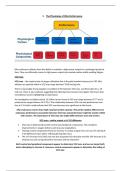
1. The Physiology of Elite Performance
Cardiac Lactate Venous
VO2 Max
Output Threshold Return
Capillary Slow- Oxidative Exercise O2 Heart
density twitch MFs enzymnes economy carrying size
capacity
Elite endurance athletes have the ability to maintain a high-power output for a prolonged period of
time. They can efficiently convert a high-power output into wanted motion whilst avoiding fatigue.
VO2 max:
VO2 max – the maximal rate of oxygen utilisation that is the gold standard measure for CRF. Elite
athletes are typically within a VO2 max range between 70-86 mL/kg/min.
There is reasonably strong negative correlation (0.91) between VO2 max, and time taken for a 10-
mile run. There is also evidence suggesting that elite/top level runners have higher VO2 max’s than
recreational runners highlighting its importance.
An investigation on highly trained, US 10Km runners found a VO2 max range between 67-77 and a
performance range between 30.5-33.6. The relationship between VO2 max and performance was
low at 0.12 which could indicate that VO2 max becomes less significant at elite levels.
Elite endurance runners have high maximal aerobic capacity. This partly explains differences in
endurance performance association between VO2 max and performance might be weaker within
elite runners. The importance of VO2 max also might differ between men and women.
VO2 max = cardiac output x A-V O2 difference
VO2 max is determined by both central and peripheral components. This combines
improvements in oxygen delivery and muscular adaptations.
Training central components found an increase in cardiac output from 22.5 to 24.9 and leg A-
V O2 difference from 168 to 178 (Double leg VO2 max.)
The 11% increase in DL VO2 max was due to greater O2 extraction and the 19% increase in SL
VO2max was due to leg blood flow increases and O2 extraction.
Both central and peripheral components appear to determine VO2 max, and we can target both
when attempting to increase it. However, central components appear to determine the ceiling of
VO2 max.
,However, it’s not all about VO2 max and there are other key components to elite endurance
performance.
Michael Joyner proposed the equation, marathon speed = VO2 max x %VO2 max @ LT x RE.
Lactate and Lactate Profile:
Lactate doesn’t cause fatigue and can be recycled by skeletal muscle during exercise. It can be
reversed back to pyruvate allowing it to be used aerobically in the oxidative energy systems.
Lactate is transported in and out of muscle
fibres via monocarboxylate transporters
(MCT.) MCT 4 favours efflux out the fibres
and MCT 1 favours influx and uptake of
lactate into the fibres.
Lactate threshold – the exercise intensity at
which lactate production exceeds the rate of lactate clearance and begins to accumulate. It’s an
indicator of change in the glycolytic flux.
Lactate threshold (LT1) is the intensity at which lactate first increases above the baseline (typically
around 1.5-2mmol/L. Lactate turning point (LTP) is the intensity at which a sudden and sustained
increase in lactate is observed (typically 1mmol/L above LT1)
, Trained and elite athletes have higher LTs in absolute and relative terms.
LT is related to the VO2 that can be maintained for prolonged periods (performance VO2.)
Elite athletes on average hit their LTP at roughly 88% VO2 max.
Lactate is strongly linked to time to fatigue and a study found that a group of athletes with a
high LT had a longer time to fatigue (60.8 minutes) on average a than a group with low LTs
(29.1 minutes) despite very similar VO2 max scores in both groups.
There is a strong relationship (0.98) between the velocity at OPLA and marathon time and its
on par as a predictor of performance as half marathon times.
Speed at Lactate threshold is a component that is really trainable and it can have large benefits on
performance output.
Enhanced skeletal muscle oxidative capacity increases
mitochondrial density and enzyme activity, improving oxygen
utilization and ATP production through aerobic pathways. This
elevates lactate threshold, reduces metabolic by-product
accumulation, optimizes substrate utilization, delays fatigue,
supports faster recovery kinetics, and enables sustained high-
intensity workloads, thereby maximizing endurance
performance efficiency and resilience.
A study on 14 adults, that underwent endurance training, found large scale skeletal muscle
adaptations.
Total mitochondrial volume density increased by 42.69%.
Capillary-to-fibre ratio increased by 17.55%.
Oxidative phosphorylation increased by 10.54%.

