

HUMAN EVOLUTION
HOMINID STUDIES
CLASSIFICATION OF HOMINIDS
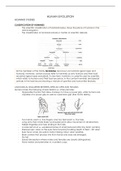
- The scientific classification of hominids below shows the place of humans in the
animal kingdom.
- The classification of hominids remains a matter of scientific debate.
All the members of the family Hominidae are known as hominids [great apes and
humans]. However, certain sources refer to hominids as only humans and their fossil
ancestors [great apes excluded]. A new term, hominins, is currently used by scientists,
which refers to humans and their fossil ancestors. In this context hominids are bipedal
animals in the fossil record showing a mixture of ape-like and human-like features.
ANATOMICAL SIMILARITIES BETWEEN AFRICAN APES AND HUMANS
Humans share the following characteristics w. other primates:
- Opposable thumbs that allow monkeys to have a power grip, while humans are
capable of a power grip as well as a precision grip [fine motor ability].
- Two hands, each w. five fingers; and two feet each w. five toes.
- Long arms that rotate freely as shoulder joints allow movement in all directions.
- Naked fingertips and toes ending in flat nails.
- A reduced snout w. weakened sense of smell [reduced olfactory brain centers].
- Stereoscopic vision as the eyes face forward providing depth of field – 3D vision.
- Eyes have cones [as well as rods] making colour vision possible.
- Brain centers that process info from hands and eyes are enlarged.
- No tail.
- Sexual dimorphism where males and females are clearly distinguished.
- Have molars and premolars w. rounded cusps.
,ANATOMICAL DIFFERENCES BETWEEN AFRICAN APES AND HUMANS
AFRICAN APES HUMANS
Quadrupedal: knuckle walkers. Bipedal: walk upright on two legs.
Foramen magnum [opening for spinal cord] Foramen magnum closer to front of skull
at back of skull. [central under skull].
C-shaped vertebral column. S-shaped vertebral column.
Arms longer and stronger than legs. Arms shorter and weaker than legs.
Knee joints smaller and weaker. Knee joints larger and stronger.
Opposable [grasping] big toe w. power grip. Non-opposable [forward-thrusting] big toe in
line w. other toes.
Flat feet. Curved foot arch.
Long and narrow pelvis. Short and wide pelvis.
Smaller, less developed brain. Large, developed brain.
Large, prominent canines. Smaller canines; the same size as other
teeth.
Thin tooth enamel. Thick tooth enamel.
Large, prominent jawbone w. no chin Rounded jaw w. developed chin [reduced
[prognathism]. prognathism].
Wider, sloping face. Narrow, flat face.
Narrow, rectangular palate. Wider, more curved palate.
Prominent cranial and brow ridges. Reduced cranial and brow ridges.
EVIDENCE OF COMMON ANCESTORS FOR LIVING HOMINIDS [INCLUDING HUMANS]
- The evolutionary theory does not state that humans evolved from the chimpanzee /
gorilla, but it proposes that they share a common ancestor.
- Scientists are searching for a common ancestor of all living hominids,
- The big question scientists have to answer is whether the common ancestor was ape-
like / human-like.
- Remains of earlier hominids are very rare.
- There are three main lines of evidence that indicate hominids may have shared a
common ancestor:
o Fossil evidence.
o Genetic evidence.
o Archaeological evidence.
FOSSIL EVIDENCE
- Paleontologists study fossils to provide more information on the structure, movement,
lifestyle and environment of a particular species.
- Certain features of hominid fossils indicate how changes occurred over time.
- Hominid fossils are rarely complete and consist mainly of fragments.
- Most hominid fossils are teeth, jaw bones or skull fragments.
- The remains of feet, hands, pelvic bones or vertebral columns are scarce.
- Long bones e.g. femurs are more commonly found.
- In the search for a common ancestor for hominids, paleontologists look particularly at
the following features of hominid fossils:
o Bipedalism.
o Dentition [teeth].
o Palate shape.
o Brain size.
o Prognathism.
o Cranial and brow ridges.
, Bipedalism
- The greatest observable difference between apes and humans lies in the difference
in posture and method of locomotion.
- Apes are four-footed [quadrupedal] w. gorillas and chimpanzees demonstrating a
particular manner of walking i.e. knuckle-walking.
- Humans, however, are bipedal and walk upright.
- Hominid fossils show evidence of a transition from quadrupedalism to bipedalism.
Various explanations are given for the transition from quadrupedalism to bipedalism.
Many anthropologists question whether these advantages were sufficient to cause the
significant changes involved in the evolution of bipedalism.
Advantages of bipedalism include:
- Upright bodies expose a smaller surface area to the sun which reduces risk of
overheating while hunting, foraging or escaping predators.
- Upright bodies expose a larger surface area to air currents which causes cooling
and reduces dependency on water.
- Hands are free to use tools, prepare food, carry young, hunt or fight.
- Vision extends further over the tall grass of the Savannah to find food or avoid
predators.
- Adaptability to occupy a wider range of habitats.
- For early hominids to become bipedal and walk upright, their skeletons had to
change quite considerably.
- The following changes in structure are observed in humans:
o In bipedal humans the foramen magnum shifted forward so that the skull rests
on top of the vertebral column and the eyes face forward. The foramen
magnum is positioned centrally at the bottom of the skull. In quadrupedal
apes the head is positioned in front of the vertebral column w. the foramen
magnum at the back of the skull.
o The human vertebral column is S-shaped for flexibility and shock absorption.
The vertebral column of apes is C-shaped [arched].
o Humans have shorter arms and longer legs, while apes have shorter legs and
longer arms.
o In humans the knee-joints have become larger and stronger to support
greater body weight.
HOMINID STUDIES
CLASSIFICATION OF HOMINIDS
- The scientific classification of hominids below shows the place of humans in the
animal kingdom.
- The classification of hominids remains a matter of scientific debate.
All the members of the family Hominidae are known as hominids [great apes and
humans]. However, certain sources refer to hominids as only humans and their fossil
ancestors [great apes excluded]. A new term, hominins, is currently used by scientists,
which refers to humans and their fossil ancestors. In this context hominids are bipedal
animals in the fossil record showing a mixture of ape-like and human-like features.
ANATOMICAL SIMILARITIES BETWEEN AFRICAN APES AND HUMANS
Humans share the following characteristics w. other primates:
- Opposable thumbs that allow monkeys to have a power grip, while humans are
capable of a power grip as well as a precision grip [fine motor ability].
- Two hands, each w. five fingers; and two feet each w. five toes.
- Long arms that rotate freely as shoulder joints allow movement in all directions.
- Naked fingertips and toes ending in flat nails.
- A reduced snout w. weakened sense of smell [reduced olfactory brain centers].
- Stereoscopic vision as the eyes face forward providing depth of field – 3D vision.
- Eyes have cones [as well as rods] making colour vision possible.
- Brain centers that process info from hands and eyes are enlarged.
- No tail.
- Sexual dimorphism where males and females are clearly distinguished.
- Have molars and premolars w. rounded cusps.
,ANATOMICAL DIFFERENCES BETWEEN AFRICAN APES AND HUMANS
AFRICAN APES HUMANS
Quadrupedal: knuckle walkers. Bipedal: walk upright on two legs.
Foramen magnum [opening for spinal cord] Foramen magnum closer to front of skull
at back of skull. [central under skull].
C-shaped vertebral column. S-shaped vertebral column.
Arms longer and stronger than legs. Arms shorter and weaker than legs.
Knee joints smaller and weaker. Knee joints larger and stronger.
Opposable [grasping] big toe w. power grip. Non-opposable [forward-thrusting] big toe in
line w. other toes.
Flat feet. Curved foot arch.
Long and narrow pelvis. Short and wide pelvis.
Smaller, less developed brain. Large, developed brain.
Large, prominent canines. Smaller canines; the same size as other
teeth.
Thin tooth enamel. Thick tooth enamel.
Large, prominent jawbone w. no chin Rounded jaw w. developed chin [reduced
[prognathism]. prognathism].
Wider, sloping face. Narrow, flat face.
Narrow, rectangular palate. Wider, more curved palate.
Prominent cranial and brow ridges. Reduced cranial and brow ridges.
EVIDENCE OF COMMON ANCESTORS FOR LIVING HOMINIDS [INCLUDING HUMANS]
- The evolutionary theory does not state that humans evolved from the chimpanzee /
gorilla, but it proposes that they share a common ancestor.
- Scientists are searching for a common ancestor of all living hominids,
- The big question scientists have to answer is whether the common ancestor was ape-
like / human-like.
- Remains of earlier hominids are very rare.
- There are three main lines of evidence that indicate hominids may have shared a
common ancestor:
o Fossil evidence.
o Genetic evidence.
o Archaeological evidence.
FOSSIL EVIDENCE
- Paleontologists study fossils to provide more information on the structure, movement,
lifestyle and environment of a particular species.
- Certain features of hominid fossils indicate how changes occurred over time.
- Hominid fossils are rarely complete and consist mainly of fragments.
- Most hominid fossils are teeth, jaw bones or skull fragments.
- The remains of feet, hands, pelvic bones or vertebral columns are scarce.
- Long bones e.g. femurs are more commonly found.
- In the search for a common ancestor for hominids, paleontologists look particularly at
the following features of hominid fossils:
o Bipedalism.
o Dentition [teeth].
o Palate shape.
o Brain size.
o Prognathism.
o Cranial and brow ridges.
, Bipedalism
- The greatest observable difference between apes and humans lies in the difference
in posture and method of locomotion.
- Apes are four-footed [quadrupedal] w. gorillas and chimpanzees demonstrating a
particular manner of walking i.e. knuckle-walking.
- Humans, however, are bipedal and walk upright.
- Hominid fossils show evidence of a transition from quadrupedalism to bipedalism.
Various explanations are given for the transition from quadrupedalism to bipedalism.
Many anthropologists question whether these advantages were sufficient to cause the
significant changes involved in the evolution of bipedalism.
Advantages of bipedalism include:
- Upright bodies expose a smaller surface area to the sun which reduces risk of
overheating while hunting, foraging or escaping predators.
- Upright bodies expose a larger surface area to air currents which causes cooling
and reduces dependency on water.
- Hands are free to use tools, prepare food, carry young, hunt or fight.
- Vision extends further over the tall grass of the Savannah to find food or avoid
predators.
- Adaptability to occupy a wider range of habitats.
- For early hominids to become bipedal and walk upright, their skeletons had to
change quite considerably.
- The following changes in structure are observed in humans:
o In bipedal humans the foramen magnum shifted forward so that the skull rests
on top of the vertebral column and the eyes face forward. The foramen
magnum is positioned centrally at the bottom of the skull. In quadrupedal
apes the head is positioned in front of the vertebral column w. the foramen
magnum at the back of the skull.
o The human vertebral column is S-shaped for flexibility and shock absorption.
The vertebral column of apes is C-shaped [arched].
o Humans have shorter arms and longer legs, while apes have shorter legs and
longer arms.
o In humans the knee-joints have become larger and stronger to support
greater body weight.


