APEA 3P Clinical Reasoning and Diagnostic
Practice Questions 2026–2027 – Complete
Exam-Style Questions with Correct Answers &
Detailed Rationales | Verified & Reliable
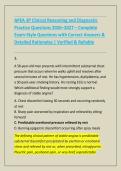
1.
A 58-year-old man presents with intermittent substernal chest
pressure that occurs when he walks uphill and resolves after
several minutes of rest. He has hypertension, dyslipidemia, and
a 30-pack-year smoking history. His resting ECG is normal.
Which additional finding would most strongly support a
diagnosis of stable angina?
A. Chest discomfort lasting 30 seconds and occurring randomly
at rest
B. Sharp pain worsened by inspiration and relieved by sitting
forward
C. Predictable exertional pressure relieved by rest
D. Burning epigastric discomfort occurring after spicy meals
The defining clinical pattern of stable angina is predictable
substernal discomfort precipitated by exertion or emotional
stress and relieved by rest or, when prescribed, nitroglycerin.
Pleuritic pain, positional pain, or very brief unpredictable
,episodes suggest alternative diagnoses. A normal resting ECG
does not exclude ischemic heart disease.
2.
A 46-year-old woman reports fatigue, constipation, cold
intolerance, dry skin, and an 8-kg weight gain over the past
year. Examination reveals delayed relaxation of deep tendon
reflexes. Which laboratory pattern is most consistent with
primary hypothyroidism?
A. Low TSH and high free T4
B. High TSH and low free T4
C. Low TSH and low free T4
D. High TSH and high free T4
In primary hypothyroidism, the thyroid gland fails to produce
adequate thyroid hormone, so the pituitary increases TSH
secretion through loss of negative feedback. Therefore, the
characteristic pattern is elevated TSH with reduced free T4. Low
TSH with low free T4 instead suggests a central hypothyroid
process.
3.
,A 72-year-old woman develops sudden right facial droop, right
arm weakness, and expressive aphasia 45 minutes before
arriving at the clinic. Glucose is 108 mg/dL. Which action is the
priority?
A. Obtain carotid Doppler ultrasonography before further
evaluation
B. Administer aspirin immediately without imaging
C. Activate emergency stroke evaluation for immediate brain
imaging
D. Schedule outpatient neurology follow-up within 24 hours
Acute focal neurologic deficits with sudden onset should be
treated as a potential stroke until proven otherwise. Rapid
neuroimaging is necessary to distinguish ischemic stroke from
intracranial hemorrhage and to determine eligibility for time-
sensitive reperfusion therapy. Aspirin should not be given blindly
before hemorrhage has been excluded.
4.
A 34-year-old woman has episodic palpitations, tremulousness,
heat intolerance, anxiety, and unintentional weight loss.
Examination reveals a fine tremor and a diffuse, non-tender
thyroid enlargement. Which additional finding is most likely?
, A. Delayed deep tendon reflexes
B. Bradycardia
C. Periorbital edema
D. Lid retraction and a widened palpebral fissure
Hyperthyroidism increases sympathetic activity and produces
findings such as tremor, tachycardia, heat intolerance, and
hyperreflexia. Graves disease may additionally produce lid
retraction, lid lag, and, in some patients, infiltrative
ophthalmopathy. Delayed reflex relaxation and bradycardia are
more consistent with hypothyroidism.
5.
A 67-year-old man with hypertension has an average home
blood pressure of 146/92 mm Hg on multiple properly obtained
readings. Which classification best applies under contemporary
adult blood-pressure criteria?
A. Elevated blood pressure
B. Stage 1 hypertension
C. Stage 2 hypertension
D. Hypertensive emergency
An average systolic pressure of at least 140 mm Hg or diastolic
pressure of at least 90 mm Hg falls within stage 2 hypertension
under the 2025 adult blood-pressure guideline framework. A
Practice Questions 2026–2027 – Complete
Exam-Style Questions with Correct Answers &
Detailed Rationales | Verified & Reliable
1.
A 58-year-old man presents with intermittent substernal chest
pressure that occurs when he walks uphill and resolves after
several minutes of rest. He has hypertension, dyslipidemia, and
a 30-pack-year smoking history. His resting ECG is normal.
Which additional finding would most strongly support a
diagnosis of stable angina?
A. Chest discomfort lasting 30 seconds and occurring randomly
at rest
B. Sharp pain worsened by inspiration and relieved by sitting
forward
C. Predictable exertional pressure relieved by rest
D. Burning epigastric discomfort occurring after spicy meals
The defining clinical pattern of stable angina is predictable
substernal discomfort precipitated by exertion or emotional
stress and relieved by rest or, when prescribed, nitroglycerin.
Pleuritic pain, positional pain, or very brief unpredictable
,episodes suggest alternative diagnoses. A normal resting ECG
does not exclude ischemic heart disease.
2.
A 46-year-old woman reports fatigue, constipation, cold
intolerance, dry skin, and an 8-kg weight gain over the past
year. Examination reveals delayed relaxation of deep tendon
reflexes. Which laboratory pattern is most consistent with
primary hypothyroidism?
A. Low TSH and high free T4
B. High TSH and low free T4
C. Low TSH and low free T4
D. High TSH and high free T4
In primary hypothyroidism, the thyroid gland fails to produce
adequate thyroid hormone, so the pituitary increases TSH
secretion through loss of negative feedback. Therefore, the
characteristic pattern is elevated TSH with reduced free T4. Low
TSH with low free T4 instead suggests a central hypothyroid
process.
3.
,A 72-year-old woman develops sudden right facial droop, right
arm weakness, and expressive aphasia 45 minutes before
arriving at the clinic. Glucose is 108 mg/dL. Which action is the
priority?
A. Obtain carotid Doppler ultrasonography before further
evaluation
B. Administer aspirin immediately without imaging
C. Activate emergency stroke evaluation for immediate brain
imaging
D. Schedule outpatient neurology follow-up within 24 hours
Acute focal neurologic deficits with sudden onset should be
treated as a potential stroke until proven otherwise. Rapid
neuroimaging is necessary to distinguish ischemic stroke from
intracranial hemorrhage and to determine eligibility for time-
sensitive reperfusion therapy. Aspirin should not be given blindly
before hemorrhage has been excluded.
4.
A 34-year-old woman has episodic palpitations, tremulousness,
heat intolerance, anxiety, and unintentional weight loss.
Examination reveals a fine tremor and a diffuse, non-tender
thyroid enlargement. Which additional finding is most likely?
, A. Delayed deep tendon reflexes
B. Bradycardia
C. Periorbital edema
D. Lid retraction and a widened palpebral fissure
Hyperthyroidism increases sympathetic activity and produces
findings such as tremor, tachycardia, heat intolerance, and
hyperreflexia. Graves disease may additionally produce lid
retraction, lid lag, and, in some patients, infiltrative
ophthalmopathy. Delayed reflex relaxation and bradycardia are
more consistent with hypothyroidism.
5.
A 67-year-old man with hypertension has an average home
blood pressure of 146/92 mm Hg on multiple properly obtained
readings. Which classification best applies under contemporary
adult blood-pressure criteria?
A. Elevated blood pressure
B. Stage 1 hypertension
C. Stage 2 hypertension
D. Hypertensive emergency
An average systolic pressure of at least 140 mm Hg or diastolic
pressure of at least 90 mm Hg falls within stage 2 hypertension
under the 2025 adult blood-pressure guideline framework. A