

CPCU - ETHICS 311 QUESTIONS WITH VERIFIED ANSWERS
Correct 62
Incorrect 00
1 of 62
Definition
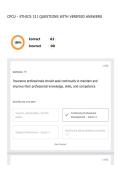
Insurance professionals should seek continually to maintain and
improve their professional knowledge, skills, and competence
Give this one a try later!
insurers, policyholders, and the Continuing Professional
public Development - Canon 2
identify the ethical dilemma (checklist
Diligent Performance - Canon 4
- 1)
Don't know?
2 of 62
,Term
- high ethical standards
- professional competence
- altruism
- commitment to continuing education
- participation in an association of a society
- ability to think and act independently
- recognition as a professional
Give this one a try later!
the question to ask about all Traits of Professionalism: What it
stakeholders Takes
Three steps of ethical decision
tools for ethical decision making
making
Don't know?
3 of 62
Definition
different groups of stakeholders that insurance professionals have
responsibilities with
Give this one a try later!
, Continuing Professional
producers (protecting public interest)
Development - Canon 2
claims reps (protecting public insurers, policyholders, and the
interest) public
Don't know?
4 of 62
Term
Commitment to Continuing Education
Give this one a try later!
- a statement of the organization's values that employees must uphold
- a description of how values correlate with the responsibilities of each employee
- confirmation that employee must follow all regulatory rules and statutes
- descriptions of conflicts employees must avoid, such as supervising immediate
family members
- a process for anonymously reporting code violations
- guidance for handling "gray areas" with examples of unethical conduct and
appropriate responses
- insurance practitioners must know how different coverages apply in particular
situations, understand the implications of risk and its effect on individuals and
society, and apply that knowledge to help customers protect themselves from risk
exposures
- aware of their abilities as well as their limitations and sometimes require us to admit
that we "don't know what we don't know" and seek help from others
, - each area of insurance demands specific, specialized knowledge that must
be built on a broad educational foundation
- insurance professionals must continually update their knowledge in response
to changes in the legal environment, new regulations, emerging loss
exposures, and new statutes
- may be required by law in some states as a prerequisite for producer
licensing and license renewals
- Insurance professionals should aspire to raise the professional and ethical
standards of the insurance and risk management profession
- minimally, requires practitioners to foster competence and ethical conduct among
themselves and others in the industry - this includes attracting capable people to
the industry and encourage their growth
Don't know?
5 of 62
Term
Participation in an Association or Society
Give this one a try later!
the process of restoring an individual or organization to pre-loss financial condition
- helps maintain order in society, reducing the public's dependence on charitable
organizations
Correct 62
Incorrect 00
1 of 62
Definition
Insurance professionals should seek continually to maintain and
improve their professional knowledge, skills, and competence
Give this one a try later!
insurers, policyholders, and the Continuing Professional
public Development - Canon 2
identify the ethical dilemma (checklist
Diligent Performance - Canon 4
- 1)
Don't know?
2 of 62
,Term
- high ethical standards
- professional competence
- altruism
- commitment to continuing education
- participation in an association of a society
- ability to think and act independently
- recognition as a professional
Give this one a try later!
the question to ask about all Traits of Professionalism: What it
stakeholders Takes
Three steps of ethical decision
tools for ethical decision making
making
Don't know?
3 of 62
Definition
different groups of stakeholders that insurance professionals have
responsibilities with
Give this one a try later!
, Continuing Professional
producers (protecting public interest)
Development - Canon 2
claims reps (protecting public insurers, policyholders, and the
interest) public
Don't know?
4 of 62
Term
Commitment to Continuing Education
Give this one a try later!
- a statement of the organization's values that employees must uphold
- a description of how values correlate with the responsibilities of each employee
- confirmation that employee must follow all regulatory rules and statutes
- descriptions of conflicts employees must avoid, such as supervising immediate
family members
- a process for anonymously reporting code violations
- guidance for handling "gray areas" with examples of unethical conduct and
appropriate responses
- insurance practitioners must know how different coverages apply in particular
situations, understand the implications of risk and its effect on individuals and
society, and apply that knowledge to help customers protect themselves from risk
exposures
- aware of their abilities as well as their limitations and sometimes require us to admit
that we "don't know what we don't know" and seek help from others
, - each area of insurance demands specific, specialized knowledge that must
be built on a broad educational foundation
- insurance professionals must continually update their knowledge in response
to changes in the legal environment, new regulations, emerging loss
exposures, and new statutes
- may be required by law in some states as a prerequisite for producer
licensing and license renewals
- Insurance professionals should aspire to raise the professional and ethical
standards of the insurance and risk management profession
- minimally, requires practitioners to foster competence and ethical conduct among
themselves and others in the industry - this includes attracting capable people to
the industry and encourage their growth
Don't know?
5 of 62
Term
Participation in an Association or Society
Give this one a try later!
the process of restoring an individual or organization to pre-loss financial condition
- helps maintain order in society, reducing the public's dependence on charitable
organizations

