
BIOD 102 Biology II | Module 1 Examination - Portage Learning 2026/2027 Updated Edition
PORTAGE LEARNING || 2026/2027 UPDATED
BIOD 102 Biology II
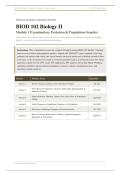
Module 1 Examination: Evolution & Population Genetics
75 Questions | Four Options Each (A-D), One Correct | Time Allowed: 120 Minutes | Questions Weighted
Equally | Answer Key with Detailed Rationales Included
Instructions. This examination assesses the complete Portage Learning BIOD 102 Module 1 learning
objectives in evolution and population genetics, aligned with 2026/2027 course standards. Each item
presents four options with exactly one correct answer; the keyed answer and a detailed rationale follow
every item, so the document serves both as a formal examination and as a self-paced review tool. Items
span three cognitive levels (30% recall, 50% application, 20% analysis) and include Hardy-Weinberg
calculation problems, natural-selection simulation scenarios, evidence-classification items, and
speciation scenario analysis.
Section Primary Focus Questions
Section 1 Darwin, Wallace, Lamarck, & Pre-Darwinian Thought Q1-Q12
Fossil Record, Comparative Anatomy, Embryology, Biogeography, &
Section 2 Q13-Q27
Molecular Evidence
Natural Selection, Mutation, Genetic Drift, Gene Flow, & Nonrandom
Section 3 Q28-Q42
Mating
Section 4 Allele Frequencies, Equilibrium Conditions, & Calculations Q43-Q56
Section 5 Directional, Stabilizing, Disruptive, & Sexual Selection Q57-Q67
Species Concepts, Reproductive Isolation, Allopatric/Sympatric
Section 6 Q68-Q75
Speciation, & Coevolution
Evolution & Population Genetics 1
,BIOD 102 Biology II | Module 1 Examination - Portage Learning 2026/2027 Updated Edition
SECTION 1
Introduction to Evolution and Historical Context
Darwin, Wallace, Lamarck, & Pre-Darwinian Thought | Questions 1-12
Q1: In On the Origin of Species, Charles Darwin described evolution as 'descent with
modification.' Which statement best captures what Darwin meant by this phrase?
A. Species living today descended with modification from ancestral species that
lived before them, so all organisms are connected through branching lines of
common ancestry. [CORRECT]
B. Each species was independently created in its modern form and has remained
unchanged since the beginning of life on Earth.
C. Traits acquired by parents during their lifetimes, such as enlarged muscles from
exercise, are passed on and gradually improve their offspring.
D. Life progresses up a fixed ladder of increasing complexity, with simpler forms
transforming directly into more advanced forms over time.
Correct Answer: A
Rationale: Darwin's phrase summarized two linked claims: modern species descended from
ancestral ones, and heritable modifications accumulated across generations to produce today's
diversity. Option B describes the doctrine of fixity of species that Darwin's evidence explicitly
refuted. Option C is Lamarck's inheritance of acquired characteristics, and option D restates
Aristotle's scala naturae; neither is Darwin's mechanism.
Q2: A student explains the giraffe's long neck by proposing that ancestral giraffes
repeatedly stretched to reach high foliage, slightly lengthened their necks during their
lifetimes, and passed these lengthened necks directly to their offspring. The primary flaw in
this explanation is that it:
A. assumes giraffes feed from trees, when in fact giraffes are ground-grazing animals.
B. relies on genetic drift, a mechanism that operates only in very large populations.
C. invokes the inheritance of characteristics acquired during an individual's
lifetime, whereas natural selection can only amplify heritable variation that
already exists among individuals. [CORRECT]
D. confuses macroevolution with the formation of new species through polyploidy.
Correct Answer: C
Rationale: The student has restated Lamarck's inheritance of acquired characteristics, a
mechanism refuted by genetics: stretching neck muscles does not alter the DNA carried in gametes,
so acquired lengthening is not transmitted. Natural selection instead acts on pre-existing heritable
variation in neck length, favoring individuals whose genes happen to produce longer necks. Options
A, B, and D misstate the biology and do not address the core error.
Evolution & Population Genetics 2
,BIOD 102 Biology II | Module 1 Examination - Portage Learning 2026/2027 Updated Edition
Q3: Which pre-Darwinian naturalist, a founder of vertebrate paleontology, interpreted the
succession of fossil assemblages in the Paris Basin as evidence that each stratum boundary
recorded a sudden extinction event followed by recolonization, a view later termed
catastrophism?
A. Charles Lyell
B. Georges Cuvier [CORRECT]
C. Jean-Baptiste de Lamarck
D. Erasmus Darwin
Correct Answer: B
Rationale: Cuvier documented abrupt transitions in the fossil faunas of the Paris Basin and argued
that catastrophes had reset regional faunas, with new forms migrating in afterward. Lyell
championed uniformitarianism rather than catastrophism, Lamarck proposed an early evolutionary
mechanism based on use and disuse, and Erasmus Darwin, Charles's grandfather, speculated
informally about common descent without a developed mechanism.
Q4: Darwin read Charles Lyell's Principles of Geology during the voyage of the Beagle and
later wrote that thinking like a geologist was central to his discoveries. The most important
contribution of Hutton's and Lyell's uniformitarianism to Darwin's evolutionary thinking
was the idea that:
A. geological features are best explained by a small number of sudden, worldwide
catastrophes.
B. Earth is only a few thousand years old, so evolution must proceed very rapidly.
C. rocks and fossils are always deposited in the order in which species became extinct.
D. slow, continuous processes observed today, such as erosion and
sedimentation, explain major geological change, implying that Earth is ancient
and that gradual biological change had ample time to occur. [CORRECT]
Correct Answer: D
Rationale: Uniformitarianism replaced catastrophism by demonstrating that ordinary, ongoing
processes acting over immense spans of time can produce dramatic change. This gave Darwin the
deep time his mechanism required, because natural selection accumulates only tiny differences
each generation. Options A and B state positions that uniformitarianism overturned, and option C is
not a geological principle Darwin relied upon.
Evolution & Population Genetics 3
, BIOD 102 Biology II | Module 1 Examination - Portage Learning 2026/2027 Updated Edition
Q5: Darwin acknowledged that Thomas Malthus's 1798 essay on human population supplied
'a theory by which to work.' Which insight did Darwin draw from Malthus?
A. Human agriculture demonstrates that food supply can expand without limit.
B. Populations always grow slowly enough that resources never become limiting.
C. Because populations tend to produce far more offspring than resources can
support, only a fraction survive, creating a struggle for existence in which
favorable heritable variations are preserved. [CORRECT]
D. Struggle in nature occurs mainly between different species competing for the same
prey.
Correct Answer: C
Rationale: Malthus argued that human populations grow exponentially while food supply grows
linearly, so checks such as famine and disease inevitably limit numbers. Darwin generalized this to
all organisms, converting overproduction into his inference of a struggle for existence among
heritably varied individuals. Option D narrows the struggle incorrectly; competition occurs within
species as well, and environmental factors such as drought also impose it.
Q6: Darwin's theory is organized around observations and inferences. A population of
wildflowers produces thousands of seeds per plant each year, yet the number of adult plants
in the population stays roughly constant from year to year. Which inference follows most
directly from these facts?
A. Only a small fraction of seeds become reproducing adults, so individuals
differ in reproductive success, and those with favorable inherited traits tend to
leave more offspring. [CORRECT]
B. The population is necessarily approaching Hardy-Weinberg equilibrium at every
locus.
C. The wildflowers must be receiving gene flow from a neighboring population.
D. The seeds that fail to establish do so at random, independent of their inherited
traits.
Correct Answer: A
Rationale: Overproduction combined with a stable population size implies that most offspring
perish, which grounds Darwin's inferences of a struggle for existence and differential reproductive
success. Because individuals vary heritably, selection follows from these premises. Option B
invokes an unrelated topic, option C is unsupported by the facts given, and option D contradicts the
nonrandom survival that heritable variation and differential success imply.
Evolution & Population Genetics 4
PORTAGE LEARNING || 2026/2027 UPDATED
BIOD 102 Biology II
Module 1 Examination: Evolution & Population Genetics
75 Questions | Four Options Each (A-D), One Correct | Time Allowed: 120 Minutes | Questions Weighted
Equally | Answer Key with Detailed Rationales Included
Instructions. This examination assesses the complete Portage Learning BIOD 102 Module 1 learning
objectives in evolution and population genetics, aligned with 2026/2027 course standards. Each item
presents four options with exactly one correct answer; the keyed answer and a detailed rationale follow
every item, so the document serves both as a formal examination and as a self-paced review tool. Items
span three cognitive levels (30% recall, 50% application, 20% analysis) and include Hardy-Weinberg
calculation problems, natural-selection simulation scenarios, evidence-classification items, and
speciation scenario analysis.
Section Primary Focus Questions
Section 1 Darwin, Wallace, Lamarck, & Pre-Darwinian Thought Q1-Q12
Fossil Record, Comparative Anatomy, Embryology, Biogeography, &
Section 2 Q13-Q27
Molecular Evidence
Natural Selection, Mutation, Genetic Drift, Gene Flow, & Nonrandom
Section 3 Q28-Q42
Mating
Section 4 Allele Frequencies, Equilibrium Conditions, & Calculations Q43-Q56
Section 5 Directional, Stabilizing, Disruptive, & Sexual Selection Q57-Q67
Species Concepts, Reproductive Isolation, Allopatric/Sympatric
Section 6 Q68-Q75
Speciation, & Coevolution
Evolution & Population Genetics 1
,BIOD 102 Biology II | Module 1 Examination - Portage Learning 2026/2027 Updated Edition
SECTION 1
Introduction to Evolution and Historical Context
Darwin, Wallace, Lamarck, & Pre-Darwinian Thought | Questions 1-12
Q1: In On the Origin of Species, Charles Darwin described evolution as 'descent with
modification.' Which statement best captures what Darwin meant by this phrase?
A. Species living today descended with modification from ancestral species that
lived before them, so all organisms are connected through branching lines of
common ancestry. [CORRECT]
B. Each species was independently created in its modern form and has remained
unchanged since the beginning of life on Earth.
C. Traits acquired by parents during their lifetimes, such as enlarged muscles from
exercise, are passed on and gradually improve their offspring.
D. Life progresses up a fixed ladder of increasing complexity, with simpler forms
transforming directly into more advanced forms over time.
Correct Answer: A
Rationale: Darwin's phrase summarized two linked claims: modern species descended from
ancestral ones, and heritable modifications accumulated across generations to produce today's
diversity. Option B describes the doctrine of fixity of species that Darwin's evidence explicitly
refuted. Option C is Lamarck's inheritance of acquired characteristics, and option D restates
Aristotle's scala naturae; neither is Darwin's mechanism.
Q2: A student explains the giraffe's long neck by proposing that ancestral giraffes
repeatedly stretched to reach high foliage, slightly lengthened their necks during their
lifetimes, and passed these lengthened necks directly to their offspring. The primary flaw in
this explanation is that it:
A. assumes giraffes feed from trees, when in fact giraffes are ground-grazing animals.
B. relies on genetic drift, a mechanism that operates only in very large populations.
C. invokes the inheritance of characteristics acquired during an individual's
lifetime, whereas natural selection can only amplify heritable variation that
already exists among individuals. [CORRECT]
D. confuses macroevolution with the formation of new species through polyploidy.
Correct Answer: C
Rationale: The student has restated Lamarck's inheritance of acquired characteristics, a
mechanism refuted by genetics: stretching neck muscles does not alter the DNA carried in gametes,
so acquired lengthening is not transmitted. Natural selection instead acts on pre-existing heritable
variation in neck length, favoring individuals whose genes happen to produce longer necks. Options
A, B, and D misstate the biology and do not address the core error.
Evolution & Population Genetics 2
,BIOD 102 Biology II | Module 1 Examination - Portage Learning 2026/2027 Updated Edition
Q3: Which pre-Darwinian naturalist, a founder of vertebrate paleontology, interpreted the
succession of fossil assemblages in the Paris Basin as evidence that each stratum boundary
recorded a sudden extinction event followed by recolonization, a view later termed
catastrophism?
A. Charles Lyell
B. Georges Cuvier [CORRECT]
C. Jean-Baptiste de Lamarck
D. Erasmus Darwin
Correct Answer: B
Rationale: Cuvier documented abrupt transitions in the fossil faunas of the Paris Basin and argued
that catastrophes had reset regional faunas, with new forms migrating in afterward. Lyell
championed uniformitarianism rather than catastrophism, Lamarck proposed an early evolutionary
mechanism based on use and disuse, and Erasmus Darwin, Charles's grandfather, speculated
informally about common descent without a developed mechanism.
Q4: Darwin read Charles Lyell's Principles of Geology during the voyage of the Beagle and
later wrote that thinking like a geologist was central to his discoveries. The most important
contribution of Hutton's and Lyell's uniformitarianism to Darwin's evolutionary thinking
was the idea that:
A. geological features are best explained by a small number of sudden, worldwide
catastrophes.
B. Earth is only a few thousand years old, so evolution must proceed very rapidly.
C. rocks and fossils are always deposited in the order in which species became extinct.
D. slow, continuous processes observed today, such as erosion and
sedimentation, explain major geological change, implying that Earth is ancient
and that gradual biological change had ample time to occur. [CORRECT]
Correct Answer: D
Rationale: Uniformitarianism replaced catastrophism by demonstrating that ordinary, ongoing
processes acting over immense spans of time can produce dramatic change. This gave Darwin the
deep time his mechanism required, because natural selection accumulates only tiny differences
each generation. Options A and B state positions that uniformitarianism overturned, and option C is
not a geological principle Darwin relied upon.
Evolution & Population Genetics 3
, BIOD 102 Biology II | Module 1 Examination - Portage Learning 2026/2027 Updated Edition
Q5: Darwin acknowledged that Thomas Malthus's 1798 essay on human population supplied
'a theory by which to work.' Which insight did Darwin draw from Malthus?
A. Human agriculture demonstrates that food supply can expand without limit.
B. Populations always grow slowly enough that resources never become limiting.
C. Because populations tend to produce far more offspring than resources can
support, only a fraction survive, creating a struggle for existence in which
favorable heritable variations are preserved. [CORRECT]
D. Struggle in nature occurs mainly between different species competing for the same
prey.
Correct Answer: C
Rationale: Malthus argued that human populations grow exponentially while food supply grows
linearly, so checks such as famine and disease inevitably limit numbers. Darwin generalized this to
all organisms, converting overproduction into his inference of a struggle for existence among
heritably varied individuals. Option D narrows the struggle incorrectly; competition occurs within
species as well, and environmental factors such as drought also impose it.
Q6: Darwin's theory is organized around observations and inferences. A population of
wildflowers produces thousands of seeds per plant each year, yet the number of adult plants
in the population stays roughly constant from year to year. Which inference follows most
directly from these facts?
A. Only a small fraction of seeds become reproducing adults, so individuals
differ in reproductive success, and those with favorable inherited traits tend to
leave more offspring. [CORRECT]
B. The population is necessarily approaching Hardy-Weinberg equilibrium at every
locus.
C. The wildflowers must be receiving gene flow from a neighboring population.
D. The seeds that fail to establish do so at random, independent of their inherited
traits.
Correct Answer: A
Rationale: Overproduction combined with a stable population size implies that most offspring
perish, which grounds Darwin's inferences of a struggle for existence and differential reproductive
success. Because individuals vary heritably, selection follows from these premises. Option B
invokes an unrelated topic, option C is unsupported by the facts given, and option D contradicts the
nonrandom survival that heritable variation and differential success imply.
Evolution & Population Genetics 4

