
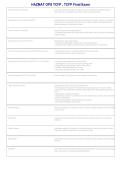
HAZMAT OPS TCFP , TCFP Final Exam
Class B foam concentrates Foam fire-suppression agent designed for use on ignited or unignited Class B
flammable or combustible liquids. Also known as Class B Foam
Aqueous Film Forming Foam (AFFF) Synthetic foam concentrate that, when combined with water, can form a complete
vapor barrier over fuel spills and fires and is a highly effective extinguishing and
blanketing agent on hydrocarbon fuels.
Protein Foam (3% and 6%) Class B fires involving hydrocarbons
• Protecting flammable and combustible liquids where they are stored, transported,
and processed
Fluoroprotein Foam (3% and 6%) Hydrocarbon vapor suppression
• Subsurface application to hydrocarbon fuel storage tanks
• Extinguishing in-depth crude petroleum or other hydrocar- bon fuel fires
Film Forming Fluoroprotein Foam (FFFP) (3% and 6%) • Suppressing vapors in unignited spills of hazardous liquids
• Extinguishing fires in hydro- carbon fuels
Aqueous Film Forming Foam (AFFF) (1%, 3%, and 6%) • Controlling and extinguishing Class B fires
• Handling land or sea crash rescues involving spills
• Extinguishing most transpor- tation-related fires
• Wetting and penetrating Class A fuels
• Securing unignited hydrocar- bon spills
Alcohol- Resistant AFFF (3% and 6%) Fires or spills of both hydrocar- bon and polar solvent fuels
High- Expansion Foam Extinguishing Class A and some Class B fires
• Flooding confined spaces • Volumetrically displacing vapor, heat, and smoke
• Reducing vaporization from liquefied natural gas spills • Extinguishing pesticide
fires
• Suppressing fuming acid vapors
• Suppressing vapors in coal mines and other subterranean spaces and concealed
spaces in basements
• Extinguishing agent in fixed extinguishing systems
• Not recommended for outdoor use
Head Pressure Pressure exerted by a stationary column of water, directly proportional to the height
of the column
Detonation Instantaneous and explosive release of stored chemical energy of a hazardous
material.
Violent rupture Immediate release of chemical or mechanical energy caused by runaway cracks.
They occur within a time frame of one second or less
Rapid relief Fast release of a pressurized hazardous material through properly operating safety
devices.
Spill/leak Slow release of a hazardous material under atmospheric or head pressure through
holes, rips, tears, or usual openings/attachments.
, HAZMAT OPS TCFP , TCFP Final Exam
Engulfment Dispersion of material as defined in the General Emergency Behavior Model
(GEBMO); an engulfing event occurs when matter and/or energy disperses and
forms a danger zone.
Hemispheric Semicircular or dome- shaped pattern of airborne hazardous material that is still
partially in contact with the ground or water.
Cloud Ball-shaped pattern of an airborne hazardous material where the material has
collectively risen above the ground
or water at a hazardous materials incident
Plume Irregularly shaped pattern of an airborne hazardous material where wind and/or
topography influence the downrange course from the point of release
Cone Triangular-shaped pattern of a hazardous material with a point source at the breach
and a wide base downrange
Stream Surface-following pattern of liquid hazardous material that is affected by gravity and
topographical contours
Pool Three-dimensional(includingdepth),slow-flowingliquiddispersion. Liquids assume the
shape of their container and pool in low areas
Irregular Irregular or indiscriminate deposit of a hazardous material (such as that carried by
contaminated responders
Atmospheric Pressure Force exerted by the weight of the atmosphere at the surface of the earth.
Pressure at gauge This describes a unit of pressure relative to the sur- rounding atmosphere.
Nonpressure Intermodal Tank (IM-101) Contents: Liquids or solids (both hazardous and nonhazardous)
Pressure Intermodal Tan
IM-101 Intermodel Tank for 25.4-100 psi
IM-102 Intermodel Tank for 14.5 - 25.4 psi
Pressure Intermodal Tank Containers Commonly carries: Liquefied petroleum gas, Anhydrous Ammonia, motor fuel anti
knock compound, and aluminum alkyls
Cryogenic Intermodal Tanks (IMO Type 7) Contents: Refrigerated liquid gases,
argon, oxygen, helium
, HAZMAT OPS TCFP , TCFP Final Exam
Tube Module Intermodal Container An intermodal container that is capable of holding high pressure gases 3000 psi or
5000 psi
Spec 51 or IMO Type 5 100-500 psi
IMO Type 7 2400 to 5,000 psi
Nerve Agents Deadly toxic substances that attack the central nervous system. They are liquids at
ambient temperatures and dispersed as an aerosolized liquid (vapor, not gas).
Nerve Agents contain Tabun (GA)
Sarin (GB)
Soman (GD)
V Agent (VX)
Blister Agents/Vesicants chemicals that severely blister the eyes, respiratory tract, and skin on contact
Blister Agents/Vesicants contain Mustard (H)
Distilled mustard (HD)
Nitrogen mustard (HN)
Lewisite (L)
Phosgene Oxime (CX)
Blood Agents -decrease the function of hemoglobin in the blood
Blood Agents contain Hydrogen Cyanide (AC)
Cyanogen Chloride (CK)
Choking Agents Gaseous or liquid casualty agents with initial symptoms that include tears, dry
throat, nausea, vomiting, and headache.
Choking Agents contain Chlorine (CL)
Phosgene (CG)
Riot Control Agents / Irritants Tear Gas (CS)
Tear Gas (CR)
Mace (CN)
Pepper Spray (OC)
Adamsite (DM)
Riot Control Agents / Irritants are chemi- cal compounds that cause immediate irritation to the eyes, mouth,
throat, lungs, and skin, temporarily disabling people
Gross decontamination phase of decontamination where significant reduc- tion of the amount surface
contamination takes place as quickly as possible.
, HAZMAT OPS TCFP , TCFP Final Exam
Emergency Decontamination to remove the threatening contaminant from the victim as quickly as possible —
there is no regard for the environment or property protection.
Technical decontamination uses chemical or physical methods to thoroughly remove or neutralize contaminants
from responders' PPE (primarily entry team personnel) and equipment
High Explosive Explosive that decomposes extremely rapidly (almost instantaneously) and has a
detonation velocity faster than the speed of sound
Detonation Explosion with an energy front that travels faster than the speed of sound.
Ammonium Nitrate and Fuel Oil (ANFO) High explosive blasting agent made of common fertilizer mixed with diesel fuel or
oil; requires a booster to initiate detonation.
Low Explosive Explosive material that deflagrates, producing a reaction slower than the speed of
sound.
Deflagrate To explode (burn quickly) at a rate of speed slower than the speed of sound.
Incendiary Device (1) Contrivance designed and used to start a fire. (2) Any mechanical, electrical,
or chemical device used intentionally to initiate combustion and start a fire. Also
known as Explosive Device.
Primary Explosive High explosive that is easily initiated and highly sensitive to heat; often used as a
detonator. Also known as Initiation Device.
Detonator Device used to trigger less sensitive explosives, usually composed of a primary
explosive; for example, a blasting cap. Detonators may be initiated mechanically,
electrically, or chemically.
Secondary Explosive High explosive that is designed to detonate only under specific circumstances,
including activation from
the detonation of a primary explosive. Also known as Main Charge Explosive.
Tertiary Explosive High explosive that require initiation from a secondary explosive. Tertiary explosives
are often categorized with secondary explosives. Also known as Blasting Agents.
Homemade Explosive (HME Explosive material constructed using common household chemicals. The finished
product is usually highly unstable.
Hexamethylene Triperoxide Diamine (HMTD) Peroxide- based white powder high explosive organic compound that can be
manufactured using nonspecialized equipment. Sensitive to shock and friction
during manufacture and handling. Similar to acetone peroxide (TATP).
Explosive Ordnance Disposal (EOD Emergency responders specially trained and equipped to handle and dispose of
explosive devices. Also called Hazardous Devices Units or Bomb Squad.
Class B foam concentrates Foam fire-suppression agent designed for use on ignited or unignited Class B
flammable or combustible liquids. Also known as Class B Foam
Aqueous Film Forming Foam (AFFF) Synthetic foam concentrate that, when combined with water, can form a complete
vapor barrier over fuel spills and fires and is a highly effective extinguishing and
blanketing agent on hydrocarbon fuels.
Protein Foam (3% and 6%) Class B fires involving hydrocarbons
• Protecting flammable and combustible liquids where they are stored, transported,
and processed
Fluoroprotein Foam (3% and 6%) Hydrocarbon vapor suppression
• Subsurface application to hydrocarbon fuel storage tanks
• Extinguishing in-depth crude petroleum or other hydrocar- bon fuel fires
Film Forming Fluoroprotein Foam (FFFP) (3% and 6%) • Suppressing vapors in unignited spills of hazardous liquids
• Extinguishing fires in hydro- carbon fuels
Aqueous Film Forming Foam (AFFF) (1%, 3%, and 6%) • Controlling and extinguishing Class B fires
• Handling land or sea crash rescues involving spills
• Extinguishing most transpor- tation-related fires
• Wetting and penetrating Class A fuels
• Securing unignited hydrocar- bon spills
Alcohol- Resistant AFFF (3% and 6%) Fires or spills of both hydrocar- bon and polar solvent fuels
High- Expansion Foam Extinguishing Class A and some Class B fires
• Flooding confined spaces • Volumetrically displacing vapor, heat, and smoke
• Reducing vaporization from liquefied natural gas spills • Extinguishing pesticide
fires
• Suppressing fuming acid vapors
• Suppressing vapors in coal mines and other subterranean spaces and concealed
spaces in basements
• Extinguishing agent in fixed extinguishing systems
• Not recommended for outdoor use
Head Pressure Pressure exerted by a stationary column of water, directly proportional to the height
of the column
Detonation Instantaneous and explosive release of stored chemical energy of a hazardous
material.
Violent rupture Immediate release of chemical or mechanical energy caused by runaway cracks.
They occur within a time frame of one second or less
Rapid relief Fast release of a pressurized hazardous material through properly operating safety
devices.
Spill/leak Slow release of a hazardous material under atmospheric or head pressure through
holes, rips, tears, or usual openings/attachments.
, HAZMAT OPS TCFP , TCFP Final Exam
Engulfment Dispersion of material as defined in the General Emergency Behavior Model
(GEBMO); an engulfing event occurs when matter and/or energy disperses and
forms a danger zone.
Hemispheric Semicircular or dome- shaped pattern of airborne hazardous material that is still
partially in contact with the ground or water.
Cloud Ball-shaped pattern of an airborne hazardous material where the material has
collectively risen above the ground
or water at a hazardous materials incident
Plume Irregularly shaped pattern of an airborne hazardous material where wind and/or
topography influence the downrange course from the point of release
Cone Triangular-shaped pattern of a hazardous material with a point source at the breach
and a wide base downrange
Stream Surface-following pattern of liquid hazardous material that is affected by gravity and
topographical contours
Pool Three-dimensional(includingdepth),slow-flowingliquiddispersion. Liquids assume the
shape of their container and pool in low areas
Irregular Irregular or indiscriminate deposit of a hazardous material (such as that carried by
contaminated responders
Atmospheric Pressure Force exerted by the weight of the atmosphere at the surface of the earth.
Pressure at gauge This describes a unit of pressure relative to the sur- rounding atmosphere.
Nonpressure Intermodal Tank (IM-101) Contents: Liquids or solids (both hazardous and nonhazardous)
Pressure Intermodal Tan
IM-101 Intermodel Tank for 25.4-100 psi
IM-102 Intermodel Tank for 14.5 - 25.4 psi
Pressure Intermodal Tank Containers Commonly carries: Liquefied petroleum gas, Anhydrous Ammonia, motor fuel anti
knock compound, and aluminum alkyls
Cryogenic Intermodal Tanks (IMO Type 7) Contents: Refrigerated liquid gases,
argon, oxygen, helium
, HAZMAT OPS TCFP , TCFP Final Exam
Tube Module Intermodal Container An intermodal container that is capable of holding high pressure gases 3000 psi or
5000 psi
Spec 51 or IMO Type 5 100-500 psi
IMO Type 7 2400 to 5,000 psi
Nerve Agents Deadly toxic substances that attack the central nervous system. They are liquids at
ambient temperatures and dispersed as an aerosolized liquid (vapor, not gas).
Nerve Agents contain Tabun (GA)
Sarin (GB)
Soman (GD)
V Agent (VX)
Blister Agents/Vesicants chemicals that severely blister the eyes, respiratory tract, and skin on contact
Blister Agents/Vesicants contain Mustard (H)
Distilled mustard (HD)
Nitrogen mustard (HN)
Lewisite (L)
Phosgene Oxime (CX)
Blood Agents -decrease the function of hemoglobin in the blood
Blood Agents contain Hydrogen Cyanide (AC)
Cyanogen Chloride (CK)
Choking Agents Gaseous or liquid casualty agents with initial symptoms that include tears, dry
throat, nausea, vomiting, and headache.
Choking Agents contain Chlorine (CL)
Phosgene (CG)
Riot Control Agents / Irritants Tear Gas (CS)
Tear Gas (CR)
Mace (CN)
Pepper Spray (OC)
Adamsite (DM)
Riot Control Agents / Irritants are chemi- cal compounds that cause immediate irritation to the eyes, mouth,
throat, lungs, and skin, temporarily disabling people
Gross decontamination phase of decontamination where significant reduc- tion of the amount surface
contamination takes place as quickly as possible.
, HAZMAT OPS TCFP , TCFP Final Exam
Emergency Decontamination to remove the threatening contaminant from the victim as quickly as possible —
there is no regard for the environment or property protection.
Technical decontamination uses chemical or physical methods to thoroughly remove or neutralize contaminants
from responders' PPE (primarily entry team personnel) and equipment
High Explosive Explosive that decomposes extremely rapidly (almost instantaneously) and has a
detonation velocity faster than the speed of sound
Detonation Explosion with an energy front that travels faster than the speed of sound.
Ammonium Nitrate and Fuel Oil (ANFO) High explosive blasting agent made of common fertilizer mixed with diesel fuel or
oil; requires a booster to initiate detonation.
Low Explosive Explosive material that deflagrates, producing a reaction slower than the speed of
sound.
Deflagrate To explode (burn quickly) at a rate of speed slower than the speed of sound.
Incendiary Device (1) Contrivance designed and used to start a fire. (2) Any mechanical, electrical,
or chemical device used intentionally to initiate combustion and start a fire. Also
known as Explosive Device.
Primary Explosive High explosive that is easily initiated and highly sensitive to heat; often used as a
detonator. Also known as Initiation Device.
Detonator Device used to trigger less sensitive explosives, usually composed of a primary
explosive; for example, a blasting cap. Detonators may be initiated mechanically,
electrically, or chemically.
Secondary Explosive High explosive that is designed to detonate only under specific circumstances,
including activation from
the detonation of a primary explosive. Also known as Main Charge Explosive.
Tertiary Explosive High explosive that require initiation from a secondary explosive. Tertiary explosives
are often categorized with secondary explosives. Also known as Blasting Agents.
Homemade Explosive (HME Explosive material constructed using common household chemicals. The finished
product is usually highly unstable.
Hexamethylene Triperoxide Diamine (HMTD) Peroxide- based white powder high explosive organic compound that can be
manufactured using nonspecialized equipment. Sensitive to shock and friction
during manufacture and handling. Similar to acetone peroxide (TATP).
Explosive Ordnance Disposal (EOD Emergency responders specially trained and equipped to handle and dispose of
explosive devices. Also called Hazardous Devices Units or Bomb Squad.

