
NUR 2474 Pharmacology Final Examination (NEW 2026/2027) : Pharmacology for Professional Nursing Total: 150 Questions | Time: 180 minutes
RASMUSSEN UNIVERSITY | SCHOOL OF NURSING | NUR 2474
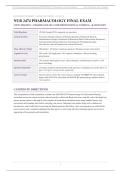
NUR 2474 PHARMACOLOGY FINAL EXAM
(NEW 2026/2027) : PHARMACOLOGY FOR PROFESSIONAL NURSING - RASMUSSEN
Total Questions 150 (Q1 through Q150, sequential, no omissions)
Content Sections 10 sections: Pharmacokinetics & Pharmacodynamics; Medication Safety &
Administration; Dosage Calculations & Medication Math; Cardiovascular; Respiratory;
Gastrointestinal & Renal; Endocrine; Neurological & Psychopharmacology;
Anti-infective; Special Populations & Advanced Practice
Time Allowed / Points 180 minutes | 150 points (1 point per question) | Passing score per course policy
Cognitive Levels 20% recall | 50% application | 30% analysis (calculations, clinical reasoning,
prioritization)
Question Style 75% scenario-based (patient cases, clinical situations, administration scenarios) | 25%
direct knowledge
Special Components 25 dosage-calculation and medication-math questions | 5 integrated case studies (Q73-75,
Q115-117, Q131-132, Q141-142, Q149-150)
Answer Format One best answer (A-D). The correct choice is marked *[CORRECT]* and a rationale
aligned with NUR 2474 curriculum and NCLEX-RN pharmacology standards follows
every question.
CANDIDATE DIRECTIONS
This comprehensive final examination evaluates the full NUR 2474 Pharmacology for Professional Nursing
curriculum across ten content sections, ordered exactly as delivered. Read each stem carefully, select the single best
answer among options A through D, and complete all medication-calculation items using standard metric-unit
conversions and rounding rules before selecting your answer. Integrated case studies begin with a shaded case
introduction; read it fully before answering the linked questions that follow. After each question you will find the
correct answer and a rationale explaining why that option is correct and why the remaining options are incorrect,
supporting self-assessment and remediation.
1
,NUR 2474 Pharmacology Final Examination (NEW 2026/2027) : Pharmacology for Professional Nursing Total: 150 Questions | Time: 180 minutes
Section 1: Pharmacokinetics & Pharmacodynamics
Questions 1-20
Q1. A nurse is preparing to switch a client with severe cancer pain from IV morphine to oral morphine
solution. The prescriber writes an oral dose several times larger than the IV dose. The nurse recognizes that a
higher oral dose is required primarily because of which pharmacokinetic property?
A. Oral morphine has a much larger volume of distribution than IV morphine.
B. Oral morphine undergoes extensive protein binding before reaching the tissues.
C. Oral morphine is extensively metabolized by the liver before reaching systemic circulation (first-pass
effect). *[CORRECT]*
D. Oral morphine is excreted more rapidly by the kidneys when given by mouth.
Correct Answer: C
Rationale: Orally administered morphine is absorbed into the portal circulation and passes directly through the liver,
where a large fraction is biotransformed before it ever reaches the systemic blood supply; this presystemic or first-pass
metabolism greatly reduces oral bioavailability, so the dose must be increased. IV administration bypasses the
gastrointestinal tract and portal system entirely, delivering 100% of the dose. Volume of distribution and protein binding
are drug properties that do not differ by route, and renal excretion depends on plasma drug levels rather than the route of
administration.
Q2. A drug monograph states that the oral bioavailability of a medication is 40%. Which interpretation of this
statement is correct?
A. 40% of the drug molecules bind to plasma albumin in the bloodstream.
B. 40% of clients who take the drug will excrete it unchanged in the urine.
C. Only 40% of each orally administered dose reaches the systemic circulation in active (unchanged)
form. *[CORRECT]*
D. The client requires only 40% of the standard oral dose to achieve a therapeutic effect.
Correct Answer: C
Rationale: Bioavailability is the fraction of an administered dose that reaches systemic circulation intact and is available
to act on target receptors; 40% means the remaining 60% is lost to incomplete absorption or first-pass metabolism. It is a
property of the drug and route, not of the client's response or a dosing shortcut. Protein binding is a separate concept
measured as the percentage of drug bound to plasma proteins, and urinary excretion describes elimination, not
bioavailability.
Q3. A client who has been stabilized on warfarin, which is approximately 99% plasma-protein bound, is newly
prescribed sulfamethoxazole-trimethoprim, which competes for the same protein-binding sites. The nurse
should monitor this client most closely for which finding?
A. Decreased anticoagulant effect with new deep-vein thrombosis
B. Reduced absorption of sulfamethoxazole-trimethoprim from the GI tract
C. Development of a hypersensitivity rash unrelated to drug levels
D. Signs of bleeding such as unusual bruising, dark tarry stools, and bleeding gums *[CORRECT]*
Correct Answer: D
Rationale: When two highly protein-bound drugs share albumin binding sites, the second drug displaces the first, causing
a transient surge of free (unbound) warfarin; only free drug is pharmacologically active, so anticoagulation intensifies and
bleeding risk rises sharply. The nurse should monitor the INR and observe for bleeding. The interaction does the opposite
of decreasing anticoagulant effect, it does not affect GI absorption of the antibiotic, and hypersensitivity is an immune
phenomenon unrelated to protein displacement.
2
,NUR 2474 Pharmacology Final Examination (NEW 2026/2027) : Pharmacology for Professional Nursing Total: 150 Questions | Time: 180 minutes
Q4. A newly ordered medication has a reported half-life of 8 hours. Approximately how long after therapy
begins, at a consistent dosing schedule, will the drug reach steady-state plasma concentration?
A. 80 hours
B. 8 hours
C. 40 hours *[CORRECT]*
D. 24 hours
Correct Answer: C
Rationale: Steady state is achieved after approximately four to five half-lives of consistent dosing, when the amount of
drug eliminated equals the amount administered with each dose; five half-lives of 8 hours equals 40 hours, at which point
about 97% of eventual plateau is reached. Eight hours represents only a single half-life, and 24 hours is only three
half-lives. Eighty hours is ten half-lives, well beyond the point at which steady state is clinically established.
Q5. A client asks the nurse why a new oral medication must be taken at evenly spaced times every day when
the client 'does not feel any different yet.' Which explanation by the nurse is most accurate?
A. Consistent timing maintains plasma drug levels within the therapeutic range around the clock.
*[CORRECT]*
B. Consistent timing prevents the immune system from developing an allergic reaction to the drug.
C. Consistent timing gradually increases the bioavailability of the drug over weeks of therapy.
D. Consistent timing reduces the likelihood of an idiosyncratic reaction to the medication.
Correct Answer: A
Rationale: Scheduled dosing keeps peak and trough plasma concentrations inside the therapeutic range, the narrow band
in which the drug is effective without becoming toxic; missed or irregular doses allow levels to fall below the minimum
effective concentration. Bioavailability is a fixed property of the drug and formulation and does not improve with time.
Allergic reactions are immune responses and idiosyncratic reactions are genetically determined; neither is prevented by
dosing schedules.
Q6. A nurse is monitoring a client receiving an IV antibiotic with a narrow margin between therapeutic and
toxic concentrations. To obtain a blood sample for a PEAK serum drug level, the nurse should plan to draw the
specimen at which time?
A. At any time during therapy, because serum levels do not fluctuate with dosing
B. Immediately before the next scheduled dose is administered
C. Approximately 30 minutes after the IV infusion is completed *[CORRECT]*
D. 2 hours before the current infusion is scheduled to end
Correct Answer: C
Rationale: The peak level reflects the highest plasma concentration and for an IV drug is drawn shortly after the infusion
finishes, when distribution into serum is complete; this value is compared with the toxic threshold. The trough, drawn
immediately before the next dose, documents the lowest concentration and is used for drugs such as vancomycin and
aminoglycosides. Drawing at an arbitrary time produces an uninterpretable value because levels rise and fall with each
dose.
3
, NUR 2474 Pharmacology Final Examination (NEW 2026/2027) : Pharmacology for Professional Nursing Total: 150 Questions | Time: 180 minutes
Q7. A client taking phenytoin, with a documented therapeutic range of 10 to 20 mcg/mL, has a serum level
drawn that returns at 28 mcg/mL. The client reports double vision and an unsteady gait. Which action should
the nurse take first?
A. Administer an additional loading dose as ordered on the PRN record
B. Administer the next scheduled dose to prevent the level from falling further
C. Hold the next dose and notify the provider of the level and clinical findings *[CORRECT]*
D. Encourage increased fluid intake and recheck the level the following morning
Correct Answer: C
Rationale: A level of 28 mcg/mL is above the 10 to 20 mcg/mL therapeutic range, and the client's diplopia and ataxia are
classic signs of phenytoin toxicity; the priority is to hold further dosing and notify the provider so the regimen can be
adjusted. Giving the scheduled dose would raise the level toward seizure-causing concentrations, and a loading dose would
be dangerously inappropriate. Fluids do not accelerate phenytoin clearance and would delay needed intervention.
Q8. A provider orders a loading dose of IV amiodarone to be followed by a lower maintenance infusion. The
nurse understands that the primary purpose of the loading dose is to:
A. Determine whether the client is allergic to the drug before continuing therapy
B. Reduce the risk of toxicity during the first hours of treatment
C. Establish the client's baseline renal and hepatic function
D. Achieve a therapeutic plasma concentration rapidly at the start of therapy *[CORRECT]*
Correct Answer: D
Rationale: A loading dose is a larger initial dose designed to fill the volume of distribution quickly, reaching effective
plasma levels within minutes to hours; this is essential for drugs with long half-lives, such as amiodarone, that would
otherwise take days to work. A maintenance dose follows to replace only the amount eliminated per dosing interval.
Loading doses do not test for allergy, do not protect against toxicity, and have no relationship to laboratory baselines.
Q9. Which statement accurately describes a maintenance dose?
A. The amount of drug administered at regular intervals to keep the plasma concentration within the
therapeutic range *[CORRECT]*
B. The initial dose that is twice the usual amount given to saturate all available receptors
C. The smallest amount of the drug that will produce signs of toxicity
D. A dose that is reduced by half and given only to pediatric clients
Correct Answer: A
Rationale: After a loading dose (if one is given) establishes a therapeutic level, the maintenance dose replaces the amount
of drug cleared from the body during each dosing interval, sustaining the plasma concentration inside the therapeutic
window. The larger initial saturating dose describes a loading dose, not a maintenance dose. A dose that produces toxicity
is by definition a toxic dose, and pediatric maintenance doses are weight-based rather than fixed fractions of adult doses.
4
RASMUSSEN UNIVERSITY | SCHOOL OF NURSING | NUR 2474
NUR 2474 PHARMACOLOGY FINAL EXAM
(NEW 2026/2027) : PHARMACOLOGY FOR PROFESSIONAL NURSING - RASMUSSEN
Total Questions 150 (Q1 through Q150, sequential, no omissions)
Content Sections 10 sections: Pharmacokinetics & Pharmacodynamics; Medication Safety &
Administration; Dosage Calculations & Medication Math; Cardiovascular; Respiratory;
Gastrointestinal & Renal; Endocrine; Neurological & Psychopharmacology;
Anti-infective; Special Populations & Advanced Practice
Time Allowed / Points 180 minutes | 150 points (1 point per question) | Passing score per course policy
Cognitive Levels 20% recall | 50% application | 30% analysis (calculations, clinical reasoning,
prioritization)
Question Style 75% scenario-based (patient cases, clinical situations, administration scenarios) | 25%
direct knowledge
Special Components 25 dosage-calculation and medication-math questions | 5 integrated case studies (Q73-75,
Q115-117, Q131-132, Q141-142, Q149-150)
Answer Format One best answer (A-D). The correct choice is marked *[CORRECT]* and a rationale
aligned with NUR 2474 curriculum and NCLEX-RN pharmacology standards follows
every question.
CANDIDATE DIRECTIONS
This comprehensive final examination evaluates the full NUR 2474 Pharmacology for Professional Nursing
curriculum across ten content sections, ordered exactly as delivered. Read each stem carefully, select the single best
answer among options A through D, and complete all medication-calculation items using standard metric-unit
conversions and rounding rules before selecting your answer. Integrated case studies begin with a shaded case
introduction; read it fully before answering the linked questions that follow. After each question you will find the
correct answer and a rationale explaining why that option is correct and why the remaining options are incorrect,
supporting self-assessment and remediation.
1
,NUR 2474 Pharmacology Final Examination (NEW 2026/2027) : Pharmacology for Professional Nursing Total: 150 Questions | Time: 180 minutes
Section 1: Pharmacokinetics & Pharmacodynamics
Questions 1-20
Q1. A nurse is preparing to switch a client with severe cancer pain from IV morphine to oral morphine
solution. The prescriber writes an oral dose several times larger than the IV dose. The nurse recognizes that a
higher oral dose is required primarily because of which pharmacokinetic property?
A. Oral morphine has a much larger volume of distribution than IV morphine.
B. Oral morphine undergoes extensive protein binding before reaching the tissues.
C. Oral morphine is extensively metabolized by the liver before reaching systemic circulation (first-pass
effect). *[CORRECT]*
D. Oral morphine is excreted more rapidly by the kidneys when given by mouth.
Correct Answer: C
Rationale: Orally administered morphine is absorbed into the portal circulation and passes directly through the liver,
where a large fraction is biotransformed before it ever reaches the systemic blood supply; this presystemic or first-pass
metabolism greatly reduces oral bioavailability, so the dose must be increased. IV administration bypasses the
gastrointestinal tract and portal system entirely, delivering 100% of the dose. Volume of distribution and protein binding
are drug properties that do not differ by route, and renal excretion depends on plasma drug levels rather than the route of
administration.
Q2. A drug monograph states that the oral bioavailability of a medication is 40%. Which interpretation of this
statement is correct?
A. 40% of the drug molecules bind to plasma albumin in the bloodstream.
B. 40% of clients who take the drug will excrete it unchanged in the urine.
C. Only 40% of each orally administered dose reaches the systemic circulation in active (unchanged)
form. *[CORRECT]*
D. The client requires only 40% of the standard oral dose to achieve a therapeutic effect.
Correct Answer: C
Rationale: Bioavailability is the fraction of an administered dose that reaches systemic circulation intact and is available
to act on target receptors; 40% means the remaining 60% is lost to incomplete absorption or first-pass metabolism. It is a
property of the drug and route, not of the client's response or a dosing shortcut. Protein binding is a separate concept
measured as the percentage of drug bound to plasma proteins, and urinary excretion describes elimination, not
bioavailability.
Q3. A client who has been stabilized on warfarin, which is approximately 99% plasma-protein bound, is newly
prescribed sulfamethoxazole-trimethoprim, which competes for the same protein-binding sites. The nurse
should monitor this client most closely for which finding?
A. Decreased anticoagulant effect with new deep-vein thrombosis
B. Reduced absorption of sulfamethoxazole-trimethoprim from the GI tract
C. Development of a hypersensitivity rash unrelated to drug levels
D. Signs of bleeding such as unusual bruising, dark tarry stools, and bleeding gums *[CORRECT]*
Correct Answer: D
Rationale: When two highly protein-bound drugs share albumin binding sites, the second drug displaces the first, causing
a transient surge of free (unbound) warfarin; only free drug is pharmacologically active, so anticoagulation intensifies and
bleeding risk rises sharply. The nurse should monitor the INR and observe for bleeding. The interaction does the opposite
of decreasing anticoagulant effect, it does not affect GI absorption of the antibiotic, and hypersensitivity is an immune
phenomenon unrelated to protein displacement.
2
,NUR 2474 Pharmacology Final Examination (NEW 2026/2027) : Pharmacology for Professional Nursing Total: 150 Questions | Time: 180 minutes
Q4. A newly ordered medication has a reported half-life of 8 hours. Approximately how long after therapy
begins, at a consistent dosing schedule, will the drug reach steady-state plasma concentration?
A. 80 hours
B. 8 hours
C. 40 hours *[CORRECT]*
D. 24 hours
Correct Answer: C
Rationale: Steady state is achieved after approximately four to five half-lives of consistent dosing, when the amount of
drug eliminated equals the amount administered with each dose; five half-lives of 8 hours equals 40 hours, at which point
about 97% of eventual plateau is reached. Eight hours represents only a single half-life, and 24 hours is only three
half-lives. Eighty hours is ten half-lives, well beyond the point at which steady state is clinically established.
Q5. A client asks the nurse why a new oral medication must be taken at evenly spaced times every day when
the client 'does not feel any different yet.' Which explanation by the nurse is most accurate?
A. Consistent timing maintains plasma drug levels within the therapeutic range around the clock.
*[CORRECT]*
B. Consistent timing prevents the immune system from developing an allergic reaction to the drug.
C. Consistent timing gradually increases the bioavailability of the drug over weeks of therapy.
D. Consistent timing reduces the likelihood of an idiosyncratic reaction to the medication.
Correct Answer: A
Rationale: Scheduled dosing keeps peak and trough plasma concentrations inside the therapeutic range, the narrow band
in which the drug is effective without becoming toxic; missed or irregular doses allow levels to fall below the minimum
effective concentration. Bioavailability is a fixed property of the drug and formulation and does not improve with time.
Allergic reactions are immune responses and idiosyncratic reactions are genetically determined; neither is prevented by
dosing schedules.
Q6. A nurse is monitoring a client receiving an IV antibiotic with a narrow margin between therapeutic and
toxic concentrations. To obtain a blood sample for a PEAK serum drug level, the nurse should plan to draw the
specimen at which time?
A. At any time during therapy, because serum levels do not fluctuate with dosing
B. Immediately before the next scheduled dose is administered
C. Approximately 30 minutes after the IV infusion is completed *[CORRECT]*
D. 2 hours before the current infusion is scheduled to end
Correct Answer: C
Rationale: The peak level reflects the highest plasma concentration and for an IV drug is drawn shortly after the infusion
finishes, when distribution into serum is complete; this value is compared with the toxic threshold. The trough, drawn
immediately before the next dose, documents the lowest concentration and is used for drugs such as vancomycin and
aminoglycosides. Drawing at an arbitrary time produces an uninterpretable value because levels rise and fall with each
dose.
3
, NUR 2474 Pharmacology Final Examination (NEW 2026/2027) : Pharmacology for Professional Nursing Total: 150 Questions | Time: 180 minutes
Q7. A client taking phenytoin, with a documented therapeutic range of 10 to 20 mcg/mL, has a serum level
drawn that returns at 28 mcg/mL. The client reports double vision and an unsteady gait. Which action should
the nurse take first?
A. Administer an additional loading dose as ordered on the PRN record
B. Administer the next scheduled dose to prevent the level from falling further
C. Hold the next dose and notify the provider of the level and clinical findings *[CORRECT]*
D. Encourage increased fluid intake and recheck the level the following morning
Correct Answer: C
Rationale: A level of 28 mcg/mL is above the 10 to 20 mcg/mL therapeutic range, and the client's diplopia and ataxia are
classic signs of phenytoin toxicity; the priority is to hold further dosing and notify the provider so the regimen can be
adjusted. Giving the scheduled dose would raise the level toward seizure-causing concentrations, and a loading dose would
be dangerously inappropriate. Fluids do not accelerate phenytoin clearance and would delay needed intervention.
Q8. A provider orders a loading dose of IV amiodarone to be followed by a lower maintenance infusion. The
nurse understands that the primary purpose of the loading dose is to:
A. Determine whether the client is allergic to the drug before continuing therapy
B. Reduce the risk of toxicity during the first hours of treatment
C. Establish the client's baseline renal and hepatic function
D. Achieve a therapeutic plasma concentration rapidly at the start of therapy *[CORRECT]*
Correct Answer: D
Rationale: A loading dose is a larger initial dose designed to fill the volume of distribution quickly, reaching effective
plasma levels within minutes to hours; this is essential for drugs with long half-lives, such as amiodarone, that would
otherwise take days to work. A maintenance dose follows to replace only the amount eliminated per dosing interval.
Loading doses do not test for allergy, do not protect against toxicity, and have no relationship to laboratory baselines.
Q9. Which statement accurately describes a maintenance dose?
A. The amount of drug administered at regular intervals to keep the plasma concentration within the
therapeutic range *[CORRECT]*
B. The initial dose that is twice the usual amount given to saturate all available receptors
C. The smallest amount of the drug that will produce signs of toxicity
D. A dose that is reduced by half and given only to pediatric clients
Correct Answer: A
Rationale: After a loading dose (if one is given) establishes a therapeutic level, the maintenance dose replaces the amount
of drug cleared from the body during each dosing interval, sustaining the plasma concentration inside the therapeutic
window. The larger initial saturating dose describes a loading dose, not a maintenance dose. A dose that produces toxicity
is by definition a toxic dose, and pediatric maintenance doses are weight-based rather than fixed fractions of adult doses.
4

