
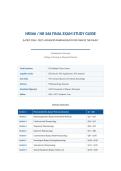
NR566 / NR 566 FINAL EXAM STUDY GUIDE
(LATEST ): ADVANCED PHARMACOLOGY FOR CARE OF THE FAMILY
Chamberlain University
College of Nursing & Advanced Practice
Total Questions 150 Multiple-Choice Items
Cognitive Levels 20% Recall | 50% Application | 30% Analysis
Item Style 75% Scenario-Based | 25% Direct Knowledge
Sections 9 Pharmacology Domains
Standards Alignment AACN Essentials of Master's Education
Edition Academic Year
Section Overview
Section 1 Pharmacokinetics & Pharmacodynamics Q1 - Q20
Section 2 Pharmacogenomics & Personalized Medicine Q21 - Q35
Section 3 Cardiovascular Pharmacology Q36 - Q55
Section 4 Respiratory Pharmacology Q56 - Q70
Section 5 Endocrine Pharmacology Q71 - Q90
Section 6 Gastrointestinal & Renal Pharmacology Q91 - Q105
Section 7 Neurological & Psychopharmacology Q106 - Q120
Section 8 Anti-infective Pharmacology Q121 - Q135
Section 9 Special Populations & Family Care Q136 - Q150
, Section 1: Pharmacokinetics & Pharmacodynamics (Q1 - Q20)
Q1: A 72-year-old male with hepatic cirrhosis is prescribed a highly protein-bound medication (warfarin, 99%
bound). The provider should anticipate that the patient will experience which effect compared to a patient
without cirrhosis?
A. Decreased free drug levels requiring dose increase
B. Increased free drug levels requiring dose reduction *[CORRECT]*
C. No change in dosing because protein binding does not affect free drug
D. Increased metabolism requiring more frequent dosing
Correct Answer: B
Rationale: In cirrhosis, albumin synthesis decreases, leading to fewer protein-binding sites and more free (active) warfarin. The
NR 566 curriculum emphasizes that reduced protein binding increases drug toxicity risk, so doses must be reduced and INR
monitored more frequently. Option A reverses the relationship; option C ignores the central role of free drug concentration; option
D confuses metabolism with protein binding.
Q2: A patient receives an oral medication that undergoes extensive first-pass metabolism. The bioavailability is
approximately 30%. Which statement best explains the clinical implication of this pharmacokinetic property?
A. The oral dose must be lower than the IV dose to achieve the same effect
B. The oral dose must be higher than the IV dose to achieve the same systemic effect *[CORRECT]*
C. The drug should only be given by the sublingual route to bypass metabolism
D. First-pass metabolism increases the oral drug's half-life significantly
Correct Answer: B
Rationale: First-pass (presystemic) metabolism in the liver and gut wall reduces the amount of active drug reaching systemic
circulation. Therefore, the oral dose must exceed the IV dose to achieve equivalent therapeutic concentrations. Option A is
incorrect because lower oral dosing would produce subtherapeutic levels. Option C is overly absolute; sublingual is only one
alternative route. Option D is wrong because first-pass metabolism does not directly prolong half-life, which is governed by
elimination kinetics.
Q3: A patient is started on a medication with a half-life of 12 hours. The patient asks how long it will take to
reach steady state. The advanced practice nurse correctly responds:
A. Approximately 12 hours
B. Approximately 24 hours
C. Approximately 48 to 60 hours *[CORRECT]*
D. Approximately 7 days
Correct Answer: C
Rationale: Steady state is reached in approximately 4 to 5 half-lives. With a half-life of 12 hours, 5 half-lives equal 60 hours (about
2.5 days). The NR 566 curriculum stresses this principle for timing therapeutic drug monitoring and dose adjustments. Option A
reflects one half-life (50% of steady state), option B reflects two half-lives (75%), and option D would apply to a drug with a
24-hour half-life (5 days).
,Q4: A drug has a narrow therapeutic index. Which monitoring parameter is most important for the advanced
practice nurse to evaluate to prevent toxicity?
A. Patient-reported symptom improvement only
B. Serum drug trough and peak levels within the therapeutic range *[CORRECT]*
C. Heart rate and blood pressure at each visit
D. Liver function tests every 6 months
Correct Answer: B
Rationale: Narrow therapeutic index drugs (e.g., digoxin, lithium, warfarin, phenytoin, aminoglycosides) require serum drug
concentration monitoring because the difference between therapeutic and toxic doses is small. The AACN Essentials and NR 566
curriculum emphasize serum drug levels for these agents. Symptom reports alone are unreliable (option A). Vital signs (option C)
and LFTs (option D) are useful but do not replace direct drug concentration monitoring for narrow-index drugs.
Q5: A 55-year-old female is prescribed a medication that is a competitive antagonist at the beta-1 receptor.
Which pharmacodynamic concept explains why increasing the dose of an endogenous agonist (norepinephrine)
can partially overcome the antagonist's effect?
A. Irreversible receptor binding
B. Surmountable antagonism with rightward dose-response shift *[CORRECT]*
C. Noncompetitive inhibition at a separate allosteric site
D. Receptor downregulation from chronic agonist exposure
Correct Answer: B
Rationale: Competitive (surmountable) antagonists bind reversibly to the same receptor site as the agonist. Increasing agonist
concentration can overcome this blockade, producing a parallel rightward shift in the dose-response curve. This is a foundational
pharmacodynamic principle in NR 566. Option A describes irreversible antagonism; option C describes allosteric noncompetitive
antagonism; option D describes receptor adaptation seen with chronic agonist use, not acute antagonist-reversal.
Q6: A patient taking a CYP3A4 inhibitor begins therapy with a drug metabolized by CYP3A4. The advanced
practice nurse anticipates which change in the substrate drug's pharmacokinetics?
A. Decreased plasma levels requiring dose increase
B. Increased plasma levels with potential toxicity *[CORRECT]*
C. No change because CYP3A4 inhibition does not affect oral drugs
D. Increased renal clearance compensating for reduced metabolism
Correct Answer: B
Rationale: CYP3A4 inhibition reduces hepatic metabolism of substrate drugs, increasing plasma concentrations and the risk of
dose-dependent adverse effects. NR 566 drug-interaction content stresses reviewing CYP pathways before prescribing. Option A is
the opposite effect; option C is incorrect because CYP3A4 metabolizes many oral drugs; option D is incorrect because renal
clearance does not automatically compensate for impaired metabolism.
, Q7: A drug exhibits first-order kinetics. Which statement is correct regarding its elimination?
A. A constant amount of drug is eliminated per unit time regardless of concentration
B. A constant fraction of the drug is eliminated per unit time *[CORRECT]*
C. The half-life increases as the dose increases
D. The drug accumulates indefinitely without reaching steady state
Correct Answer: B
Rationale: In first-order kinetics, the elimination rate is proportional to plasma concentration, so a constant fraction (e.g., 50%
per half-life) is removed per unit time. Most clinically used drugs follow first-order kinetics. Option A describes zero-order kinetics
(e.g., phenytoin, ethanol). Option C is wrong because half-life is constant in first-order elimination. Option D describes linear
accumulation that does not occur because steady state is achieved after 4 to 5 half-lives.
Q8: Which statement accurately describes the difference between potency and efficacy?
A. Potency refers to the maximum effect a drug can produce; efficacy refers to the dose required to produce an effect
B. Potency refers to the dose required to produce a given effect; efficacy refers to the maximum effect a drug
can produce *[CORRECT]*
C. Potency and efficacy are interchangeable terms describing the same pharmacologic property
D. Potency is determined by receptor affinity; efficacy is determined by bioavailability only
Correct Answer: B
Rationale: Potency (reflected by EC50) describes the concentration or dose needed to produce a defined effect; a lower dose
means higher potency. Efficacy (reflected by Emax) is the maximum therapeutic effect a drug can achieve, governed by intrinsic
activity at the receptor. NR 566 emphasizes that a highly potent drug may have low efficacy and vice versa. Option A reverses the
definitions; option C is incorrect; option D confuses determinants of each property.
Q9: A patient develops an idiosyncratic reaction to a medication. Which characteristic best defines this type of
adverse drug reaction?
A. A predictable, dose-dependent side effect related to the drug's pharmacologic action
B. An unpredictable, genetically determined reaction unrelated to the drug's known pharmacologic action
*[CORRECT]*
C. An immune-mediated hypersensitivity reaction requiring prior sensitization
D. A reaction caused by drug accumulation exceeding the therapeutic index
Correct Answer: B
Rationale: Idiosyncratic reactions are unpredictable, often genetically determined responses that are unrelated to the drug's
known pharmacologic action and occur in a small subset of patients (e.g., chloramphenicol-induced aplastic anemia). NR 566
distinguishes these from side effects (option A, dose-dependent and predictable), allergic reactions (option C, immune-mediated),
and toxicity (option D, dose-related accumulation).
(LATEST ): ADVANCED PHARMACOLOGY FOR CARE OF THE FAMILY
Chamberlain University
College of Nursing & Advanced Practice
Total Questions 150 Multiple-Choice Items
Cognitive Levels 20% Recall | 50% Application | 30% Analysis
Item Style 75% Scenario-Based | 25% Direct Knowledge
Sections 9 Pharmacology Domains
Standards Alignment AACN Essentials of Master's Education
Edition Academic Year
Section Overview
Section 1 Pharmacokinetics & Pharmacodynamics Q1 - Q20
Section 2 Pharmacogenomics & Personalized Medicine Q21 - Q35
Section 3 Cardiovascular Pharmacology Q36 - Q55
Section 4 Respiratory Pharmacology Q56 - Q70
Section 5 Endocrine Pharmacology Q71 - Q90
Section 6 Gastrointestinal & Renal Pharmacology Q91 - Q105
Section 7 Neurological & Psychopharmacology Q106 - Q120
Section 8 Anti-infective Pharmacology Q121 - Q135
Section 9 Special Populations & Family Care Q136 - Q150
, Section 1: Pharmacokinetics & Pharmacodynamics (Q1 - Q20)
Q1: A 72-year-old male with hepatic cirrhosis is prescribed a highly protein-bound medication (warfarin, 99%
bound). The provider should anticipate that the patient will experience which effect compared to a patient
without cirrhosis?
A. Decreased free drug levels requiring dose increase
B. Increased free drug levels requiring dose reduction *[CORRECT]*
C. No change in dosing because protein binding does not affect free drug
D. Increased metabolism requiring more frequent dosing
Correct Answer: B
Rationale: In cirrhosis, albumin synthesis decreases, leading to fewer protein-binding sites and more free (active) warfarin. The
NR 566 curriculum emphasizes that reduced protein binding increases drug toxicity risk, so doses must be reduced and INR
monitored more frequently. Option A reverses the relationship; option C ignores the central role of free drug concentration; option
D confuses metabolism with protein binding.
Q2: A patient receives an oral medication that undergoes extensive first-pass metabolism. The bioavailability is
approximately 30%. Which statement best explains the clinical implication of this pharmacokinetic property?
A. The oral dose must be lower than the IV dose to achieve the same effect
B. The oral dose must be higher than the IV dose to achieve the same systemic effect *[CORRECT]*
C. The drug should only be given by the sublingual route to bypass metabolism
D. First-pass metabolism increases the oral drug's half-life significantly
Correct Answer: B
Rationale: First-pass (presystemic) metabolism in the liver and gut wall reduces the amount of active drug reaching systemic
circulation. Therefore, the oral dose must exceed the IV dose to achieve equivalent therapeutic concentrations. Option A is
incorrect because lower oral dosing would produce subtherapeutic levels. Option C is overly absolute; sublingual is only one
alternative route. Option D is wrong because first-pass metabolism does not directly prolong half-life, which is governed by
elimination kinetics.
Q3: A patient is started on a medication with a half-life of 12 hours. The patient asks how long it will take to
reach steady state. The advanced practice nurse correctly responds:
A. Approximately 12 hours
B. Approximately 24 hours
C. Approximately 48 to 60 hours *[CORRECT]*
D. Approximately 7 days
Correct Answer: C
Rationale: Steady state is reached in approximately 4 to 5 half-lives. With a half-life of 12 hours, 5 half-lives equal 60 hours (about
2.5 days). The NR 566 curriculum stresses this principle for timing therapeutic drug monitoring and dose adjustments. Option A
reflects one half-life (50% of steady state), option B reflects two half-lives (75%), and option D would apply to a drug with a
24-hour half-life (5 days).
,Q4: A drug has a narrow therapeutic index. Which monitoring parameter is most important for the advanced
practice nurse to evaluate to prevent toxicity?
A. Patient-reported symptom improvement only
B. Serum drug trough and peak levels within the therapeutic range *[CORRECT]*
C. Heart rate and blood pressure at each visit
D. Liver function tests every 6 months
Correct Answer: B
Rationale: Narrow therapeutic index drugs (e.g., digoxin, lithium, warfarin, phenytoin, aminoglycosides) require serum drug
concentration monitoring because the difference between therapeutic and toxic doses is small. The AACN Essentials and NR 566
curriculum emphasize serum drug levels for these agents. Symptom reports alone are unreliable (option A). Vital signs (option C)
and LFTs (option D) are useful but do not replace direct drug concentration monitoring for narrow-index drugs.
Q5: A 55-year-old female is prescribed a medication that is a competitive antagonist at the beta-1 receptor.
Which pharmacodynamic concept explains why increasing the dose of an endogenous agonist (norepinephrine)
can partially overcome the antagonist's effect?
A. Irreversible receptor binding
B. Surmountable antagonism with rightward dose-response shift *[CORRECT]*
C. Noncompetitive inhibition at a separate allosteric site
D. Receptor downregulation from chronic agonist exposure
Correct Answer: B
Rationale: Competitive (surmountable) antagonists bind reversibly to the same receptor site as the agonist. Increasing agonist
concentration can overcome this blockade, producing a parallel rightward shift in the dose-response curve. This is a foundational
pharmacodynamic principle in NR 566. Option A describes irreversible antagonism; option C describes allosteric noncompetitive
antagonism; option D describes receptor adaptation seen with chronic agonist use, not acute antagonist-reversal.
Q6: A patient taking a CYP3A4 inhibitor begins therapy with a drug metabolized by CYP3A4. The advanced
practice nurse anticipates which change in the substrate drug's pharmacokinetics?
A. Decreased plasma levels requiring dose increase
B. Increased plasma levels with potential toxicity *[CORRECT]*
C. No change because CYP3A4 inhibition does not affect oral drugs
D. Increased renal clearance compensating for reduced metabolism
Correct Answer: B
Rationale: CYP3A4 inhibition reduces hepatic metabolism of substrate drugs, increasing plasma concentrations and the risk of
dose-dependent adverse effects. NR 566 drug-interaction content stresses reviewing CYP pathways before prescribing. Option A is
the opposite effect; option C is incorrect because CYP3A4 metabolizes many oral drugs; option D is incorrect because renal
clearance does not automatically compensate for impaired metabolism.
, Q7: A drug exhibits first-order kinetics. Which statement is correct regarding its elimination?
A. A constant amount of drug is eliminated per unit time regardless of concentration
B. A constant fraction of the drug is eliminated per unit time *[CORRECT]*
C. The half-life increases as the dose increases
D. The drug accumulates indefinitely without reaching steady state
Correct Answer: B
Rationale: In first-order kinetics, the elimination rate is proportional to plasma concentration, so a constant fraction (e.g., 50%
per half-life) is removed per unit time. Most clinically used drugs follow first-order kinetics. Option A describes zero-order kinetics
(e.g., phenytoin, ethanol). Option C is wrong because half-life is constant in first-order elimination. Option D describes linear
accumulation that does not occur because steady state is achieved after 4 to 5 half-lives.
Q8: Which statement accurately describes the difference between potency and efficacy?
A. Potency refers to the maximum effect a drug can produce; efficacy refers to the dose required to produce an effect
B. Potency refers to the dose required to produce a given effect; efficacy refers to the maximum effect a drug
can produce *[CORRECT]*
C. Potency and efficacy are interchangeable terms describing the same pharmacologic property
D. Potency is determined by receptor affinity; efficacy is determined by bioavailability only
Correct Answer: B
Rationale: Potency (reflected by EC50) describes the concentration or dose needed to produce a defined effect; a lower dose
means higher potency. Efficacy (reflected by Emax) is the maximum therapeutic effect a drug can achieve, governed by intrinsic
activity at the receptor. NR 566 emphasizes that a highly potent drug may have low efficacy and vice versa. Option A reverses the
definitions; option C is incorrect; option D confuses determinants of each property.
Q9: A patient develops an idiosyncratic reaction to a medication. Which characteristic best defines this type of
adverse drug reaction?
A. A predictable, dose-dependent side effect related to the drug's pharmacologic action
B. An unpredictable, genetically determined reaction unrelated to the drug's known pharmacologic action
*[CORRECT]*
C. An immune-mediated hypersensitivity reaction requiring prior sensitization
D. A reaction caused by drug accumulation exceeding the therapeutic index
Correct Answer: B
Rationale: Idiosyncratic reactions are unpredictable, often genetically determined responses that are unrelated to the drug's
known pharmacologic action and occur in a small subset of patients (e.g., chloramphenicol-induced aplastic anemia). NR 566
distinguishes these from side effects (option A, dose-dependent and predictable), allergic reactions (option C, immune-mediated),
and toxicity (option D, dose-related accumulation).

