
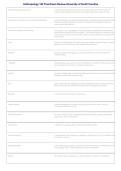
Anthropology 102 Final Exam Review-University of South Carolina
Explain what social groups are a social group has been defined as two or more people who interact with one
another, share similar characteristics, and collectively have a sense of unity.
Define what is included in the term social stratification Social stratification is a society's categorization of people into socioeconomic strata,
based upon their occupation and income, wealth and social status, or derived
power (social and political).
Discuss the concept of civil society Civil society is the "aggregate of non-governmental organizations and institutions
that manifest interests and will of citizens". Civil society includes the family and the
private sphere, referred to as the "third sector" of society, distinct from government
and business.
Race Race is the classification of humans into groups based on physical traits, ancestry,
genetics, or social relations, or the relations between them.
Ethnicity the fact or state of belonging to a social group that has a common national or
cultural tradition.
"Passing" Racial passing occurs when a person classified as a member of one racial group is
also accepted as a member of a different racial group.
Gender the state of being male or female (typically used with reference to social and cultural
differences rather than biological ones).
Sex either of the two main categories (male and female) into which humans and many
other living things are divided on the basis of their reproductive functions.
Sexuality a person's sexual orientation or preference.
Gender Identity a person's perception of having a particular gender, which may or may not
correspond with their birth sex.
Gender Expression the way in which a person expresses their gender identity, typically through their
appearance, dress, and behavior.
Social Class a division of a society based on social and economic status.
Achieved position a social position that a person can acquire on the basis of merit; it is a position that
is earned or chosen.
Ascribed position is the social status a person is assigned at birth or assumed involuntarily later in life.
It is a position that is neither earned nor chosen but assigned.
Status the relative social, professional, or other standing of someone or something.
, Anthropology 102 Final Exam Review-University of South Carolina
Modes of Reproduction influenced by Modes of Livelihood 1) The Foraging Mode of Reproduction
-Moderate death and birth rates
-Value of Children: Moderate
-Fertility:
-Indirect means (suppress ovulation)
-Direct means
2) The Agricultural Mode of Reproduction
-High birth rates, declining death rates
-Value of children: high
-Pronatalist technique (encouraging child birth)
-Increased reliance on direct means of birth control
-Increasing specialization: midwives, herbalists
3) The Industrial/Informatics Mode of Reproduction
-Negative population growth in industrial/informatics countires: below replacement
level fertility
-Value of children: mixed
-Follows the demographic transition (high number of births/deaths into low numbers
of births/deaths)
Culture Shapes Sexual Intercourse -Influence...when to start having sex and how often, how many children to have,
and when to stop having sex and children
-Cultural guidelines
-Government politics
-Local & International organizations..
Fertility Considerations At the State Level:
-Economic factors, especially labor requirements
-Maintaining the tax base, military, ethnic, and regional proportions
-Providing public services
-Dealing with population aging
At the Global Level:
-Religious teachings
-International relations and foreign aid
The Cultural Construction of Personality in Childhood -Six Cultures Study
-Research on many children's behavior in six cultures
-Major finding of difference between horticultural and industrial/informatics sites:
-Horticulture: nurturant-responsible children
-Industrial/informatics: dependent-dominant children
-Mothers' work roles
-Horticultural contexts vs. Industrial/Informatics contexts
Adolescence the period following the onset of puberty during which a young person develops
from a child into an adult.
Asexuality is the lack of sexual attraction to anyone, or low or absent interest in or desire for
sexual activity.
Demographic transition refers to the transition from high birth and death rates to lower birth and death rates
as a country or region develops from a pre-industrial to an industrialized economic
system.
Female genital mutilation Female genital mutilation (FGM), also known as female genital cutting and female
circumcision, is the ritual removal of some or all of the external female genitalia. The
practice is found in Africa, Asia and the Middle East, and within communities from
countries in which FGM is common.
Fertility the ability to conceive children or young.
Gender Plurarlism Having someone coexist with multiple genders
Explain what social groups are a social group has been defined as two or more people who interact with one
another, share similar characteristics, and collectively have a sense of unity.
Define what is included in the term social stratification Social stratification is a society's categorization of people into socioeconomic strata,
based upon their occupation and income, wealth and social status, or derived
power (social and political).
Discuss the concept of civil society Civil society is the "aggregate of non-governmental organizations and institutions
that manifest interests and will of citizens". Civil society includes the family and the
private sphere, referred to as the "third sector" of society, distinct from government
and business.
Race Race is the classification of humans into groups based on physical traits, ancestry,
genetics, or social relations, or the relations between them.
Ethnicity the fact or state of belonging to a social group that has a common national or
cultural tradition.
"Passing" Racial passing occurs when a person classified as a member of one racial group is
also accepted as a member of a different racial group.
Gender the state of being male or female (typically used with reference to social and cultural
differences rather than biological ones).
Sex either of the two main categories (male and female) into which humans and many
other living things are divided on the basis of their reproductive functions.
Sexuality a person's sexual orientation or preference.
Gender Identity a person's perception of having a particular gender, which may or may not
correspond with their birth sex.
Gender Expression the way in which a person expresses their gender identity, typically through their
appearance, dress, and behavior.
Social Class a division of a society based on social and economic status.
Achieved position a social position that a person can acquire on the basis of merit; it is a position that
is earned or chosen.
Ascribed position is the social status a person is assigned at birth or assumed involuntarily later in life.
It is a position that is neither earned nor chosen but assigned.
Status the relative social, professional, or other standing of someone or something.
, Anthropology 102 Final Exam Review-University of South Carolina
Modes of Reproduction influenced by Modes of Livelihood 1) The Foraging Mode of Reproduction
-Moderate death and birth rates
-Value of Children: Moderate
-Fertility:
-Indirect means (suppress ovulation)
-Direct means
2) The Agricultural Mode of Reproduction
-High birth rates, declining death rates
-Value of children: high
-Pronatalist technique (encouraging child birth)
-Increased reliance on direct means of birth control
-Increasing specialization: midwives, herbalists
3) The Industrial/Informatics Mode of Reproduction
-Negative population growth in industrial/informatics countires: below replacement
level fertility
-Value of children: mixed
-Follows the demographic transition (high number of births/deaths into low numbers
of births/deaths)
Culture Shapes Sexual Intercourse -Influence...when to start having sex and how often, how many children to have,
and when to stop having sex and children
-Cultural guidelines
-Government politics
-Local & International organizations..
Fertility Considerations At the State Level:
-Economic factors, especially labor requirements
-Maintaining the tax base, military, ethnic, and regional proportions
-Providing public services
-Dealing with population aging
At the Global Level:
-Religious teachings
-International relations and foreign aid
The Cultural Construction of Personality in Childhood -Six Cultures Study
-Research on many children's behavior in six cultures
-Major finding of difference between horticultural and industrial/informatics sites:
-Horticulture: nurturant-responsible children
-Industrial/informatics: dependent-dominant children
-Mothers' work roles
-Horticultural contexts vs. Industrial/Informatics contexts
Adolescence the period following the onset of puberty during which a young person develops
from a child into an adult.
Asexuality is the lack of sexual attraction to anyone, or low or absent interest in or desire for
sexual activity.
Demographic transition refers to the transition from high birth and death rates to lower birth and death rates
as a country or region develops from a pre-industrial to an industrialized economic
system.
Female genital mutilation Female genital mutilation (FGM), also known as female genital cutting and female
circumcision, is the ritual removal of some or all of the external female genitalia. The
practice is found in Africa, Asia and the Middle East, and within communities from
countries in which FGM is common.
Fertility the ability to conceive children or young.
Gender Plurarlism Having someone coexist with multiple genders

