
STUDY NOTES & REFERENCE GUIDE
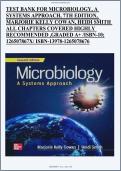
TEST BANK FOR MICROBIOLOGY, A
SYSTEMS APPROACH, 7TH EDITION,
MARJORIE KELLY COWAN, HEIDI SMITH
ALL CHAPTERS COVERED HIGHLY
RECOMMENDED ,GRADED A+ /ISBN-10;
126507867X/ ISBN-13978-1265078676
COURSEROOMSITY ‐ Stuvia | Page 1 of 756
, STUDY NOTES & REFERENCE GUIDE
Chapter 1 The Main Themes of Microbiology
1) Microorganisms are best defined as organisms that .
A) cause human disease
B) lack a cell nucleus
C) are infectious particles
D) are too small to be seen with the unaided eye
E) can only be found growing in laboratories
Question Details
Learning Outcome : 01.01 List the six types of microorganisms we will be studying in this book. ASM Topic : Module 02 Structure
and Function
Bloom's : 1. Remember Section : 01.01
Topic : Cellular Organization
ASM Objective : 02.01 The structure and function of microorganisms have been revealed by the use of m Accessibility : Keyboard
Navigation
2) Which of the following are not considered microorganisms?
A) Mosquitoes
B) Protozoa
C) Bacteria
D) Viruses
E) Fungi
Version 1 1
COURSEROOMSITY ‐ Stuvia | Page 2 of 756
, STUDY NOTES & REFERENCE GUIDE
Question Details
Learning Outcome : 01.01 List the six types of microorganisms we will be studying in this book. ASM Topic : Module 05 Systems
ASM Objective : 05.01 Microorganisms are ubiquitous and live in diverse and dynamic ecosystems. Bloom's : 2. Understand
Section : 01.01
Topic : Taxonomy of Microorganisms
Accessibility : Keyboard Navigation
Version 1 2
COURSEROOMSITY ‐ Stuvia | Page 3 of 756
, STUDY NOTES & REFERENCE GUIDE
3) Helminths are .
A) bacteria
B) protozoa
C) molds
D) parasitic worms
E) infectious particles
Question Details
Learning Outcome : 01.01 List the six types of microorganisms we will be studying in this book. ASM Topic : Module 02 Structure
and Function
ASM Objective : 02.04 While microscopic eukaryotes (for example, fungi, protozoa, and algae) carry ou Bloom's : 1. Remember
Section : 01.01
Topic : Taxonomy of Microorganisms
Accessibility : Keyboard Navigation
4) Among these types of microorganisms, the _ arenoncellular.
A) viruses
B) helminths
C) protozoans
D) bacteria
Question Details
Learning Outcome : 01.01 List the six types of microorganisms we will be studying in this book. Learning Outcome : 01.08 Identify
two types of acellular microorganisms.
ASM Topic : Module 02 Structure and Function Bloom's : 1.
Remember
Section : 01.01
Section : 01.05
Topic : Cellular Organization
ASM Objective : 02.05 The replication cycles of viruses (lytic and lysogenic) differ among viruses a Accessibility : Keyboard
Navigation
Version 1 3
COURSEROOMSITY ‐ Stuvia | Page 4 of 756
TEST BANK FOR MICROBIOLOGY, A
SYSTEMS APPROACH, 7TH EDITION,
MARJORIE KELLY COWAN, HEIDI SMITH
ALL CHAPTERS COVERED HIGHLY
RECOMMENDED ,GRADED A+ /ISBN-10;
126507867X/ ISBN-13978-1265078676
COURSEROOMSITY ‐ Stuvia | Page 1 of 756
, STUDY NOTES & REFERENCE GUIDE
Chapter 1 The Main Themes of Microbiology
1) Microorganisms are best defined as organisms that .
A) cause human disease
B) lack a cell nucleus
C) are infectious particles
D) are too small to be seen with the unaided eye
E) can only be found growing in laboratories
Question Details
Learning Outcome : 01.01 List the six types of microorganisms we will be studying in this book. ASM Topic : Module 02 Structure
and Function
Bloom's : 1. Remember Section : 01.01
Topic : Cellular Organization
ASM Objective : 02.01 The structure and function of microorganisms have been revealed by the use of m Accessibility : Keyboard
Navigation
2) Which of the following are not considered microorganisms?
A) Mosquitoes
B) Protozoa
C) Bacteria
D) Viruses
E) Fungi
Version 1 1
COURSEROOMSITY ‐ Stuvia | Page 2 of 756
, STUDY NOTES & REFERENCE GUIDE
Question Details
Learning Outcome : 01.01 List the six types of microorganisms we will be studying in this book. ASM Topic : Module 05 Systems
ASM Objective : 05.01 Microorganisms are ubiquitous and live in diverse and dynamic ecosystems. Bloom's : 2. Understand
Section : 01.01
Topic : Taxonomy of Microorganisms
Accessibility : Keyboard Navigation
Version 1 2
COURSEROOMSITY ‐ Stuvia | Page 3 of 756
, STUDY NOTES & REFERENCE GUIDE
3) Helminths are .
A) bacteria
B) protozoa
C) molds
D) parasitic worms
E) infectious particles
Question Details
Learning Outcome : 01.01 List the six types of microorganisms we will be studying in this book. ASM Topic : Module 02 Structure
and Function
ASM Objective : 02.04 While microscopic eukaryotes (for example, fungi, protozoa, and algae) carry ou Bloom's : 1. Remember
Section : 01.01
Topic : Taxonomy of Microorganisms
Accessibility : Keyboard Navigation
4) Among these types of microorganisms, the _ arenoncellular.
A) viruses
B) helminths
C) protozoans
D) bacteria
Question Details
Learning Outcome : 01.01 List the six types of microorganisms we will be studying in this book. Learning Outcome : 01.08 Identify
two types of acellular microorganisms.
ASM Topic : Module 02 Structure and Function Bloom's : 1.
Remember
Section : 01.01
Section : 01.05
Topic : Cellular Organization
ASM Objective : 02.05 The replication cycles of viruses (lytic and lysogenic) differ among viruses a Accessibility : Keyboard
Navigation
Version 1 3
COURSEROOMSITY ‐ Stuvia | Page 4 of 756

