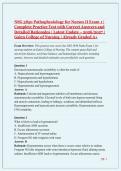
NSG 3850 Pathophysiology for Nurses II Exam 1 |
Complete Practice Test with Correct Answers and
Detailed Rationales | Latest Update – 2026/2027 |
Galen College of Nursing | Already Graded A+
Exam Overview: This practice test covers the NSG 3850 Patho Exam 1 for
nursing students at Galen College of Nursing. The content spans fluid and
electrolyte balance, acid-base balance, and hematologic disorders including
anemia. Answers and detailed rationales are provided for each question.
Question 1
Decreased neuromuscular excitability is often the result of:
A. Hypercalcemia and hypermagnesemia
B. Hypomagnesemia and hyperkalemia
C. Hypocalcemia and hypokalemia
D. Hypernatremia and hypomagnesemia
Answer: A
Rationale: Calcium and magnesium stabilize cell membranes and decrease
neuromuscular excitability. Elevated levels of both ions depress neuronal firing
and muscle contraction, leading to lethargy, weakness, and diminished reflexes.
Hypomagnesemia and hypocalcemia increase excitability. Hypernatremia causes
CNS irritability.
Question 2
What is likely to lead to hyponatremia?
A. Insufficient ADH secretion
B. Excess aldosterone secretion
C. Administration of IV normal saline
D. Frequent NG tube irrigation with water
Answer: D
Rationale: Hyponatremia occurs when there is excess water relative to sodium.
Frequent NG tube irrigation with water introduces hypotonic fluid, diluting serum
sodium. Insufficient ADH leads to hypernatremia. Excess aldosterone causes
pg. 1
,sodium retention. Normal saline contains sodium and would not cause
hyponatremia.
Question 3
An increase in the resting membrane potential (hyperpolarized) is associated with:
A. Hypokalemia
B. Hyperkalemia
C. Hypocalcemia
D. Hypercalcemia
Answer: A
Rationale: Potassium is the primary intracellular cation that establishes resting
membrane potential. Hypokalemia results in hyperpolarization, making it more
difficult to reach threshold for depolarization. This leads to muscle weakness,
fatigue, and cardiac arrhythmias. Hyperkalemia causes depolarization.
Question 4
Abnormalities in intracellular regulation of enzyme activity and cellular production
of ATP are associated with:
A. Hyponatremia
B. Hypocalcemia
C. Hypophosphatemia
D. Hypokalemia
Answer: C
Rationale: Phosphate is essential for ATP synthesis and enzyme function.
Hypophosphatemia leads to decreased ATP production, impairing cellular energy
metabolism. This affects multiple organ systems including muscle weakness,
cardiac dysfunction, and respiratory failure.
Question 5
The fraction of total body water (TBW) volume contained in the intracellular space
in adults is:
A. Three fourths
B. Two thirds
C. One half
D. One third
pg. 2
, Answer: B
Rationale: Approximately two-thirds of total body water is contained in the
intracellular space in adults. The remaining one-third is extracellular fluid.
Question 6
Clinical manifestations of severe symptomatic hypophosphatemia are caused by:
A. Excess proteins
B. Renal damage
C. Deficiency of ATP
D. Hypocalcemia
Answer: C
Rationale: Severe hypophosphatemia depletes ATP, impairing cellular energy
metabolism. This causes muscle weakness, cardiac dysfunction, and respiratory
failure. The manifestations are directly related to ATP deficiency.
Question 7
A person who overuses magnesium-aluminum antacids for a long period of time is
likely to develop:
A. Hypokalemia
B. Hyperkalemia
C. Hypophosphatemia
D. Hyperphosphatemia
Answer: C
Rationale: Magnesium-aluminum antacids bind phosphate in the gastrointestinal
tract, preventing absorption. Long-term overuse leads to hypophosphatemia. This
is a well-known complication of chronic antacid use.
Question 8
The electrolyte that has a higher concentration in the extracellular fluid than in the
intracellular fluid is _____ ions:
A. Sodium
B. Phosphate
C. Magnesium
D. Potassium
Answer: A
pg. 3
Complete Practice Test with Correct Answers and
Detailed Rationales | Latest Update – 2026/2027 |
Galen College of Nursing | Already Graded A+
Exam Overview: This practice test covers the NSG 3850 Patho Exam 1 for
nursing students at Galen College of Nursing. The content spans fluid and
electrolyte balance, acid-base balance, and hematologic disorders including
anemia. Answers and detailed rationales are provided for each question.
Question 1
Decreased neuromuscular excitability is often the result of:
A. Hypercalcemia and hypermagnesemia
B. Hypomagnesemia and hyperkalemia
C. Hypocalcemia and hypokalemia
D. Hypernatremia and hypomagnesemia
Answer: A
Rationale: Calcium and magnesium stabilize cell membranes and decrease
neuromuscular excitability. Elevated levels of both ions depress neuronal firing
and muscle contraction, leading to lethargy, weakness, and diminished reflexes.
Hypomagnesemia and hypocalcemia increase excitability. Hypernatremia causes
CNS irritability.
Question 2
What is likely to lead to hyponatremia?
A. Insufficient ADH secretion
B. Excess aldosterone secretion
C. Administration of IV normal saline
D. Frequent NG tube irrigation with water
Answer: D
Rationale: Hyponatremia occurs when there is excess water relative to sodium.
Frequent NG tube irrigation with water introduces hypotonic fluid, diluting serum
sodium. Insufficient ADH leads to hypernatremia. Excess aldosterone causes
pg. 1
,sodium retention. Normal saline contains sodium and would not cause
hyponatremia.
Question 3
An increase in the resting membrane potential (hyperpolarized) is associated with:
A. Hypokalemia
B. Hyperkalemia
C. Hypocalcemia
D. Hypercalcemia
Answer: A
Rationale: Potassium is the primary intracellular cation that establishes resting
membrane potential. Hypokalemia results in hyperpolarization, making it more
difficult to reach threshold for depolarization. This leads to muscle weakness,
fatigue, and cardiac arrhythmias. Hyperkalemia causes depolarization.
Question 4
Abnormalities in intracellular regulation of enzyme activity and cellular production
of ATP are associated with:
A. Hyponatremia
B. Hypocalcemia
C. Hypophosphatemia
D. Hypokalemia
Answer: C
Rationale: Phosphate is essential for ATP synthesis and enzyme function.
Hypophosphatemia leads to decreased ATP production, impairing cellular energy
metabolism. This affects multiple organ systems including muscle weakness,
cardiac dysfunction, and respiratory failure.
Question 5
The fraction of total body water (TBW) volume contained in the intracellular space
in adults is:
A. Three fourths
B. Two thirds
C. One half
D. One third
pg. 2
, Answer: B
Rationale: Approximately two-thirds of total body water is contained in the
intracellular space in adults. The remaining one-third is extracellular fluid.
Question 6
Clinical manifestations of severe symptomatic hypophosphatemia are caused by:
A. Excess proteins
B. Renal damage
C. Deficiency of ATP
D. Hypocalcemia
Answer: C
Rationale: Severe hypophosphatemia depletes ATP, impairing cellular energy
metabolism. This causes muscle weakness, cardiac dysfunction, and respiratory
failure. The manifestations are directly related to ATP deficiency.
Question 7
A person who overuses magnesium-aluminum antacids for a long period of time is
likely to develop:
A. Hypokalemia
B. Hyperkalemia
C. Hypophosphatemia
D. Hyperphosphatemia
Answer: C
Rationale: Magnesium-aluminum antacids bind phosphate in the gastrointestinal
tract, preventing absorption. Long-term overuse leads to hypophosphatemia. This
is a well-known complication of chronic antacid use.
Question 8
The electrolyte that has a higher concentration in the extracellular fluid than in the
intracellular fluid is _____ ions:
A. Sodium
B. Phosphate
C. Magnesium
D. Potassium
Answer: A
pg. 3