
NIGHTINGALE COLLEGE
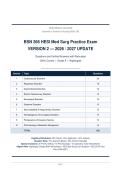
Bachelor of Science in Nursing (BSN) 266
BSN 266 HESI Med Surg Practice Exam
VERSION 2 — UPDATE
Questions and Verified Answers with Rationales
100% Correct | Grade A | Nightingale
Section Topic Questions
1 Cardiovascular Disorders 20
2 Respiratory Disorders 18
3 Gastrointestinal Disorders 15
4 Renal & Genitourinary Disorders 15
5 Neurological Disorders 15
6 Endocrine Disorders 15
7 Musculoskeletal & Integumentary Disorders 12
8 Hematological & Immunological Disorders 12
9 Perioperative & Emergency Nursing 15
10 Pharmacology & Medication Management 13
TOTAL 150
Cognitive Distribution: 20% Recall • 50% Application • 30% Analysis
Question Style: 75% Scenario-Based • 25% Direct Knowledge
Special Inclusions: 20 Priority-Setting • 15 Pharmacology • 10 Laboratory Value Interpretation
Aligned With: Nightingale College BSN 266 Syllabus • HESI Med Surg Exam Blueprint • NCLEX-RN Test
Plan (2026/2027)
Page 1
,BSN 266 HESI Med Surg Practice Exam V2 (2026/2027) Nightingale College | Grade A
Verified Answers • Detailed Rationales • NCLEX-RN Standards
Page 2
,BSN 266 HESI Med Surg Practice Exam V2 (2026/2027) Nightingale College | Grade A
Section 1: Cardiovascular Disorders
Q1: The nurse on a telemetry unit is receiving shift report on four clients. Which client should the
nurse assess FIRST?
A. A client with atrial fibrillation and a controlled ventricular rate of 88/min
B. A client with a transvenous pacemaker showing loss of capture on the monitor [CORRECT]
C. A client with occasional premature ventricular contractions at 4/min
D. A client with sinus tachycardia and a heart rate of 108/min after ambulating
Correct Answer: B
Rationale: Loss of pacemaker capture means the pacemaker fails to depolarize the ventricle, which can
rapidly progress to asystole and is an immediate life-threatening emergency requiring urgent assessment
and intervention. Atrial fibrillation with a controlled rate, occasional PVCs, and sinus tachycardia after
activity are expected or non-emergent findings that require monitoring but not first priority. This reflects the
NCLEX-RN priority-setting framework (ABCs and Maslow's) emphasized in the BSN 266 cardiovascular
module.
Q2: A client presents to the emergency department with chest pain. The cardiac troponin I level is
0.8 ng/mL. The nurse understands that this value indicates which finding?
A. A normal value with no cardiac injury
B. An early myocardial infarction requiring immediate intervention [CORRECT]
C. A false positive related to renal disease
D. A stable angina episode without muscle damage
Correct Answer: B
Rationale: Normal cardiac troponin I is less than 0.04 ng/mL; a level of 0.8 ng/mL is markedly elevated
and indicates myocardial cell necrosis consistent with acute myocardial infarction, requiring immediate
intervention per the HESI Med Surg cardiac ischemia pathway. Stable angina does not cause troponin
elevation because there is no necrosis. Renal disease may mildly elevate troponin but not to this degree,
and the clinical picture of chest pain confirms myocardial injury.
Q3: A client with heart failure has a new prescription for furosemide 40 mg IV push. Which
assessment finding is MOST important for the nurse to monitor after administration?
A. Serum sodium and calcium levels
B. Serum potassium and blood pressure [CORRECT]
C. Activated partial thromboplastin time and heart rate
D. Blood urea nitrogen and respiratory rate
Correct Answer: B
Rationale: Furosemide is a loop diuretic that causes significant potassium wasting and volume depletion;
therefore serum potassium and blood pressure must be monitored closely to detect hypokalemia and
hypotension, which increase risk for dysrhythmias and falls. Sodium is also affected but is less acutely
dangerous than potassium; calcium, aPTT, BUN, and respiratory rate are not the priority parameters for
loop diuretic therapy. Hypokalemia potentiates digoxin toxicity and cardiac dysrhythmias in heart failure
clients, aligning with NCLEX safety standards.
Page 3
, BSN 266 HESI Med Surg Practice Exam V2 (2026/2027) Nightingale College | Grade A
Q4: The nurse notes the ECG strip of a client with chest pain shows ST-segment elevation in leads
II, III, and aVF. The nurse recognizes this finding is consistent with which condition?
A. Anterior wall myocardial infarction
B. Inferior wall myocardial infarction [CORRECT]
C. Lateral wall myocardial infarction
D. Subendocardial ischemia without infarction
Correct Answer: B
Rationale: ST-segment elevation in leads II, III, and aVF indicates an inferior wall myocardial infarction,
supplied by the right coronary artery. Anterior wall MI shows elevation in V1-V4 (left anterior descending);
lateral wall MI shows elevation in I, aVL, V5-V6 (circumflex). Subendocardial ischemia typically produces
ST depression or T-wave inversion rather than elevation. Rapid ECG recognition is a HESI-critical
competency supporting door-to-balloon time goals.
Q5: A client with a history of angina is prescribed sublingual nitroglycerin tablets. Which client
statement indicates teaching has been effective?
A. I will swallow the tablet with a full glass of water at the first sign of chest pain
B. I will take one tablet every 5 minutes for up to three doses and call 911 if pain continues
[CORRECT]
C. I should store the tablets in a warm, brightly lit location for easy access
D. I can take nitroglycerin safely while using my sildenafil for erectile dysfunction
Correct Answer: B
Rationale: Sublingual nitroglycerin is taken every 5 minutes for up to three doses; if chest pain is not
relieved, the client must call 911 because ongoing pain suggests myocardial infarction. The tablet must be
dissolved under the tongue, not swallowed, for rapid absorption. Nitroglycerin must be stored in a dark,
cool, dry container because light degrades it, and it is contraindicated with sildenafil due to life-threatening
hypotension. These points are reinforced in the BSN 266 cardiovascular pharmacology unit.
Q6: A client is admitted with a deep vein thrombosis (DVT) in the left leg. The nurse identifies leg
pain and swelling. Which nursing intervention is MOST appropriate?
A. Apply a heating pad to the left leg to relieve discomfort
B. Elevate the affected leg and administer prescribed anticoagulant therapy [CORRECT]
C. Gently massage the calf to promote venous return
D. Encourage the client to ambulate frequently to prevent pooling
Correct Answer: B
Rationale: Elevation reduces edema and pain, and prescribed anticoagulants (such as heparin or
enoxaparin) prevent clot propagation and embolization. Heat, massage, and ambulation are
contraindicated because they can dislodge the thrombus and cause a pulmonary embolism. The BSN 266
venous disorder protocol and NCLEX-RN safety standards require strict avoidance of massage and abrupt
movement in any client with confirmed DVT.
Page 4
Bachelor of Science in Nursing (BSN) 266
BSN 266 HESI Med Surg Practice Exam
VERSION 2 — UPDATE
Questions and Verified Answers with Rationales
100% Correct | Grade A | Nightingale
Section Topic Questions
1 Cardiovascular Disorders 20
2 Respiratory Disorders 18
3 Gastrointestinal Disorders 15
4 Renal & Genitourinary Disorders 15
5 Neurological Disorders 15
6 Endocrine Disorders 15
7 Musculoskeletal & Integumentary Disorders 12
8 Hematological & Immunological Disorders 12
9 Perioperative & Emergency Nursing 15
10 Pharmacology & Medication Management 13
TOTAL 150
Cognitive Distribution: 20% Recall • 50% Application • 30% Analysis
Question Style: 75% Scenario-Based • 25% Direct Knowledge
Special Inclusions: 20 Priority-Setting • 15 Pharmacology • 10 Laboratory Value Interpretation
Aligned With: Nightingale College BSN 266 Syllabus • HESI Med Surg Exam Blueprint • NCLEX-RN Test
Plan (2026/2027)
Page 1
,BSN 266 HESI Med Surg Practice Exam V2 (2026/2027) Nightingale College | Grade A
Verified Answers • Detailed Rationales • NCLEX-RN Standards
Page 2
,BSN 266 HESI Med Surg Practice Exam V2 (2026/2027) Nightingale College | Grade A
Section 1: Cardiovascular Disorders
Q1: The nurse on a telemetry unit is receiving shift report on four clients. Which client should the
nurse assess FIRST?
A. A client with atrial fibrillation and a controlled ventricular rate of 88/min
B. A client with a transvenous pacemaker showing loss of capture on the monitor [CORRECT]
C. A client with occasional premature ventricular contractions at 4/min
D. A client with sinus tachycardia and a heart rate of 108/min after ambulating
Correct Answer: B
Rationale: Loss of pacemaker capture means the pacemaker fails to depolarize the ventricle, which can
rapidly progress to asystole and is an immediate life-threatening emergency requiring urgent assessment
and intervention. Atrial fibrillation with a controlled rate, occasional PVCs, and sinus tachycardia after
activity are expected or non-emergent findings that require monitoring but not first priority. This reflects the
NCLEX-RN priority-setting framework (ABCs and Maslow's) emphasized in the BSN 266 cardiovascular
module.
Q2: A client presents to the emergency department with chest pain. The cardiac troponin I level is
0.8 ng/mL. The nurse understands that this value indicates which finding?
A. A normal value with no cardiac injury
B. An early myocardial infarction requiring immediate intervention [CORRECT]
C. A false positive related to renal disease
D. A stable angina episode without muscle damage
Correct Answer: B
Rationale: Normal cardiac troponin I is less than 0.04 ng/mL; a level of 0.8 ng/mL is markedly elevated
and indicates myocardial cell necrosis consistent with acute myocardial infarction, requiring immediate
intervention per the HESI Med Surg cardiac ischemia pathway. Stable angina does not cause troponin
elevation because there is no necrosis. Renal disease may mildly elevate troponin but not to this degree,
and the clinical picture of chest pain confirms myocardial injury.
Q3: A client with heart failure has a new prescription for furosemide 40 mg IV push. Which
assessment finding is MOST important for the nurse to monitor after administration?
A. Serum sodium and calcium levels
B. Serum potassium and blood pressure [CORRECT]
C. Activated partial thromboplastin time and heart rate
D. Blood urea nitrogen and respiratory rate
Correct Answer: B
Rationale: Furosemide is a loop diuretic that causes significant potassium wasting and volume depletion;
therefore serum potassium and blood pressure must be monitored closely to detect hypokalemia and
hypotension, which increase risk for dysrhythmias and falls. Sodium is also affected but is less acutely
dangerous than potassium; calcium, aPTT, BUN, and respiratory rate are not the priority parameters for
loop diuretic therapy. Hypokalemia potentiates digoxin toxicity and cardiac dysrhythmias in heart failure
clients, aligning with NCLEX safety standards.
Page 3
, BSN 266 HESI Med Surg Practice Exam V2 (2026/2027) Nightingale College | Grade A
Q4: The nurse notes the ECG strip of a client with chest pain shows ST-segment elevation in leads
II, III, and aVF. The nurse recognizes this finding is consistent with which condition?
A. Anterior wall myocardial infarction
B. Inferior wall myocardial infarction [CORRECT]
C. Lateral wall myocardial infarction
D. Subendocardial ischemia without infarction
Correct Answer: B
Rationale: ST-segment elevation in leads II, III, and aVF indicates an inferior wall myocardial infarction,
supplied by the right coronary artery. Anterior wall MI shows elevation in V1-V4 (left anterior descending);
lateral wall MI shows elevation in I, aVL, V5-V6 (circumflex). Subendocardial ischemia typically produces
ST depression or T-wave inversion rather than elevation. Rapid ECG recognition is a HESI-critical
competency supporting door-to-balloon time goals.
Q5: A client with a history of angina is prescribed sublingual nitroglycerin tablets. Which client
statement indicates teaching has been effective?
A. I will swallow the tablet with a full glass of water at the first sign of chest pain
B. I will take one tablet every 5 minutes for up to three doses and call 911 if pain continues
[CORRECT]
C. I should store the tablets in a warm, brightly lit location for easy access
D. I can take nitroglycerin safely while using my sildenafil for erectile dysfunction
Correct Answer: B
Rationale: Sublingual nitroglycerin is taken every 5 minutes for up to three doses; if chest pain is not
relieved, the client must call 911 because ongoing pain suggests myocardial infarction. The tablet must be
dissolved under the tongue, not swallowed, for rapid absorption. Nitroglycerin must be stored in a dark,
cool, dry container because light degrades it, and it is contraindicated with sildenafil due to life-threatening
hypotension. These points are reinforced in the BSN 266 cardiovascular pharmacology unit.
Q6: A client is admitted with a deep vein thrombosis (DVT) in the left leg. The nurse identifies leg
pain and swelling. Which nursing intervention is MOST appropriate?
A. Apply a heating pad to the left leg to relieve discomfort
B. Elevate the affected leg and administer prescribed anticoagulant therapy [CORRECT]
C. Gently massage the calf to promote venous return
D. Encourage the client to ambulate frequently to prevent pooling
Correct Answer: B
Rationale: Elevation reduces edema and pain, and prescribed anticoagulants (such as heparin or
enoxaparin) prevent clot propagation and embolization. Heat, massage, and ambulation are
contraindicated because they can dislodge the thrombus and cause a pulmonary embolism. The BSN 266
venous disorder protocol and NCLEX-RN safety standards require strict avoidance of massage and abrupt
movement in any client with confirmed DVT.
Page 4

