
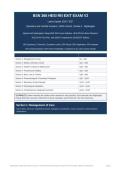
BSN 366 HESI RN EXIT EXAM V2
Latest Update
Questions and Verified Answers | 100% Correct | Grade A - Nightingale
Aligned with Nightingale College BSN 366 Course Syllabus, HESI RN Exit Exam Blueprint,
NCLEX-RN Test Plan, and QSEN Competencies (2026/2027 Edition)
150 Questions | 9 Sections | Cognitive Levels: 20% Recall, 50% Application, 30% Analysis
75% Scenario-Based | 25% Direct Knowledge | 4 Options (A-D), One Correct Answer
Section Question Range
Section 1: Management of Care Q1 - Q20
Section 2: Safety & Infection Control Q21 - Q35
Section 3: Health Promotion & Maintenance Q36 - Q50
Section 4: Psychosocial Integrity Q51 - Q65
Section 5: Basic Care & Comfort Q66 - Q80
Section 6: Pharmacological & Parenteral Therapies Q81 - Q100
Section 7: Reduction of Risk Potential Q101 - Q120
Section 8: Physiological Adaptation Q121 - Q140
Section 9: Comprehensive Integrated Scenarios Q141 - Q150
*[CORRECT]* marker indicates the verified correct answer for each question. Each rationale cites Nightingale
College BSN 366 curriculum, HESI RN Exit Exam standards, and NCLEX-RN Test Plan references.
Section 1: Management of Care
Client rights, advocacy, legal/ethical issues, delegation, prioritization, scope of practice, interdisciplinary
collaboration
Nightingale College BSN 366 Curriculum | HESI RN Exit Exam Blueprint | NCLEX-RN Test Plan | QSEN Competencies Page 1
,BSN 366 HESI RN Exit Exam V2 (2026/2027) | Grade A - Nightingale Page 2
*Q1:* A nurse on a medical-surgical unit is assigned to four clients at the beginning of the shift. Using the ABC
priority-setting framework, which client should the nurse assess first?
A. A client who is postoperative day 1 from an appendectomy requesting pain medication for a pain level of 6/10
B. A client with chronic obstructive pulmonary disease (COPD) whose pulse oximetry dropped from 94% to
88% over the past two hours *[CORRECT]*
C. A client with type 2 diabetes mellitus scheduled for a morning fasting blood glucose measurement
D. A client with heart failure reporting 1+ pitting edema in the bilateral ankles
Correct Answer: B
Rationale:
Using the ABC (Airway, Breathing, Circulation) priority framework, the client with COPD whose oxygen
saturation has dropped to 88% is experiencing respiratory compromise and requires immediate assessment.
Hypoxemia can rapidly progress to respiratory failure. The Nightingale College BSN 366 curriculum and
NCLEX-RN Test Plan emphasize that actual or potential threats to airway and breathing always supersede other
needs. Pain management (postoperative client), routine glucose testing (diabetic client), and chronic ankle edema
(heart failure) are important but not immediately life-threatening. The nurse should reassess the COPD client's
oxygenation status, elevate the head of the bed, and notify the provider.
*Q2:* A registered nurse (RN) is caring for five clients and is planning to delegate tasks to a licensed practical
nurse (LPN) and an unlicensed assistive personnel (UAP). Which of the following tasks is most appropriate to
delegate to the LPN?
A. Ambulating a stable client who is postoperative day 2 from a total knee replacement
B. Reinforcing teaching about a newly prescribed low-sodium diet for a client with heart failure *[CORRECT]*
C. Administering an IV push medication of morphine 4 mg to a client with acute pain
D. Performing the initial admission assessment for a newly admitted client with pneumonia
Correct Answer: B
Rationale:
The LPN scope of practice includes reinforcing teaching that has already been initiated by the RN, caring for
stable clients with predictable outcomes, and administering medications via oral, subcutaneous, intramuscular,
and (in most states) basic IV piggyback routes. Reinforcing dietary teaching is within the LPN's scope.
Ambulating a stable postoperative client is appropriate for the UAP. Administering IV push morphine is beyond
the LPN scope in most states and requires RN assessment of respiratory status. Initial admission assessments
must always be performed by the RN because they require comprehensive data collection and clinical judgment,
as mandated by the Nurse Practice Act and emphasized in the BSN 366 delegation module.
Nightingale College BSN 366 Curriculum | HESI RN Exit Exam Blueprint | NCLEX-RN Test Plan | QSEN Competencies Page 2
,BSN 366 HESI RN Exit Exam V2 (2026/2027) | Grade A - Nightingale Page 3
*Q3:* A 78-year-old client with advanced dementia is admitted with dehydration. The client's daughter
presents a durable power of attorney for health care and requests that no aggressive treatments be initiated.
Which action by the nurse is most appropriate?
A. Initiate intravenous fluids immediately because the client is dehydrated
B. Verify the document with the facility's legal department and the provider before implementing any directives
*[CORRECT]*
C. Refuse to follow the directive because the client did not sign it personally
D. Document the daughter's request and proceed with all life-sustaining measures until the provider arrives
Correct Answer: B
Rationale:
A durable power of attorney for health care (DPOA-HC) is a legal document that authorizes a surrogate to make
health care decisions when the client is unable to do so. The nurse's priority is to verify the document's validity
with the legal department and the provider before implementing or withholding treatment, ensuring compliance
with the Patient Self-Determination Act and HIPAA. The BSN 366 curriculum stresses that advance directives
must be honored once verified, but verification must precede implementation. Initiating aggressive treatment
against the documented wishes violates client autonomy, while refusing to acknowledge the document violates
federal law.
*Q4:* A client scheduled for an elective cholecystectomy tells the preoperative nurse, "I'm not sure I want to do
this surgery. My sister had complications and I'm scared." Which response by the nurse demonstrates the
principle of informed consent?
A. "Don't worry, this is a very common surgery and complications are rare."
B. "You have the right to refuse the surgery at any time. Would you like to speak with the surgeon about your
concerns?" *[CORRECT]*
C. "I'll give you a mild sedative to help you relax before the procedure."
D. "The surgery is already scheduled, so we should proceed as planned."
Correct Answer: B
Rationale:
Informed consent requires that the client understands the procedure, its risks, benefits, and alternatives, and
consents voluntarily without coercion. The client expressing uncertainty indicates the consent may not be fully
informed. The nurse's role is to advocate for the client by notifying the provider, who must clarify any questions
before consent is valid. The BSN 366 curriculum emphasizes that the nurse witnesses the consent but does not
obtain it; the provider is responsible for explaining the procedure. Providing false reassurance, sedating the
client, or pressuring them to proceed violates the ethical principles of autonomy and veracity.
Nightingale College BSN 366 Curriculum | HESI RN Exit Exam Blueprint | NCLEX-RN Test Plan | QSEN Competencies Page 3
, BSN 366 HESI RN Exit Exam V2 (2026/2027) | Grade A - Nightingale Page 4
*Q5:* A nurse manager is investigating a medication error in which a client received twice the ordered dose of
insulin. The nurse involved completed an incident report. Which statement by the nurse manager best reflects
the purpose of the incident report?
A. "This report will be used to discipline you for the medication error."
B. "This report will be placed in your personnel file and used for performance evaluation."
C. "This report will help us identify system issues and prevent similar errors in the future." *[CORRECT]*
D. "This report will be sent to the state board of nursing for investigation."
Correct Answer: C
Rationale:
Incident reports are quality improvement documents used to identify system vulnerabilities, trends, and
opportunities for improvement, not punitive tools. The BSN 366 curriculum and QSEN competency for Safety
emphasize a just culture approach that distinguishes human error from at-risk behavior and reckless conduct.
Incident reports should not be placed in personnel files or used as disciplinary evidence. They are internal
documents and are not automatically sent to the state board of nursing. The goal is system improvement through
root cause analysis to prevent future sentinel events.
*Q6:* During change-of-shift report, a nurse uses the SBAR communication tool to hand off care. Which
statement by the nurse demonstrates the "Recommendation" component of SBAR?
A. "The client's blood pressure has been trending upward all shift, currently 168/94 mmHg."
B. "The client is a 68-year-old male admitted for heart failure exacerbation."
C. "I recommend you assess the client's blood pressure in one hour and notify the provider if it remains above
160/90 mmHg." *[CORRECT]*
D. "The client has a history of hypertension, type 2 diabetes, and a previous MI in 2019."
Correct Answer: C
Rationale:
SBAR stands for Situation, Background, Assessment, Recommendation. The Recommendation component
specifies the action requested of the receiver, such as continued monitoring, provider notification, or specific
interventions. Option C clearly states a recommendation with parameters. Option A is Assessment, Option B is
Situation, and Option D is Background. The BSN 366 curriculum and QSEN Teamwork and Collaboration
competency emphasize SBAR as a structured communication method that reduces errors during handoffs and
promotes patient safety through clear, concise information transfer.
Nightingale College BSN 366 Curriculum | HESI RN Exit Exam Blueprint | NCLEX-RN Test Plan | QSEN Competencies Page 4
Latest Update
Questions and Verified Answers | 100% Correct | Grade A - Nightingale
Aligned with Nightingale College BSN 366 Course Syllabus, HESI RN Exit Exam Blueprint,
NCLEX-RN Test Plan, and QSEN Competencies (2026/2027 Edition)
150 Questions | 9 Sections | Cognitive Levels: 20% Recall, 50% Application, 30% Analysis
75% Scenario-Based | 25% Direct Knowledge | 4 Options (A-D), One Correct Answer
Section Question Range
Section 1: Management of Care Q1 - Q20
Section 2: Safety & Infection Control Q21 - Q35
Section 3: Health Promotion & Maintenance Q36 - Q50
Section 4: Psychosocial Integrity Q51 - Q65
Section 5: Basic Care & Comfort Q66 - Q80
Section 6: Pharmacological & Parenteral Therapies Q81 - Q100
Section 7: Reduction of Risk Potential Q101 - Q120
Section 8: Physiological Adaptation Q121 - Q140
Section 9: Comprehensive Integrated Scenarios Q141 - Q150
*[CORRECT]* marker indicates the verified correct answer for each question. Each rationale cites Nightingale
College BSN 366 curriculum, HESI RN Exit Exam standards, and NCLEX-RN Test Plan references.
Section 1: Management of Care
Client rights, advocacy, legal/ethical issues, delegation, prioritization, scope of practice, interdisciplinary
collaboration
Nightingale College BSN 366 Curriculum | HESI RN Exit Exam Blueprint | NCLEX-RN Test Plan | QSEN Competencies Page 1
,BSN 366 HESI RN Exit Exam V2 (2026/2027) | Grade A - Nightingale Page 2
*Q1:* A nurse on a medical-surgical unit is assigned to four clients at the beginning of the shift. Using the ABC
priority-setting framework, which client should the nurse assess first?
A. A client who is postoperative day 1 from an appendectomy requesting pain medication for a pain level of 6/10
B. A client with chronic obstructive pulmonary disease (COPD) whose pulse oximetry dropped from 94% to
88% over the past two hours *[CORRECT]*
C. A client with type 2 diabetes mellitus scheduled for a morning fasting blood glucose measurement
D. A client with heart failure reporting 1+ pitting edema in the bilateral ankles
Correct Answer: B
Rationale:
Using the ABC (Airway, Breathing, Circulation) priority framework, the client with COPD whose oxygen
saturation has dropped to 88% is experiencing respiratory compromise and requires immediate assessment.
Hypoxemia can rapidly progress to respiratory failure. The Nightingale College BSN 366 curriculum and
NCLEX-RN Test Plan emphasize that actual or potential threats to airway and breathing always supersede other
needs. Pain management (postoperative client), routine glucose testing (diabetic client), and chronic ankle edema
(heart failure) are important but not immediately life-threatening. The nurse should reassess the COPD client's
oxygenation status, elevate the head of the bed, and notify the provider.
*Q2:* A registered nurse (RN) is caring for five clients and is planning to delegate tasks to a licensed practical
nurse (LPN) and an unlicensed assistive personnel (UAP). Which of the following tasks is most appropriate to
delegate to the LPN?
A. Ambulating a stable client who is postoperative day 2 from a total knee replacement
B. Reinforcing teaching about a newly prescribed low-sodium diet for a client with heart failure *[CORRECT]*
C. Administering an IV push medication of morphine 4 mg to a client with acute pain
D. Performing the initial admission assessment for a newly admitted client with pneumonia
Correct Answer: B
Rationale:
The LPN scope of practice includes reinforcing teaching that has already been initiated by the RN, caring for
stable clients with predictable outcomes, and administering medications via oral, subcutaneous, intramuscular,
and (in most states) basic IV piggyback routes. Reinforcing dietary teaching is within the LPN's scope.
Ambulating a stable postoperative client is appropriate for the UAP. Administering IV push morphine is beyond
the LPN scope in most states and requires RN assessment of respiratory status. Initial admission assessments
must always be performed by the RN because they require comprehensive data collection and clinical judgment,
as mandated by the Nurse Practice Act and emphasized in the BSN 366 delegation module.
Nightingale College BSN 366 Curriculum | HESI RN Exit Exam Blueprint | NCLEX-RN Test Plan | QSEN Competencies Page 2
,BSN 366 HESI RN Exit Exam V2 (2026/2027) | Grade A - Nightingale Page 3
*Q3:* A 78-year-old client with advanced dementia is admitted with dehydration. The client's daughter
presents a durable power of attorney for health care and requests that no aggressive treatments be initiated.
Which action by the nurse is most appropriate?
A. Initiate intravenous fluids immediately because the client is dehydrated
B. Verify the document with the facility's legal department and the provider before implementing any directives
*[CORRECT]*
C. Refuse to follow the directive because the client did not sign it personally
D. Document the daughter's request and proceed with all life-sustaining measures until the provider arrives
Correct Answer: B
Rationale:
A durable power of attorney for health care (DPOA-HC) is a legal document that authorizes a surrogate to make
health care decisions when the client is unable to do so. The nurse's priority is to verify the document's validity
with the legal department and the provider before implementing or withholding treatment, ensuring compliance
with the Patient Self-Determination Act and HIPAA. The BSN 366 curriculum stresses that advance directives
must be honored once verified, but verification must precede implementation. Initiating aggressive treatment
against the documented wishes violates client autonomy, while refusing to acknowledge the document violates
federal law.
*Q4:* A client scheduled for an elective cholecystectomy tells the preoperative nurse, "I'm not sure I want to do
this surgery. My sister had complications and I'm scared." Which response by the nurse demonstrates the
principle of informed consent?
A. "Don't worry, this is a very common surgery and complications are rare."
B. "You have the right to refuse the surgery at any time. Would you like to speak with the surgeon about your
concerns?" *[CORRECT]*
C. "I'll give you a mild sedative to help you relax before the procedure."
D. "The surgery is already scheduled, so we should proceed as planned."
Correct Answer: B
Rationale:
Informed consent requires that the client understands the procedure, its risks, benefits, and alternatives, and
consents voluntarily without coercion. The client expressing uncertainty indicates the consent may not be fully
informed. The nurse's role is to advocate for the client by notifying the provider, who must clarify any questions
before consent is valid. The BSN 366 curriculum emphasizes that the nurse witnesses the consent but does not
obtain it; the provider is responsible for explaining the procedure. Providing false reassurance, sedating the
client, or pressuring them to proceed violates the ethical principles of autonomy and veracity.
Nightingale College BSN 366 Curriculum | HESI RN Exit Exam Blueprint | NCLEX-RN Test Plan | QSEN Competencies Page 3
, BSN 366 HESI RN Exit Exam V2 (2026/2027) | Grade A - Nightingale Page 4
*Q5:* A nurse manager is investigating a medication error in which a client received twice the ordered dose of
insulin. The nurse involved completed an incident report. Which statement by the nurse manager best reflects
the purpose of the incident report?
A. "This report will be used to discipline you for the medication error."
B. "This report will be placed in your personnel file and used for performance evaluation."
C. "This report will help us identify system issues and prevent similar errors in the future." *[CORRECT]*
D. "This report will be sent to the state board of nursing for investigation."
Correct Answer: C
Rationale:
Incident reports are quality improvement documents used to identify system vulnerabilities, trends, and
opportunities for improvement, not punitive tools. The BSN 366 curriculum and QSEN competency for Safety
emphasize a just culture approach that distinguishes human error from at-risk behavior and reckless conduct.
Incident reports should not be placed in personnel files or used as disciplinary evidence. They are internal
documents and are not automatically sent to the state board of nursing. The goal is system improvement through
root cause analysis to prevent future sentinel events.
*Q6:* During change-of-shift report, a nurse uses the SBAR communication tool to hand off care. Which
statement by the nurse demonstrates the "Recommendation" component of SBAR?
A. "The client's blood pressure has been trending upward all shift, currently 168/94 mmHg."
B. "The client is a 68-year-old male admitted for heart failure exacerbation."
C. "I recommend you assess the client's blood pressure in one hour and notify the provider if it remains above
160/90 mmHg." *[CORRECT]*
D. "The client has a history of hypertension, type 2 diabetes, and a previous MI in 2019."
Correct Answer: C
Rationale:
SBAR stands for Situation, Background, Assessment, Recommendation. The Recommendation component
specifies the action requested of the receiver, such as continued monitoring, provider notification, or specific
interventions. Option C clearly states a recommendation with parameters. Option A is Assessment, Option B is
Situation, and Option D is Background. The BSN 366 curriculum and QSEN Teamwork and Collaboration
competency emphasize SBAR as a structured communication method that reduces errors during handoffs and
promotes patient safety through clear, concise information transfer.
Nightingale College BSN 366 Curriculum | HESI RN Exit Exam Blueprint | NCLEX-RN Test Plan | QSEN Competencies Page 4

