
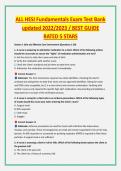
ALL HESI Fundamentals Exam Test Bank
updated 2022/2023 / BEST GUIDE
RATED 5 STARS
Section I: Safe and Effective Care Environment (Questions 1-30)
1. A nurse is preparing to administer medication to a client. Which of the following actions
should the nurse take to ensure the "rights" of medication administration are met?
A. Ask the client to state their name and date of birth.
B. Verify the medication with another nurse.
C. Check the client's armband and ask them to state their name.
D. Administer the medication and document it immediately.
Correct Answer: C
Rationale: The Joint Commission requires two client identifiers. Checking the client's
armband and asking them to state their name are two approved identifiers. Asking for name
and DOB is also acceptable, but C is a more direct and common combination. Verifying with
another nurse is only required for specific high-alert medications. Documenting immediately is
important but is not part of the verification process.
2. A nurse is caring for a client who is on airborne precautions. Which of the following types
of masks should the nurse wear when entering the client's room?
A. Surgical mask
B. N95 respirator
C. Cloth mask
D. Goggles
Correct Answer: B
Rationale: Airborne precautions are used for clients with infections like tuberculosis,
measles, and varicella. These microorganisms are small and remain suspended in the air for long
periods. An N95 respirator or a powered air-purifying respirator (PAPR) is required to filter these
particles. A surgical mask is not sufficient.
3. A nurse is assessing a client's risk for falls. Which of the following factors places the client at
the greatest risk?
A. The client is 65 years old.
B. The client has a history of a previous fall.
,C. The client is taking a diuretic.
D. The client uses a cane for ambulation.
Correct Answer: B
Rationale: A history of a previous fall is the single most significant predictor of future falls.
While age, medication (especially diuretics which can cause urgency and hypotension), and
mobility aids are all risk factors, a previous fall is the strongest indicator.
4. A nurse is preparing to perform a sterile procedure. Which of the following actions
indicates a break in sterile technique?
A. The nurse holds sterile instruments above the waist.
B. The nurse's sterile gloves touch the sterile drape.
C. The nurse turns their back to the sterile field.
D. The nurse opens a sterile package by pulling the corner back and away.
Correct Answer: C
Rationale: The nurse should never turn their back to a sterile field, as they cannot see if it
has become contaminated. The sterile field must be kept in constant view. Holding items above
the waist, touching sterile-to-sterile items, and opening packages correctly are all appropriate
actions.
5. A nurse is delegating tasks to a nursing assistant (UAP). Which of the following tasks is
appropriate for the nurse to delegate?
A. Administering a scheduled oral medication.
B. Assessing a client's newly reported chest pain.
C. Ambulating a stable client who had surgery two days ago.
D. Teaching a client how to change their wound dressing.
Correct Answer: C
Rationale: The nurse can delegate tasks to a UAP that are routine, do not require nursing
judgment, and have a predictable outcome. Ambulating a stable client is an appropriate task to
delegate. Medication administration, assessment, and teaching are all part of the nursing
process and cannot be delegated to a UAP.
6. A nurse is caring for a client who has a new prescription for restraints. Which of the
following actions should the nurse take?
A. Apply the restraints tightly to ensure they are secure.
B. Remove the restraints every 4 hours to assess the client.
C. Tie the restraints to the side rails of the bed.
D. Obtain a new prescription every 24 hours.
, Correct Answer: B
Rationale: Restraints must be removed and the client assessed every 2 hours (for
violent/self-destructive behavior) or every 4 hours (for non-violent behavior). They should be
applied snugly but not tightly, allowing for two fingers to fit underneath. They should be tied to
a part of the bed frame, not the side rails, which can move and cause injury. Prescriptions for
restraints are time-limited and must be renewed according to facility policy and law (e.g., every
4 hours for adults, every 2 hours for adolescents, every 1 hour for children under 9).
7. A client is diagnosed with Clostridioides difficile. Which of the following actions should the
nurse implement?
A. Place the client in a negative-pressure room.
B. Wear a surgical mask when providing care.
C. Use an alcohol-based hand rub after removing gloves.
D. Wear a gown and gloves when entering the room.
Correct Answer: D
Rationale: C. difficile requires contact precautions. This means wearing a gown and gloves
for all contact with the client and their environment. A negative-pressure room is for airborne
precautions. A surgical mask is not required for contact precautions. Alcohol-based hand rubs
are not effective against C. diff spores; soap and water must be used.
8. A nurse is reviewing a client's laboratory values and notes a potassium level of 2.8 mEq/L.
Which of the following findings should the nurse expect?
A. Peaked T waves on the ECG.
B. Muscle weakness and fatigue.
C. Increased deep tendon reflexes.
D. Constipation.
Correct Answer: B
Rationale: A potassium level of 2.8 mEq/L indicates hypokalemia (normal range is 3.5-5.0
mEq/L). Manifestations of hypokalemia include muscle weakness, fatigue, leg cramps,
constipation, and decreased reflexes. Peaked T waves are a sign of hyperkalemia.
9. A nurse is preparing to administer a blood transfusion. Which of the following solutions
should the nurse use to prime the IV tubing?
A. Lactated Ringer's
B. 5% Dextrose in Water (D5W)
C. 0.9% Sodium Chloride
D. Sterile Water
, Correct Answer: C
Rationale: Only 0.9% Sodium Chloride (normal saline) is compatible with blood products
and should be used to prime the tubing and to flush the line. Solutions containing calcium (like
Lactated Ringer's) can cause clotting, and dextrose can cause hemolysis of the red blood cells.
10. A nurse is teaching a client about fire safety. Which of the following actions should the
nurse take first if a fire is discovered in a client's room?
A. Activate the fire alarm.
B. Extinguish the fire.
C. Rescue the client.
D. Contain the fire by closing the door.
Correct Answer: C
Rationale: The acronym for fire safety is R.A.C.E.: Rescue, Alarm, Contain, Extinguish. The
first priority is to remove the client from immediate danger (Rescue).
11. A nurse is caring for a client who is receiving enteral feedings. To prevent aspiration, the
nurse should:
A. Position the client supine.
B. Keep the head of the bed elevated at 30-45 degrees.
C. Administer the feeding rapidly.
D. Check residual volume every 8 hours.
Correct Answer: B
Rationale: Keeping the head of the bed elevated at 30 to 45 degrees (semi-Fowler's to
Fowler's position) uses gravity to help keep the formula in the stomach and prevent reflux and
aspiration. The client should not be supine. Feedings should be administered at the prescribed
rate, not rapidly. Checking residual volume is done according to policy, but positioning is the
most critical preventative measure.
12. A nurse is preparing to insert a nasogastric (NG) tube. Which of the following actions
should the nurse take to verify the initial placement of the tube?
A. Auscultate for a "whooshing" sound while injecting air.
B. Place the end of the tube in water to check for bubbles.
C. Measure the pH of the aspirated gastric contents.
D. Ask the client to hum and listen for a sound.
Correct Answer: C
Rationale: Measuring the pH of aspirated fluid is the most reliable bedside method for
verifying initial NG tube placement. Gastric fluid is typically acidic (pH < 5.5). The auscultation
updated 2022/2023 / BEST GUIDE
RATED 5 STARS
Section I: Safe and Effective Care Environment (Questions 1-30)
1. A nurse is preparing to administer medication to a client. Which of the following actions
should the nurse take to ensure the "rights" of medication administration are met?
A. Ask the client to state their name and date of birth.
B. Verify the medication with another nurse.
C. Check the client's armband and ask them to state their name.
D. Administer the medication and document it immediately.
Correct Answer: C
Rationale: The Joint Commission requires two client identifiers. Checking the client's
armband and asking them to state their name are two approved identifiers. Asking for name
and DOB is also acceptable, but C is a more direct and common combination. Verifying with
another nurse is only required for specific high-alert medications. Documenting immediately is
important but is not part of the verification process.
2. A nurse is caring for a client who is on airborne precautions. Which of the following types
of masks should the nurse wear when entering the client's room?
A. Surgical mask
B. N95 respirator
C. Cloth mask
D. Goggles
Correct Answer: B
Rationale: Airborne precautions are used for clients with infections like tuberculosis,
measles, and varicella. These microorganisms are small and remain suspended in the air for long
periods. An N95 respirator or a powered air-purifying respirator (PAPR) is required to filter these
particles. A surgical mask is not sufficient.
3. A nurse is assessing a client's risk for falls. Which of the following factors places the client at
the greatest risk?
A. The client is 65 years old.
B. The client has a history of a previous fall.
,C. The client is taking a diuretic.
D. The client uses a cane for ambulation.
Correct Answer: B
Rationale: A history of a previous fall is the single most significant predictor of future falls.
While age, medication (especially diuretics which can cause urgency and hypotension), and
mobility aids are all risk factors, a previous fall is the strongest indicator.
4. A nurse is preparing to perform a sterile procedure. Which of the following actions
indicates a break in sterile technique?
A. The nurse holds sterile instruments above the waist.
B. The nurse's sterile gloves touch the sterile drape.
C. The nurse turns their back to the sterile field.
D. The nurse opens a sterile package by pulling the corner back and away.
Correct Answer: C
Rationale: The nurse should never turn their back to a sterile field, as they cannot see if it
has become contaminated. The sterile field must be kept in constant view. Holding items above
the waist, touching sterile-to-sterile items, and opening packages correctly are all appropriate
actions.
5. A nurse is delegating tasks to a nursing assistant (UAP). Which of the following tasks is
appropriate for the nurse to delegate?
A. Administering a scheduled oral medication.
B. Assessing a client's newly reported chest pain.
C. Ambulating a stable client who had surgery two days ago.
D. Teaching a client how to change their wound dressing.
Correct Answer: C
Rationale: The nurse can delegate tasks to a UAP that are routine, do not require nursing
judgment, and have a predictable outcome. Ambulating a stable client is an appropriate task to
delegate. Medication administration, assessment, and teaching are all part of the nursing
process and cannot be delegated to a UAP.
6. A nurse is caring for a client who has a new prescription for restraints. Which of the
following actions should the nurse take?
A. Apply the restraints tightly to ensure they are secure.
B. Remove the restraints every 4 hours to assess the client.
C. Tie the restraints to the side rails of the bed.
D. Obtain a new prescription every 24 hours.
, Correct Answer: B
Rationale: Restraints must be removed and the client assessed every 2 hours (for
violent/self-destructive behavior) or every 4 hours (for non-violent behavior). They should be
applied snugly but not tightly, allowing for two fingers to fit underneath. They should be tied to
a part of the bed frame, not the side rails, which can move and cause injury. Prescriptions for
restraints are time-limited and must be renewed according to facility policy and law (e.g., every
4 hours for adults, every 2 hours for adolescents, every 1 hour for children under 9).
7. A client is diagnosed with Clostridioides difficile. Which of the following actions should the
nurse implement?
A. Place the client in a negative-pressure room.
B. Wear a surgical mask when providing care.
C. Use an alcohol-based hand rub after removing gloves.
D. Wear a gown and gloves when entering the room.
Correct Answer: D
Rationale: C. difficile requires contact precautions. This means wearing a gown and gloves
for all contact with the client and their environment. A negative-pressure room is for airborne
precautions. A surgical mask is not required for contact precautions. Alcohol-based hand rubs
are not effective against C. diff spores; soap and water must be used.
8. A nurse is reviewing a client's laboratory values and notes a potassium level of 2.8 mEq/L.
Which of the following findings should the nurse expect?
A. Peaked T waves on the ECG.
B. Muscle weakness and fatigue.
C. Increased deep tendon reflexes.
D. Constipation.
Correct Answer: B
Rationale: A potassium level of 2.8 mEq/L indicates hypokalemia (normal range is 3.5-5.0
mEq/L). Manifestations of hypokalemia include muscle weakness, fatigue, leg cramps,
constipation, and decreased reflexes. Peaked T waves are a sign of hyperkalemia.
9. A nurse is preparing to administer a blood transfusion. Which of the following solutions
should the nurse use to prime the IV tubing?
A. Lactated Ringer's
B. 5% Dextrose in Water (D5W)
C. 0.9% Sodium Chloride
D. Sterile Water
, Correct Answer: C
Rationale: Only 0.9% Sodium Chloride (normal saline) is compatible with blood products
and should be used to prime the tubing and to flush the line. Solutions containing calcium (like
Lactated Ringer's) can cause clotting, and dextrose can cause hemolysis of the red blood cells.
10. A nurse is teaching a client about fire safety. Which of the following actions should the
nurse take first if a fire is discovered in a client's room?
A. Activate the fire alarm.
B. Extinguish the fire.
C. Rescue the client.
D. Contain the fire by closing the door.
Correct Answer: C
Rationale: The acronym for fire safety is R.A.C.E.: Rescue, Alarm, Contain, Extinguish. The
first priority is to remove the client from immediate danger (Rescue).
11. A nurse is caring for a client who is receiving enteral feedings. To prevent aspiration, the
nurse should:
A. Position the client supine.
B. Keep the head of the bed elevated at 30-45 degrees.
C. Administer the feeding rapidly.
D. Check residual volume every 8 hours.
Correct Answer: B
Rationale: Keeping the head of the bed elevated at 30 to 45 degrees (semi-Fowler's to
Fowler's position) uses gravity to help keep the formula in the stomach and prevent reflux and
aspiration. The client should not be supine. Feedings should be administered at the prescribed
rate, not rapidly. Checking residual volume is done according to policy, but positioning is the
most critical preventative measure.
12. A nurse is preparing to insert a nasogastric (NG) tube. Which of the following actions
should the nurse take to verify the initial placement of the tube?
A. Auscultate for a "whooshing" sound while injecting air.
B. Place the end of the tube in water to check for bubbles.
C. Measure the pH of the aspirated gastric contents.
D. Ask the client to hum and listen for a sound.
Correct Answer: C
Rationale: Measuring the pH of aspirated fluid is the most reliable bedside method for
verifying initial NG tube placement. Gastric fluid is typically acidic (pH < 5.5). The auscultation

