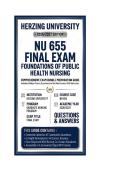
,NU 655 Final Exam Foundations of Public Health Nursing Questions
And Answers 2026/2027 Herzing University
Q1. What most directly defines the population-focused perspective
of public health nursing?
A) Providing the same clinical service to every individual
B) Concentrating nursing resources exclusively on diagnosed illness
C) Examining health patterns and determinants affecting groups and using
interventions capable of improving population outcomes
D) Limiting nursing activities to government-operated clinics
Correct Answer: C) Examining health patterns and determinants affecting
groups and using interventions capable of improving population outcomes
Rationale: Population-focused nursing considers patterns of health, risk,
protective factors, and determinants across groups and selects interventions
capable of influencing health beyond one individual.
Q2. Which historical development most strongly contributed to the
emergence of modern public health nursing?
A) Expansion of highly specialized inpatient procedures
B) Reduction of nursing involvement outside hospitals
C) Replacement of preventive services with acute treatment
D) Recognition that social and environmental conditions influence illness and
require organized community action
Correct Answer: D) Recognition that social and environmental conditions
influence illness and require organized community action
Rationale: Public health nursing developed partly from recognition that
sanitation, housing, poverty, working conditions, education, and access to
care strongly influence community health.
Q3. Florence Nightingale's broader influence on public health is
especially associated with which idea?
A) Disease patterns should be interpreted without numerical data
B) Nursing should remain separate from environmental conditions
C) Prevention is less important than hospital treatment
D) Environmental conditions, sanitation, observation, and systematic data
can be used to improve health
, Correct Answer: D) Environmental conditions, sanitation, observation, and
systematic data can be used to improve health
Rationale: Nightingale demonstrated how environmental improvement and
systematic use of health data could guide actions that reduced illness and
mortality.
Q4. Which feature of Lillian Wald's work most clearly anticipated
modern population-focused nursing?
A) Combining nursing services with attention to social conditions and
community needs
B) Restricting nursing services to people able to pay
C) Separating health problems from living conditions
D) Focusing exclusively on inpatient treatment
Correct Answer: A) Combining nursing services with attention to social
conditions and community needs
Rationale: Wald linked nursing with social reform and recognized that health
cannot be separated from the circumstances in which people live and work.
Q5. Which activity best reflects a core responsibility of a public
health nurse?
A) Identify patterns of population need and collaborate on prevention and
health-promotion strategies
B) Provide only posthospitalization care
C) Focus exclusively on physician-prescribed treatment
D) Avoid community partnerships to preserve professional independence
Correct Answer: A) Identify patterns of population need and collaborate on
prevention and health-promotion strategies
Rationale: Public health nursing integrates assessment, prevention, health
promotion, collaboration, and population-level decision-making.
Q6. A public health nurse works with schools, shelters, workplaces,
clinics, and neighborhood organizations. What principle does this
illustrate?
A) Public health nursing is limited to formal healthcare facilities
B) Only hospitals generate useful population information
C) Community organizations should not participate in health improvement
And Answers 2026/2027 Herzing University
Q1. What most directly defines the population-focused perspective
of public health nursing?
A) Providing the same clinical service to every individual
B) Concentrating nursing resources exclusively on diagnosed illness
C) Examining health patterns and determinants affecting groups and using
interventions capable of improving population outcomes
D) Limiting nursing activities to government-operated clinics
Correct Answer: C) Examining health patterns and determinants affecting
groups and using interventions capable of improving population outcomes
Rationale: Population-focused nursing considers patterns of health, risk,
protective factors, and determinants across groups and selects interventions
capable of influencing health beyond one individual.
Q2. Which historical development most strongly contributed to the
emergence of modern public health nursing?
A) Expansion of highly specialized inpatient procedures
B) Reduction of nursing involvement outside hospitals
C) Replacement of preventive services with acute treatment
D) Recognition that social and environmental conditions influence illness and
require organized community action
Correct Answer: D) Recognition that social and environmental conditions
influence illness and require organized community action
Rationale: Public health nursing developed partly from recognition that
sanitation, housing, poverty, working conditions, education, and access to
care strongly influence community health.
Q3. Florence Nightingale's broader influence on public health is
especially associated with which idea?
A) Disease patterns should be interpreted without numerical data
B) Nursing should remain separate from environmental conditions
C) Prevention is less important than hospital treatment
D) Environmental conditions, sanitation, observation, and systematic data
can be used to improve health
, Correct Answer: D) Environmental conditions, sanitation, observation, and
systematic data can be used to improve health
Rationale: Nightingale demonstrated how environmental improvement and
systematic use of health data could guide actions that reduced illness and
mortality.
Q4. Which feature of Lillian Wald's work most clearly anticipated
modern population-focused nursing?
A) Combining nursing services with attention to social conditions and
community needs
B) Restricting nursing services to people able to pay
C) Separating health problems from living conditions
D) Focusing exclusively on inpatient treatment
Correct Answer: A) Combining nursing services with attention to social
conditions and community needs
Rationale: Wald linked nursing with social reform and recognized that health
cannot be separated from the circumstances in which people live and work.
Q5. Which activity best reflects a core responsibility of a public
health nurse?
A) Identify patterns of population need and collaborate on prevention and
health-promotion strategies
B) Provide only posthospitalization care
C) Focus exclusively on physician-prescribed treatment
D) Avoid community partnerships to preserve professional independence
Correct Answer: A) Identify patterns of population need and collaborate on
prevention and health-promotion strategies
Rationale: Public health nursing integrates assessment, prevention, health
promotion, collaboration, and population-level decision-making.
Q6. A public health nurse works with schools, shelters, workplaces,
clinics, and neighborhood organizations. What principle does this
illustrate?
A) Public health nursing is limited to formal healthcare facilities
B) Only hospitals generate useful population information
C) Community organizations should not participate in health improvement