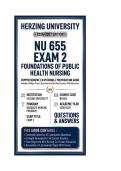
,NU 655 Exam 2 Foundations of Public Health Nursing Questions And
Answers 2026/2027 Herzing University
Q1. Which statement best describes health promotion at the
population level?
A) Providing medical treatment after disease develops
B) Enabling people and communities to increase control over factors
influencing health
C) Restricting interventions to individual behavior change
D) Concentrating resources exclusively on screening programs
Correct Answer: B) Enabling people and communities to increase control over
factors influencing health
Rationale: Population health promotion strengthens people's capacity to
improve health while also addressing social, environmental, organizational,
and policy conditions that influence their opportunities.
Q2. A city redesigns streets to include sidewalks, bicycle lanes,
safer crossings, and accessible public spaces. Which health-
promotion strategy is most directly demonstrated?
A) Developing diagnostic services
B) Expanding tertiary care
C) Increasing individual disease surveillance
D) Creating supportive environments
Correct Answer: D) Creating supportive environments
Rationale: Supportive environments make healthy behaviors safer, easier,
and more practical through changes in physical and social surroundings.
Q3. Which intervention best illustrates strengthening community
action?
A) Residents participate in identifying priorities and controlling
implementation of a neighborhood health initiative
B) Clinicians independently select health goals for residents
C) A hospital develops a treatment protocol without community participation
D) Researchers distribute information after completing a project
Correct Answer: A) Residents participate in identifying priorities and
controlling implementation of a neighborhood health initiative
, Rationale: Strengthening community action involves meaningful community
participation in priority setting, decision-making, planning, and
implementation.
Q4. A health department teaches residents how to interpret food
labels, compare serving sizes, and plan balanced meals. Which
health-promotion action is primarily being used?
A) Building public policy
B) Reorienting health services
C) Developing personal skills
D) Modifying disease surveillance
Correct Answer: C) Developing personal skills
Rationale: Education and skill-building increase people's ability to
understand health information and make informed choices.
Q5. A school district prohibits tobacco use on all school property
and provides cessation resources. Which feature makes this more
than a simple education intervention?
A) It focuses only on students already using tobacco
B) It measures disease prevalence
C) It changes the environment and organizational conditions surrounding
tobacco use
D) It eliminates the need for individual support
Correct Answer: C) It changes the environment and organizational conditions
surrounding tobacco use
Rationale: Policies can change the conditions in which behavior occurs,
supporting healthier choices while reducing exposure to harmful influences.
Q6. A population has low physical activity despite widespread
knowledge of exercise benefits. What should public health planners
investigate next?
A) Environmental and social barriers that may prevent residents from being
active
B) Whether residents can define cardiovascular disease
C) Whether all residents have identical motivation
D) Whether exercise education should be discontinued entirely
Answers 2026/2027 Herzing University
Q1. Which statement best describes health promotion at the
population level?
A) Providing medical treatment after disease develops
B) Enabling people and communities to increase control over factors
influencing health
C) Restricting interventions to individual behavior change
D) Concentrating resources exclusively on screening programs
Correct Answer: B) Enabling people and communities to increase control over
factors influencing health
Rationale: Population health promotion strengthens people's capacity to
improve health while also addressing social, environmental, organizational,
and policy conditions that influence their opportunities.
Q2. A city redesigns streets to include sidewalks, bicycle lanes,
safer crossings, and accessible public spaces. Which health-
promotion strategy is most directly demonstrated?
A) Developing diagnostic services
B) Expanding tertiary care
C) Increasing individual disease surveillance
D) Creating supportive environments
Correct Answer: D) Creating supportive environments
Rationale: Supportive environments make healthy behaviors safer, easier,
and more practical through changes in physical and social surroundings.
Q3. Which intervention best illustrates strengthening community
action?
A) Residents participate in identifying priorities and controlling
implementation of a neighborhood health initiative
B) Clinicians independently select health goals for residents
C) A hospital develops a treatment protocol without community participation
D) Researchers distribute information after completing a project
Correct Answer: A) Residents participate in identifying priorities and
controlling implementation of a neighborhood health initiative
, Rationale: Strengthening community action involves meaningful community
participation in priority setting, decision-making, planning, and
implementation.
Q4. A health department teaches residents how to interpret food
labels, compare serving sizes, and plan balanced meals. Which
health-promotion action is primarily being used?
A) Building public policy
B) Reorienting health services
C) Developing personal skills
D) Modifying disease surveillance
Correct Answer: C) Developing personal skills
Rationale: Education and skill-building increase people's ability to
understand health information and make informed choices.
Q5. A school district prohibits tobacco use on all school property
and provides cessation resources. Which feature makes this more
than a simple education intervention?
A) It focuses only on students already using tobacco
B) It measures disease prevalence
C) It changes the environment and organizational conditions surrounding
tobacco use
D) It eliminates the need for individual support
Correct Answer: C) It changes the environment and organizational conditions
surrounding tobacco use
Rationale: Policies can change the conditions in which behavior occurs,
supporting healthier choices while reducing exposure to harmful influences.
Q6. A population has low physical activity despite widespread
knowledge of exercise benefits. What should public health planners
investigate next?
A) Environmental and social barriers that may prevent residents from being
active
B) Whether residents can define cardiovascular disease
C) Whether all residents have identical motivation
D) Whether exercise education should be discontinued entirely