
ATI PN MENTAL HEALTH 2026 PROCTORED EXAM
QUESTIONS AND CORRECT ANSWERS (VERIFIED
ANSWERS) PLUS RATIONALES 2026 Q&A | INSTANT
DOWNLOAD PDF.
Question 1 (Diagram-Based)
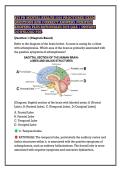
Refer to the diagram of the brain below. A nurse is caring for a client
with schizophrenia. Which area of the brain is primarily associated with
the positive symptoms of schizophrenia?
[Diagram: Sagittal section of the brain with labeled areas: A (Frontal
Lobe), B (Parietal Lobe), C (Temporal Lobe), D (Occipital Lobe)]
A. Frontal Lobe
B. Parietal Lobe
C. Temporal Lobe
D. Occipital Lobe
C. Temporal Lobe
RATIONALE: The temporal lobe, particularly the auditory cortex and
limbic structures within it, is associated with the positive symptoms of
schizophrenia, such as auditory hallucinations. The frontal lobe is more
associated with negative symptoms and executive dysfunction.
,Question 2 (Diagram-Based)
Refer to the diagram of the synapse below. A nurse is teaching a client
about the mechanism of action of SSRIs. Which component of the
synapse do SSRIs primarily affect?
[Diagram: Synapse showing presynaptic neuron, synaptic cleft, and
postsynaptic neuron with labeled components: A (Serotonin
Transporter), B (Serotonin Receptor), C (Vesicle), D (Mitochondrion)]
A. Serotonin Transporter
B. Serotonin Receptor
C. Vesicle
D. Mitochondrion
A. Serotonin Transporter
RATIONALE: SSRIs (Selective Serotonin Reuptake Inhibitors) work by
blocking the serotonin transporter on the presynaptic neuron,
preventing the reuptake of serotonin and increasing its availability in
the synaptic cleft.
Question 3 (Diagram-Based)
,Refer to the diagram of the HPA axis below. A nurse is assessing a client
with major depressive disorder. Which component of the HPA axis is
typically hyperactive in depression?
[Diagram: HPA axis showing hypothalamus, pituitary gland, and adrenal
gland with labeled hormones: A (CRH), B (ACTH), C (Cortisol), D
(Adrenaline)]
A. CRH
B. ACTH
C. Cortisol
D. Adrenaline
C. Cortisol
RATIONALE: In major depressive disorder, the HPA axis is often
hyperactive, leading to elevated cortisol levels. This is a well-
documented neuroendocrine finding in depression.
Question 4
A nurse is preparing to conduct an initial mental health assessment on a
client who has been admitted involuntarily. Which action should the
nurse take first to establish a therapeutic alliance?
A. Explain the client's legal rights and the treatment process.
B. Ask the client about their reason for hospitalization.
C. Provide the client with a written copy of unit rules.
D. Complete the admission paperwork and physical assessment.
, B. Ask the client about their reason for hospitalization.
RATIONALE: Beginning the assessment by asking the client about
their reason for hospitalization demonstrates respect for their
perspective and initiates therapeutic communication. Explaining legal
rights, providing unit rules, and completing paperwork are important
tasks but should occur after initial rapport is established.
Question 5
Which statement best describes mental health?
A. The absence of mental illness or psychiatric symptoms.
B. The successful performance of mental functions resulting in
productive activities, fulfilling relationships, and the ability to adapt to
change and cope with adversity.
C. A state of complete physical, mental, and social well-being.
D. The ability to function independently without assistance from others.
B. The successful performance of mental functions resulting in
productive activities, fulfilling relationships, and the ability to adapt to
change and cope with adversity.
RATIONALE: Mental health is defined as the successful performance
of mental functions, resulting in productive activities, fulfilling
relationships, and the ability to adapt to change and cope with adversity.
Option A is incorrect because mental health is more than the absence of
illness. Option C describes overall health. Option D describes functional
independence.
Question 6
A nurse is caring for a client who is withdrawn and refuses to speak. The
nurse sits with the client quietly for several minutes and then states, "I'll
sit with you for a while. You don't have to talk if you don't want to." This
intervention demonstrates which therapeutic communication technique?
QUESTIONS AND CORRECT ANSWERS (VERIFIED
ANSWERS) PLUS RATIONALES 2026 Q&A | INSTANT
DOWNLOAD PDF.
Question 1 (Diagram-Based)
Refer to the diagram of the brain below. A nurse is caring for a client
with schizophrenia. Which area of the brain is primarily associated with
the positive symptoms of schizophrenia?
[Diagram: Sagittal section of the brain with labeled areas: A (Frontal
Lobe), B (Parietal Lobe), C (Temporal Lobe), D (Occipital Lobe)]
A. Frontal Lobe
B. Parietal Lobe
C. Temporal Lobe
D. Occipital Lobe
C. Temporal Lobe
RATIONALE: The temporal lobe, particularly the auditory cortex and
limbic structures within it, is associated with the positive symptoms of
schizophrenia, such as auditory hallucinations. The frontal lobe is more
associated with negative symptoms and executive dysfunction.
,Question 2 (Diagram-Based)
Refer to the diagram of the synapse below. A nurse is teaching a client
about the mechanism of action of SSRIs. Which component of the
synapse do SSRIs primarily affect?
[Diagram: Synapse showing presynaptic neuron, synaptic cleft, and
postsynaptic neuron with labeled components: A (Serotonin
Transporter), B (Serotonin Receptor), C (Vesicle), D (Mitochondrion)]
A. Serotonin Transporter
B. Serotonin Receptor
C. Vesicle
D. Mitochondrion
A. Serotonin Transporter
RATIONALE: SSRIs (Selective Serotonin Reuptake Inhibitors) work by
blocking the serotonin transporter on the presynaptic neuron,
preventing the reuptake of serotonin and increasing its availability in
the synaptic cleft.
Question 3 (Diagram-Based)
,Refer to the diagram of the HPA axis below. A nurse is assessing a client
with major depressive disorder. Which component of the HPA axis is
typically hyperactive in depression?
[Diagram: HPA axis showing hypothalamus, pituitary gland, and adrenal
gland with labeled hormones: A (CRH), B (ACTH), C (Cortisol), D
(Adrenaline)]
A. CRH
B. ACTH
C. Cortisol
D. Adrenaline
C. Cortisol
RATIONALE: In major depressive disorder, the HPA axis is often
hyperactive, leading to elevated cortisol levels. This is a well-
documented neuroendocrine finding in depression.
Question 4
A nurse is preparing to conduct an initial mental health assessment on a
client who has been admitted involuntarily. Which action should the
nurse take first to establish a therapeutic alliance?
A. Explain the client's legal rights and the treatment process.
B. Ask the client about their reason for hospitalization.
C. Provide the client with a written copy of unit rules.
D. Complete the admission paperwork and physical assessment.
, B. Ask the client about their reason for hospitalization.
RATIONALE: Beginning the assessment by asking the client about
their reason for hospitalization demonstrates respect for their
perspective and initiates therapeutic communication. Explaining legal
rights, providing unit rules, and completing paperwork are important
tasks but should occur after initial rapport is established.
Question 5
Which statement best describes mental health?
A. The absence of mental illness or psychiatric symptoms.
B. The successful performance of mental functions resulting in
productive activities, fulfilling relationships, and the ability to adapt to
change and cope with adversity.
C. A state of complete physical, mental, and social well-being.
D. The ability to function independently without assistance from others.
B. The successful performance of mental functions resulting in
productive activities, fulfilling relationships, and the ability to adapt to
change and cope with adversity.
RATIONALE: Mental health is defined as the successful performance
of mental functions, resulting in productive activities, fulfilling
relationships, and the ability to adapt to change and cope with adversity.
Option A is incorrect because mental health is more than the absence of
illness. Option C describes overall health. Option D describes functional
independence.
Question 6
A nurse is caring for a client who is withdrawn and refuses to speak. The
nurse sits with the client quietly for several minutes and then states, "I'll
sit with you for a while. You don't have to talk if you don't want to." This
intervention demonstrates which therapeutic communication technique?

