

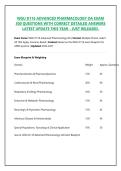
WGU D116 ADVANCED PHARMACOLOGY OA EXAM
300 QUESTIONS WITH CORRECT DETAILED ANSWERS
LATEST UPDATE THIS YEAR - JUST RELEASED.
Exam Focus: WGU D116 Advanced Pharmacology OA | Format: Multiple Choice, Select
All That Apply, Scenario-Based | Content: Based on the WGU D116 exam blueprint for
APRN practice | Updated: 2026-2027
Exam Blueprint & Weighting
Domain Weight Approx. Questions
Pharmacokinetics & Pharmacodynamics 15% 45
Cardiovascular & Renal Pharmacology 20% 60
Respiratory & Allergy Pharmacology 10% 30
Endocrine & Metabolic Pharmacology 15% 45
Neurologic & Psychiatric Pharmacology 15% 45
Infectious Disease & Antimicrobials 15% 45
Special Populations, Toxicology & Clinical Application 10% 30
Source: WGU D116 Advanced Pharmacology OA Exam Blueprint
,SECTION 1: PHARMACOKINETICS & PHARMACODYNAMICS (Questions 1-45)
Question 1
Which of the following best describes pharmacokinetics?
A) The study of drug effects on the body
B) The study of drug absorption, distribution, metabolism, and excretion (ADME)
C) The study of drug toxicity
D) The study of drug interactions
Correct Answer: B) The study of drug absorption, distribution, metabolism, and
excretion (ADME)
Rationale: Pharmacokinetics is "what the body does to the drug" and encompasses the
four processes of Absorption, Distribution, Metabolism, and Excretion (ADME).
Pharmacodynamics, in contrast, is "what the drug does to the body" – the study of drug
effects and mechanisms of action.
Question 2
The "first-pass effect" refers to:
A) Rapid intravenous administration
B) Drug metabolism in the liver before reaching systemic circulation
C) Drug excretion by the kidneys
D) Drug binding to plasma proteins
Correct Answer: B) Drug metabolism in the liver before reaching systemic
circulation
Rationale: The first-pass effect occurs when a drug is metabolized in the liver before
reaching systemic circulation, which reduces the bioavailability of orally administered
drugs. Drugs like nitroglycerin and morphine require higher oral doses or alternative
routes to bypass this effect.
Question 3
Bioavailability is defined as:
,A) The speed of drug absorption
B) The fraction of an administered dose that reaches systemic circulation unchanged
C) The volume of distribution
D) The half-life of the drug
Correct Answer: B) The fraction of an administered dose that reaches systemic
circulation unchanged
Rationale: Bioavailability measures how much of an administered dose reaches the
bloodstream unchanged. Intravenous (IV) administration has 100% bioavailability because
it bypasses absorption and first-pass metabolism.
Question 4
Which route of administration has the highest bioavailability and fastest onset of action?
A) Oral
B) Subcutaneous
C) Intravenous (IV)
D) Intramuscular (IM)
Correct Answer: C) Intravenous (IV)
Rationale: IV administration bypasses absorption barriers and first-pass metabolism,
delivering 100% of the dose directly into systemic circulation. It also provides the most
rapid onset of action and is used in emergencies requiring immediate drug effect.
Question 5
A drug with a half-life of 4 hours is administered every 4 hours. Approximately how
many half-lives are required to reach steady-state concentrations?
A) 1
B) 2
C) 4-5
D) 8
Correct Answer: C) 4-5
, Rationale: Steady-state is typically achieved after 4–5 half-lives, regardless of dosing
interval, because the amount of drug eliminated equals the amount administered over
time.
Question 6
Which organ is primarily responsible for drug metabolism?
A) Kidneys
B) Liver
C) Lungs
D) Intestines
Correct Answer: B) Liver
Rationale: The liver is the primary site of drug metabolism, containing high concentrations
of drug-metabolizing enzymes, particularly the Cytochrome P450 (CYP) enzyme system.
Question 7
Which CYP enzyme is responsible for metabolizing the largest number of drugs
(approximately 50%)?
A) CYP2D6
B) CYP1A2
C) CYP3A4
D) CYP2C9
Correct Answer: C) CYP3A4
Rationale: CYP3A4 metabolizes approximately 50% of all drugs, including statins, calcium
channel blockers, macrolide antibiotics, and many others. It is located in both the liver and
small intestine and is involved in numerous drug-drug interactions.
Question 8
300 QUESTIONS WITH CORRECT DETAILED ANSWERS
LATEST UPDATE THIS YEAR - JUST RELEASED.
Exam Focus: WGU D116 Advanced Pharmacology OA | Format: Multiple Choice, Select
All That Apply, Scenario-Based | Content: Based on the WGU D116 exam blueprint for
APRN practice | Updated: 2026-2027
Exam Blueprint & Weighting
Domain Weight Approx. Questions
Pharmacokinetics & Pharmacodynamics 15% 45
Cardiovascular & Renal Pharmacology 20% 60
Respiratory & Allergy Pharmacology 10% 30
Endocrine & Metabolic Pharmacology 15% 45
Neurologic & Psychiatric Pharmacology 15% 45
Infectious Disease & Antimicrobials 15% 45
Special Populations, Toxicology & Clinical Application 10% 30
Source: WGU D116 Advanced Pharmacology OA Exam Blueprint
,SECTION 1: PHARMACOKINETICS & PHARMACODYNAMICS (Questions 1-45)
Question 1
Which of the following best describes pharmacokinetics?
A) The study of drug effects on the body
B) The study of drug absorption, distribution, metabolism, and excretion (ADME)
C) The study of drug toxicity
D) The study of drug interactions
Correct Answer: B) The study of drug absorption, distribution, metabolism, and
excretion (ADME)
Rationale: Pharmacokinetics is "what the body does to the drug" and encompasses the
four processes of Absorption, Distribution, Metabolism, and Excretion (ADME).
Pharmacodynamics, in contrast, is "what the drug does to the body" – the study of drug
effects and mechanisms of action.
Question 2
The "first-pass effect" refers to:
A) Rapid intravenous administration
B) Drug metabolism in the liver before reaching systemic circulation
C) Drug excretion by the kidneys
D) Drug binding to plasma proteins
Correct Answer: B) Drug metabolism in the liver before reaching systemic
circulation
Rationale: The first-pass effect occurs when a drug is metabolized in the liver before
reaching systemic circulation, which reduces the bioavailability of orally administered
drugs. Drugs like nitroglycerin and morphine require higher oral doses or alternative
routes to bypass this effect.
Question 3
Bioavailability is defined as:
,A) The speed of drug absorption
B) The fraction of an administered dose that reaches systemic circulation unchanged
C) The volume of distribution
D) The half-life of the drug
Correct Answer: B) The fraction of an administered dose that reaches systemic
circulation unchanged
Rationale: Bioavailability measures how much of an administered dose reaches the
bloodstream unchanged. Intravenous (IV) administration has 100% bioavailability because
it bypasses absorption and first-pass metabolism.
Question 4
Which route of administration has the highest bioavailability and fastest onset of action?
A) Oral
B) Subcutaneous
C) Intravenous (IV)
D) Intramuscular (IM)
Correct Answer: C) Intravenous (IV)
Rationale: IV administration bypasses absorption barriers and first-pass metabolism,
delivering 100% of the dose directly into systemic circulation. It also provides the most
rapid onset of action and is used in emergencies requiring immediate drug effect.
Question 5
A drug with a half-life of 4 hours is administered every 4 hours. Approximately how
many half-lives are required to reach steady-state concentrations?
A) 1
B) 2
C) 4-5
D) 8
Correct Answer: C) 4-5
, Rationale: Steady-state is typically achieved after 4–5 half-lives, regardless of dosing
interval, because the amount of drug eliminated equals the amount administered over
time.
Question 6
Which organ is primarily responsible for drug metabolism?
A) Kidneys
B) Liver
C) Lungs
D) Intestines
Correct Answer: B) Liver
Rationale: The liver is the primary site of drug metabolism, containing high concentrations
of drug-metabolizing enzymes, particularly the Cytochrome P450 (CYP) enzyme system.
Question 7
Which CYP enzyme is responsible for metabolizing the largest number of drugs
(approximately 50%)?
A) CYP2D6
B) CYP1A2
C) CYP3A4
D) CYP2C9
Correct Answer: C) CYP3A4
Rationale: CYP3A4 metabolizes approximately 50% of all drugs, including statins, calcium
channel blockers, macrolide antibiotics, and many others. It is located in both the liver and
small intestine and is involved in numerous drug-drug interactions.
Question 8

