
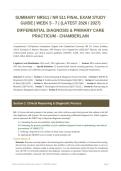
SUMMARY NR511 / NR 511 FINAL EXAM STUDY
GUIDE | WEEK 5 - 7 | (LATEST )
DIFFERENTIAL DIAGNOSIS & PRIMARY CARE
PRACTICUM - CHAMBERLAIN
Comprehensive 150-Question Examination Aligned with Chamberlain University NR 511 Course Syllabus,
AACN Essentials of Master's Education, FNP Primary Care Competencies (2026/2027 Edition), and current
evidence-based primary care clinical practice guidelines (USPSTF, AAFP, ACP, ADA, ACC/AHA, GINA,
GOLD, IDSA, KDIGO, and others).
Cognitive Level Distribution: 20% recall | 50% application | 30% analysis | Format: 80% scenario-based |
20% direct knowledge | Special Inclusions: 25 scenario-based clinical reasoning questions, 20 questions on
common primary care conditions and management, 15 questions on diagnostic testing and interpretation.
Structure: 9 sections | Section 1: Clinical Reasoning & Diagnostic Process (Q1-Q20) | Section 2: HEENT &
Respiratory (Q21-Q40) | Section 3: Cardiovascular & Hematological (Q41-Q60) | Section 4: Gastrointestinal
& Renal (Q61-Q78) | Section 5: Musculoskeletal & Dermatological (Q79-Q96) | Section 6: Endocrine &
Metabolic (Q97-Q114) | Section 7: Neurological & Psychosocial (Q115-Q132) | Section 8: Pharmacology &
Therapeutic Management (Q133-Q142) | Section 9: Patient Education & Health Promotion (Q143-Q150).
Section 1: Clinical Reasoning & Diagnostic Process
Q1: A 54-year-old male presents to the primary care clinic with new-onset chest pressure that radiates to his left
arm, diaphoresis, and dyspnea. The nurse practitioner is constructing a differential diagnosis list. Which cognitive
process represents the FIRST step in Bayesian diagnostic reasoning?
A. Calculating the post-test probability using likelihood ratios
B. Estimating the pretest probability of each candidate diagnosis based on epidemiology and clinical
presentation *[CORRECT]*
C. Ordering a troponin level to confirm or refute acute coronary syndrome
D. Applying the HEART score to stratify 6-week mortality risk
Correct Answer: B
Rationale: Bayesian reasoning begins with estimating pretest probability (the probability of a disease before testing,
derived from prevalence and clinical features), then modifies it with test results using likelihood ratios to arrive at
post-test probability. Jumping straight to testing (option C) or risk stratification (option D) skips the foundational
step. The NR 511 curriculum emphasizes that diagnostic reasoning is a sequential, evidence-based process anchored
in pretest probability, consistent with AACN Essentials competency in clinical judgment.
NR511 Final Exam Study Guide | Week 5-7 | 2026/2027 Edition Page 1
, Q2: When generating a differential diagnosis for a 32-year-old woman with chronic daily headache, which
approach is MOST consistent with evidence-based diagnostic reasoning?
A. Listing only the three most common causes of headache and selecting the most prevalent one
B. Generating a problem representation, then mapping candidate diagnoses to illness scripts with
attention to red flags that expand the differential *[CORRECT]*
C. Ordering a head CT immediately to exclude intracranial pathology before considering primary headaches
D. Documenting the patient's chief complaint and prescribing empiric preventive therapy
Correct Answer: B
Rationale: Evidence-based diagnostic reasoning requires building a concise problem representation (summary
statement), then comparing candidate diagnoses against illness scripts while actively seeking red flags (e.g.,
thunderclap onset, focal neurologic deficits) that widen the differential. Listing only common causes (option A)
reflects availability bias. Empiric treatment without diagnosis (option D) and reflex imaging (option C) violate the
NR 511 principle of hypothesis-driven, cost-conscious evaluation consistent with ACP high-value care
recommendations.
Q3: A 67-year-old smoker presents with hoarseness persisting for 6 weeks. Which of the following is a red flag
that mandates prompt laryngoscopy or referral?
A. Hoarseness improving after 3 days of voice rest
B. Hoarseness persisting longer than 3 weeks in a patient with risk factors for head and neck cancer
*[CORRECT]*
C. Hoarseness accompanied by mild viral upper respiratory symptoms
D. Hoarseness with subjective throat clearing sensation
Correct Answer: B
Rationale: Hoarseness persisting beyond 3 weeks—particularly in a smoker or person over 55—is an
AAFP-designated red flag for possible laryngeal cancer and mandates direct visualization. Acute hoarseness with
viral URI (option C) is consistent with acute laryngitis and resolves spontaneously. The NR 511 curriculum stresses
early identification of cancer red flags to ensure timely specialist referral, aligning with USPSTF and AAFP clinical
guidance.
Q4: Which statement BEST distinguishes a “rule-in” test from a “rule-out” test in primary care diagnostics?
A. A rule-in test has high sensitivity; a rule-out test has high specificity
B. A rule-in test has high specificity (SpPin); a rule-out test has high sensitivity (SnNout)
*[CORRECT]*
C. Rule-in and rule-out tests both require likelihood ratios near 1.0 to be clinically useful
D. A rule-in test is always more expensive than a rule-out test
Correct Answer: B
Rationale: A rule-in test (SpPin: Specific test, when Positive, rules in the disease) has high specificity, so a positive
result strongly confirms the diagnosis. A rule-out test (SnNout: Sensitive test, when Negative, rules out the disease)
has high sensitivity, so a negative result confidently excludes disease. Likelihood ratios near 1.0 (option C) indicate
a non-diagnostic test. Cost (option D) is unrelated to diagnostic performance. This Bayesian framework is central to
the NR 511 diagnostic process module.
NR511 Final Exam Study Guide | Week 5-7 | 2026/2027 Edition Page 2
, Q5: An NP orders a D-dimer for a 28-year-old non-smoking woman with calf pain and a Wells score of 0. The
D-dimer is normal. Which interpretation is MOST appropriate?
A. PE is excluded; no further workup is required
B. PE is excluded in this low-pretest-probability patient when paired with a negative D-dimer
*[CORRECT]*
C. A CT pulmonary angiogram is required regardless of D-dimer result
D. The D-dimer has limited specificity and should be repeated in 24 hours
Correct Answer: B
Rationale: In a low-pretest-probability patient (Wells ≤ 4), a negative quantitative D-dimer reliably excludes PE
and avoids CTPA, consistent with current ACP and ESC guidance. Option A is incomplete because the conclusion
relies on combining pretest probability with the test result, not the D-dimer alone. CTPA (option C) would be
reserved for moderate/high pretest probability or positive D-dimer. The NR 511 curriculum emphasizes Bayesian
integration of pretest probability with diagnostic testing.
Q6: A 45-year-old woman presents with fatigue, cold intolerance, and weight gain. Her TSH is 8.5 mIU/L
(reference 0.4–4.0) and free T4 is low-normal. The NP constructs a one-line summary: “Middle-aged woman
with insidious onset of hypothyroid symptoms and subclinical-to-overt biochemical hypothyroidism.” This
summary is BEST described as a:
A. Illness script
B. Problem representation *[CORRECT]*
C. Differential diagnosis
D. Diagnostic hypothesis
Correct Answer: B
Rationale: A problem representation is a concise summary statement that synthesizes key clinical features
(epidemiology, temporal course, syndromic cluster) into a single conceptual frame that drives hypothesis generation.
An illness script (option A) is the clinician's mental model of a specific disease's typical presentation. Differential
diagnosis (option C) is the candidate list, not the summary. The NR 511 curriculum teaches problem representation
as the bridge between data gathering and diagnostic reasoning.
Q7: Which of the following scenarios BEST illustrates anchoring bias?
A. The NP prematurely closes the differential after the patient confirms a diagnosis suggested by a family
member
B. The NP fixates on an initial impression of gastroesophageal reflux and fails to reconsider despite
atypical features and poor response to PPI therapy *[CORRECT]*
C. The NP orders every available laboratory test out of diagnostic uncertainty
D. The NP gives equal weight to all candidate diagnoses regardless of prevalence
Correct Answer: B
Rationale: Anchoring bias is the tendency to fixate on an initial impression and fail to adjust despite new
disconfirmatory data. The patient with atypical features and PPI non-response should prompt the NP to broaden the
differential (e.g., cardiac, musculoskeletal). Premature closure (option A) is a related but distinct bias. Excessive
testing (option C) reflects uncertainty avoidance. Cognitive bias awareness is a core NR 511 patient safety
competency aligned with AACN Essentials.
NR511 Final Exam Study Guide | Week 5-7 | 2026/2027 Edition Page 3
, Q8: A 60-year-old man presents with progressive dyspnea, orthopnea, and bilateral lower extremity edema. After
diagnosing heart failure clinically, the NP orders an echocardiogram. Which diagnostic principle is being
applied?
A. Using a high-specificity test to confirm a clinically suspected diagnosis *[CORRECT]*
B. Using a high-sensitivity test to exclude a low-probability diagnosis
C. Using a screening test in an asymptomatic population
D. Using a theranostic test to predict response to a specific therapy
Correct Answer: A
Rationale: Echocardiography confirms heart failure, quantifies ejection fraction, and characterizes structural
disease; in a patient with intermediate-to-high pretest probability based on history and exam, it functions as a rule-in
(high-specificity) test. It is not being used for screening (option C) in an asymptomatic person, nor is it primarily a
rule-out test (option B) in this scenario. This case illustrates the diagnostic principle that test choice must follow
pretest probability assessment, a key NR 511 reasoning competency.
Q9: Which of the following represents a SYSTEM-LEVEL intervention to reduce diagnostic errors in primary
care?
A. Relying solely on individual clinician vigilance
B. Implementing structured electronic differential diagnosis prompts and follow-up tracking systems
for abnormal test results *[CORRECT]*
C. Discouraging second opinions to preserve clinician autonomy
D. Removing clinical decision support tools to encourage independent reasoning
Correct Answer: B
Rationale: System-level interventions such as differential diagnosis prompts, closed-loop follow-up tracking, and
clinical decision support are evidence-based strategies endorsed by the Society to Improve Diagnosis in Medicine
and the National Academies (Improving Diagnosis in Health Care). Individual vigilance (option A) is insufficient;
removing tools (option D) increases error. The NR 511 curriculum integrates individual cognitive reasoning with
system-level safety nets, aligned with AACN Essentials quality and safety competency.
Q10: An NP sees a 35-year-old woman with chronic fatigue. After running a normal CBC, TSH, and CMP, the
NP documents “fatigue—no organic cause found” and recommends lifestyle changes. Two months later she is
diagnosed with stage III breast cancer. Which cognitive bias most likely contributed to the diagnostic error?
A. Anchoring bias
B. Premature closure *[CORRECT]*
C. Search-satisficing bias
D. Confirmation bias
Correct Answer: B
Rationale: Premature closure—the tendency to accept a diagnosis before it has been fully verified—is the most
likely contributor, as the NP concluded “no organic cause” without exploring additional differentials (e.g., breast
mass, weight changes) after initial labs were normal. Anchoring (option A) requires an initial fixation that persists.
Search-satisficing (option C) is related but specifically refers to stopping the search after one finding. The NR 511
curriculum targets premature closure as a leading driver of diagnostic error.
NR511 Final Exam Study Guide | Week 5-7 | 2026/2027 Edition Page 4
GUIDE | WEEK 5 - 7 | (LATEST )
DIFFERENTIAL DIAGNOSIS & PRIMARY CARE
PRACTICUM - CHAMBERLAIN
Comprehensive 150-Question Examination Aligned with Chamberlain University NR 511 Course Syllabus,
AACN Essentials of Master's Education, FNP Primary Care Competencies (2026/2027 Edition), and current
evidence-based primary care clinical practice guidelines (USPSTF, AAFP, ACP, ADA, ACC/AHA, GINA,
GOLD, IDSA, KDIGO, and others).
Cognitive Level Distribution: 20% recall | 50% application | 30% analysis | Format: 80% scenario-based |
20% direct knowledge | Special Inclusions: 25 scenario-based clinical reasoning questions, 20 questions on
common primary care conditions and management, 15 questions on diagnostic testing and interpretation.
Structure: 9 sections | Section 1: Clinical Reasoning & Diagnostic Process (Q1-Q20) | Section 2: HEENT &
Respiratory (Q21-Q40) | Section 3: Cardiovascular & Hematological (Q41-Q60) | Section 4: Gastrointestinal
& Renal (Q61-Q78) | Section 5: Musculoskeletal & Dermatological (Q79-Q96) | Section 6: Endocrine &
Metabolic (Q97-Q114) | Section 7: Neurological & Psychosocial (Q115-Q132) | Section 8: Pharmacology &
Therapeutic Management (Q133-Q142) | Section 9: Patient Education & Health Promotion (Q143-Q150).
Section 1: Clinical Reasoning & Diagnostic Process
Q1: A 54-year-old male presents to the primary care clinic with new-onset chest pressure that radiates to his left
arm, diaphoresis, and dyspnea. The nurse practitioner is constructing a differential diagnosis list. Which cognitive
process represents the FIRST step in Bayesian diagnostic reasoning?
A. Calculating the post-test probability using likelihood ratios
B. Estimating the pretest probability of each candidate diagnosis based on epidemiology and clinical
presentation *[CORRECT]*
C. Ordering a troponin level to confirm or refute acute coronary syndrome
D. Applying the HEART score to stratify 6-week mortality risk
Correct Answer: B
Rationale: Bayesian reasoning begins with estimating pretest probability (the probability of a disease before testing,
derived from prevalence and clinical features), then modifies it with test results using likelihood ratios to arrive at
post-test probability. Jumping straight to testing (option C) or risk stratification (option D) skips the foundational
step. The NR 511 curriculum emphasizes that diagnostic reasoning is a sequential, evidence-based process anchored
in pretest probability, consistent with AACN Essentials competency in clinical judgment.
NR511 Final Exam Study Guide | Week 5-7 | 2026/2027 Edition Page 1
, Q2: When generating a differential diagnosis for a 32-year-old woman with chronic daily headache, which
approach is MOST consistent with evidence-based diagnostic reasoning?
A. Listing only the three most common causes of headache and selecting the most prevalent one
B. Generating a problem representation, then mapping candidate diagnoses to illness scripts with
attention to red flags that expand the differential *[CORRECT]*
C. Ordering a head CT immediately to exclude intracranial pathology before considering primary headaches
D. Documenting the patient's chief complaint and prescribing empiric preventive therapy
Correct Answer: B
Rationale: Evidence-based diagnostic reasoning requires building a concise problem representation (summary
statement), then comparing candidate diagnoses against illness scripts while actively seeking red flags (e.g.,
thunderclap onset, focal neurologic deficits) that widen the differential. Listing only common causes (option A)
reflects availability bias. Empiric treatment without diagnosis (option D) and reflex imaging (option C) violate the
NR 511 principle of hypothesis-driven, cost-conscious evaluation consistent with ACP high-value care
recommendations.
Q3: A 67-year-old smoker presents with hoarseness persisting for 6 weeks. Which of the following is a red flag
that mandates prompt laryngoscopy or referral?
A. Hoarseness improving after 3 days of voice rest
B. Hoarseness persisting longer than 3 weeks in a patient with risk factors for head and neck cancer
*[CORRECT]*
C. Hoarseness accompanied by mild viral upper respiratory symptoms
D. Hoarseness with subjective throat clearing sensation
Correct Answer: B
Rationale: Hoarseness persisting beyond 3 weeks—particularly in a smoker or person over 55—is an
AAFP-designated red flag for possible laryngeal cancer and mandates direct visualization. Acute hoarseness with
viral URI (option C) is consistent with acute laryngitis and resolves spontaneously. The NR 511 curriculum stresses
early identification of cancer red flags to ensure timely specialist referral, aligning with USPSTF and AAFP clinical
guidance.
Q4: Which statement BEST distinguishes a “rule-in” test from a “rule-out” test in primary care diagnostics?
A. A rule-in test has high sensitivity; a rule-out test has high specificity
B. A rule-in test has high specificity (SpPin); a rule-out test has high sensitivity (SnNout)
*[CORRECT]*
C. Rule-in and rule-out tests both require likelihood ratios near 1.0 to be clinically useful
D. A rule-in test is always more expensive than a rule-out test
Correct Answer: B
Rationale: A rule-in test (SpPin: Specific test, when Positive, rules in the disease) has high specificity, so a positive
result strongly confirms the diagnosis. A rule-out test (SnNout: Sensitive test, when Negative, rules out the disease)
has high sensitivity, so a negative result confidently excludes disease. Likelihood ratios near 1.0 (option C) indicate
a non-diagnostic test. Cost (option D) is unrelated to diagnostic performance. This Bayesian framework is central to
the NR 511 diagnostic process module.
NR511 Final Exam Study Guide | Week 5-7 | 2026/2027 Edition Page 2
, Q5: An NP orders a D-dimer for a 28-year-old non-smoking woman with calf pain and a Wells score of 0. The
D-dimer is normal. Which interpretation is MOST appropriate?
A. PE is excluded; no further workup is required
B. PE is excluded in this low-pretest-probability patient when paired with a negative D-dimer
*[CORRECT]*
C. A CT pulmonary angiogram is required regardless of D-dimer result
D. The D-dimer has limited specificity and should be repeated in 24 hours
Correct Answer: B
Rationale: In a low-pretest-probability patient (Wells ≤ 4), a negative quantitative D-dimer reliably excludes PE
and avoids CTPA, consistent with current ACP and ESC guidance. Option A is incomplete because the conclusion
relies on combining pretest probability with the test result, not the D-dimer alone. CTPA (option C) would be
reserved for moderate/high pretest probability or positive D-dimer. The NR 511 curriculum emphasizes Bayesian
integration of pretest probability with diagnostic testing.
Q6: A 45-year-old woman presents with fatigue, cold intolerance, and weight gain. Her TSH is 8.5 mIU/L
(reference 0.4–4.0) and free T4 is low-normal. The NP constructs a one-line summary: “Middle-aged woman
with insidious onset of hypothyroid symptoms and subclinical-to-overt biochemical hypothyroidism.” This
summary is BEST described as a:
A. Illness script
B. Problem representation *[CORRECT]*
C. Differential diagnosis
D. Diagnostic hypothesis
Correct Answer: B
Rationale: A problem representation is a concise summary statement that synthesizes key clinical features
(epidemiology, temporal course, syndromic cluster) into a single conceptual frame that drives hypothesis generation.
An illness script (option A) is the clinician's mental model of a specific disease's typical presentation. Differential
diagnosis (option C) is the candidate list, not the summary. The NR 511 curriculum teaches problem representation
as the bridge between data gathering and diagnostic reasoning.
Q7: Which of the following scenarios BEST illustrates anchoring bias?
A. The NP prematurely closes the differential after the patient confirms a diagnosis suggested by a family
member
B. The NP fixates on an initial impression of gastroesophageal reflux and fails to reconsider despite
atypical features and poor response to PPI therapy *[CORRECT]*
C. The NP orders every available laboratory test out of diagnostic uncertainty
D. The NP gives equal weight to all candidate diagnoses regardless of prevalence
Correct Answer: B
Rationale: Anchoring bias is the tendency to fixate on an initial impression and fail to adjust despite new
disconfirmatory data. The patient with atypical features and PPI non-response should prompt the NP to broaden the
differential (e.g., cardiac, musculoskeletal). Premature closure (option A) is a related but distinct bias. Excessive
testing (option C) reflects uncertainty avoidance. Cognitive bias awareness is a core NR 511 patient safety
competency aligned with AACN Essentials.
NR511 Final Exam Study Guide | Week 5-7 | 2026/2027 Edition Page 3
, Q8: A 60-year-old man presents with progressive dyspnea, orthopnea, and bilateral lower extremity edema. After
diagnosing heart failure clinically, the NP orders an echocardiogram. Which diagnostic principle is being
applied?
A. Using a high-specificity test to confirm a clinically suspected diagnosis *[CORRECT]*
B. Using a high-sensitivity test to exclude a low-probability diagnosis
C. Using a screening test in an asymptomatic population
D. Using a theranostic test to predict response to a specific therapy
Correct Answer: A
Rationale: Echocardiography confirms heart failure, quantifies ejection fraction, and characterizes structural
disease; in a patient with intermediate-to-high pretest probability based on history and exam, it functions as a rule-in
(high-specificity) test. It is not being used for screening (option C) in an asymptomatic person, nor is it primarily a
rule-out test (option B) in this scenario. This case illustrates the diagnostic principle that test choice must follow
pretest probability assessment, a key NR 511 reasoning competency.
Q9: Which of the following represents a SYSTEM-LEVEL intervention to reduce diagnostic errors in primary
care?
A. Relying solely on individual clinician vigilance
B. Implementing structured electronic differential diagnosis prompts and follow-up tracking systems
for abnormal test results *[CORRECT]*
C. Discouraging second opinions to preserve clinician autonomy
D. Removing clinical decision support tools to encourage independent reasoning
Correct Answer: B
Rationale: System-level interventions such as differential diagnosis prompts, closed-loop follow-up tracking, and
clinical decision support are evidence-based strategies endorsed by the Society to Improve Diagnosis in Medicine
and the National Academies (Improving Diagnosis in Health Care). Individual vigilance (option A) is insufficient;
removing tools (option D) increases error. The NR 511 curriculum integrates individual cognitive reasoning with
system-level safety nets, aligned with AACN Essentials quality and safety competency.
Q10: An NP sees a 35-year-old woman with chronic fatigue. After running a normal CBC, TSH, and CMP, the
NP documents “fatigue—no organic cause found” and recommends lifestyle changes. Two months later she is
diagnosed with stage III breast cancer. Which cognitive bias most likely contributed to the diagnostic error?
A. Anchoring bias
B. Premature closure *[CORRECT]*
C. Search-satisficing bias
D. Confirmation bias
Correct Answer: B
Rationale: Premature closure—the tendency to accept a diagnosis before it has been fully verified—is the most
likely contributor, as the NP concluded “no organic cause” without exploring additional differentials (e.g., breast
mass, weight changes) after initial labs were normal. Anchoring (option A) requires an initial fixation that persists.
Search-satisficing (option C) is related but specifically refers to stopping the search after one finding. The NR 511
curriculum targets premature closure as a leading driver of diagnostic error.
NR511 Final Exam Study Guide | Week 5-7 | 2026/2027 Edition Page 4

