
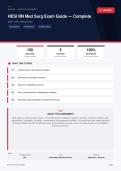
NURSING · OBJECTIVE ASSESSMENT
A+ VERIFIED
HESI RN Med Surg Exam Guide — Complete
Official Exam
150 Questions Full Rationales Verified Answers
150 5 100%
QUESTIONS SECTIONS RATIONALES
Complete coverage Core exam domains Every answer explained
WHAT THIS COVERS
01 Cardiovascular & Hematologic Disorders
02 Respiratory & Acid-Base Disorders
03 Endocrine & Metabolic Disorders
04 Renal, Gastrointestinal & Hepatobiliary Disorders
05 Neurologic, Musculoskeletal & Perioperative Nursing
ABOUT THIS ASSESSMENT
Build mastery in medical-surgical nursing — from cardiovascular, hematologic, respiratory, acid-base, endocrine, metabolic, renal,
gastrointestinal, hepatobiliary, neurologic, musculoskeletal, and perioperative conditions. This original study bank targets application
and analysis skills for the HESI RN Med Surg Exam, with full rationales for every answer. For review use only; not an institutional
proctored assessment.
PASSING SCORE LEVEL FORMAT
80% Intermediate (Nursing Course) Application / Analysis
STUVIA ACTUAL EXAM Page 1
,SECTION 1: CARDIOVASCULAR & HEMATOLOGIC DISORDERS
Q1. A 68-year-old client with a history of hypertension and diabetes is admitted with crushing chest pain
radiating to the left arm. The ECG shows ST-segment elevation in leads II, III, and aVF. The nurse recognizes the
infarct location and prioritizes the immediate intervention.
A. Posterior wall STEMI; withhold all antiplatelet therapy until cardiology arrives.
B. Inferior wall STEMI; prepare for emergent reperfusion while monitoring for bradycardia and right ventricular involvement.
C. Lateral wall STEMI; focus solely on pain control with morphine.
D. Anterior wall STEMI; administer nitroglycerin without regard to blood pressure.
Correct Answer: B
Rationale:
ST elevation in II, III, and aVF indicates an inferior wall STEMI, often associated with right coronary artery occlusion. Bradycardia and RV
involvement are common; reperfusion is time-critical.
Q2. A client receiving continuous heparin infusion for a pulmonary embolism has an aPTT of 120 seconds
(therapeutic range 60–80 seconds). The nurse’s most appropriate action is:
A. Switch immediately to low-molecular-weight heparin without consulting the provider.
B. Increase the infusion rate to reach a higher therapeutic level.
C. Continue the current rate because the value is only mildly elevated.
D. Hold the infusion, notify the provider, and prepare to administer protamine sulfate if ordered while assessing for bleeding.
Correct Answer: D
Rationale:
An aPTT significantly above the therapeutic range increases bleeding risk. Holding the infusion, notifying the provider, and having the
antidote available are the priority safety actions.
Q3. A client with chronic atrial fibrillation is prescribed warfarin. The nurse teaches the client about dietary
consistency and monitoring. Which statement by the client indicates correct understanding?
A. I can stop eating all green vegetables so that my INR stays high.
B. I will keep my intake of vitamin K–rich foods relatively consistent and have my INR checked as scheduled.
C. I will double my warfarin dose if I eat a large salad.
D. I no longer need blood tests once my dose is stable for a month.
Correct Answer: B
Rationale:
Consistency in vitamin K intake stabilizes INR. Abrupt elimination or large fluctuations and unsupervised dose changes increase risk of
thrombosis or bleeding.
STUVIA ACTUAL EXAM · Page 2
,SECTION 1: CARDIOVASCULAR & HEMATOLOGIC DISORDERS
Q4. A postoperative client develops sudden dyspnea, chest pain, and a sense of impending doom. Oxygen
saturation drops to 88% on room air. The nurse suspects venous thromboembolism and initiates the priority
actions.
A. Encourage immediate ambulation to improve venous return.
B. Place the client in high Fowler’s, apply oxygen, notify the rapid-response team, and prepare for diagnostic evaluation and
anticoagulation.
C. Massage the calves vigorously to dislodge any clots.
D. Administer a fluid bolus to treat presumed hypovolemia.
Correct Answer: B
Rationale:
Acute PE presents with sudden respiratory distress. Support oxygenation, summon help, and prepare for definitive therapy; ambulation or
massage can worsen the condition.
Q5. A client with heart failure has a weight gain of 2.5 kg in 48 hours, increasing dyspnea, and crackles to the
mid-lung fields. The nurse interprets these findings and plans the next intervention.
A. Recognize fluid volume overload; administer prescribed diuretic, restrict fluid and sodium, and reassess respiratory status and
daily weights.
B. Place the client in Trendelenburg position to improve venous return.
C. Encourage increased oral fluid intake to improve renal perfusion.
D. Attribute the weight gain solely to increased appetite and continue current orders.
Correct Answer: A
Rationale:
Rapid weight gain with pulmonary congestion indicates fluid overload. Diuresis, sodium/fluid restriction, and close monitoring are standard
interventions.
Q6. A client recovering from cardiac catheterization via the right femoral artery develops a rapidly expanding
hematoma at the puncture site and reports severe pain. The nurse’s immediate action is:
A. Remove the pressure dressing to inspect the site more closely.
B. Ambulate the client to promote circulation.
C. Apply firm pressure above the puncture site, keep the leg extended, notify the provider, and monitor vital signs for hypovolemia.
D. Elevate the head of the bed to 45 degrees and encourage coughing.
Correct Answer: C
Rationale:
An expanding hematoma signals possible arterial bleeding. Direct pressure, immobilization, and prompt medical notification are required to
prevent significant blood loss.
STUVIA ACTUAL EXAM · Page 3
, SECTION 1: CARDIOVASCULAR & HEMATOLOGIC DISORDERS
Q7. A client with unstable angina is started on a nitroglycerin infusion. The nurse monitors for the expected
therapeutic effect and the most common adverse effect requiring intervention.
A. Relief of chest pain; hypotension and headache are common and may require dose adjustment or fluid support.
B. Resolution of ST elevation without any hemodynamic change.
C. Complete elimination of all cardiac enzyme elevation within one hour.
D. Increased blood pressure; hypertension is the primary adverse effect.
Correct Answer: A
Rationale:
Nitroglycerin reduces preload and myocardial oxygen demand, relieving ischemic pain. Hypotension and headache are frequent dose-limiting
effects.
Q8. A client with sickle-cell disease is admitted in vaso-occlusive crisis with severe joint and back pain. The
nurse prioritizes the initial management interventions.
A. Encourage vigorous exercise to improve circulation.
B. Apply ice packs to all painful joints to reduce inflammation.
C. Restrict fluids to prevent circulatory overload.
D. Administer prescribed opioids and IV fluids, maintain oxygenation, and keep the room warm while monitoring for complications.
Correct Answer: D
Rationale:
Pain control, hydration, and oxygenation are the cornerstones of vaso-occlusive crisis management. Cold and dehydration worsen sickling.
Q9. A client receiving a blood transfusion develops fever, chills, and low-back pain 15 minutes after the infusion
begins. The nurse’s first actions are:
A. Flush the tubing with dextrose solution to clear the remaining blood.
B. Continue the transfusion while obtaining a full set of vital signs.
C. Stop the transfusion, maintain IV access with normal saline, notify the provider and blood bank, and monitor vital signs.
D. Slow the infusion rate and administer acetaminophen.
Correct Answer: C
Rationale:
Fever, chills, and back pain suggest an acute hemolytic or febrile reaction. Immediate cessation, saline keep-open, and notification are
mandatory.
STUVIA ACTUAL EXAM · Page 4

