
Nursing Fundamentals - Exam 1
Nursing Fundamentals - Exam 1
Study online at https://quizlet.com/_h34ddg
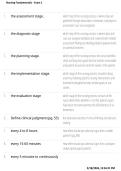
1. the assessment stage. which step of the nursing process is where data are
gathered through observation, interviews, and physical
assessment cues are recognized.
2. the diagnosis stage which step of the nursing process is where data and
cues are analyzed validated and clustered with related
assessment findings to identify problems patient needs
or potential concerns
3. the planning stage. which step of the nursing process the nurse identifies
short and long term goals that are realistic measurable
and patient focused to meet the needs of the patient.
4. the implementation stage. which stage of the nursing process includes taking
action by initiating specific nursing interventions and
treatments designed to help achieve goals or out-
comes.
5. the evaluation stage which stage of the nursing process consists of the
nurse determines whether or not the patients goals
have been met and examines the effectiveness of in-
terventions.
6. Define clinical judgment (pg. 55) the observed outcome of critical thinking and decision
making
7. every 4 to 8 hours How often should you take vital signs from a stable
patient? (pg.280)
8. every 15-60 minutes How often should you take vital signs from a postpro-
cedure/postsurgical patient?
9. every 5 minutes to continuously
9/18/2026, 12:56:21 PM
, Nursing Fundamentals - Exam 1
Nursing Fundamentals - Exam 1
Study online at https://quizlet.com/_h34ddg
How often should you take vital signs for a critical/un-
stable patient?
10. Can the task of taking vital signs be yes
delegated to an unliscensed assis-
tive personnel?
11. What is the normal temp range? 97.6 to 99.5
12. What is the normal range for res- 12-20
perations per min? (BPM)
13. What is the normal range for blood 100-120/60-80
pressure? (BP)
14. What is the normal oxygen level? 95-100%
15. What is the normal pulse range? 60-100
(bpm)
16. How do we measure a patients lev- on a scale of 1-10
el of pain
17. eupnea normal breathing
18. tachypnea rapid breathing
19. bradypnea abnormally slow breathing
20. systolic top number of BP-heart contracting
21. diastolic bottom number of BP-heart at rest/filling
22. SBAR is a widely accepted method situation background assessment and recommenda-
of hand-off that involves interper- tion
9/18/2026, 12:56:21 PM
Nursing Fundamentals - Exam 1
Study online at https://quizlet.com/_h34ddg
1. the assessment stage. which step of the nursing process is where data are
gathered through observation, interviews, and physical
assessment cues are recognized.
2. the diagnosis stage which step of the nursing process is where data and
cues are analyzed validated and clustered with related
assessment findings to identify problems patient needs
or potential concerns
3. the planning stage. which step of the nursing process the nurse identifies
short and long term goals that are realistic measurable
and patient focused to meet the needs of the patient.
4. the implementation stage. which stage of the nursing process includes taking
action by initiating specific nursing interventions and
treatments designed to help achieve goals or out-
comes.
5. the evaluation stage which stage of the nursing process consists of the
nurse determines whether or not the patients goals
have been met and examines the effectiveness of in-
terventions.
6. Define clinical judgment (pg. 55) the observed outcome of critical thinking and decision
making
7. every 4 to 8 hours How often should you take vital signs from a stable
patient? (pg.280)
8. every 15-60 minutes How often should you take vital signs from a postpro-
cedure/postsurgical patient?
9. every 5 minutes to continuously
9/18/2026, 12:56:21 PM
, Nursing Fundamentals - Exam 1
Nursing Fundamentals - Exam 1
Study online at https://quizlet.com/_h34ddg
How often should you take vital signs for a critical/un-
stable patient?
10. Can the task of taking vital signs be yes
delegated to an unliscensed assis-
tive personnel?
11. What is the normal temp range? 97.6 to 99.5
12. What is the normal range for res- 12-20
perations per min? (BPM)
13. What is the normal range for blood 100-120/60-80
pressure? (BP)
14. What is the normal oxygen level? 95-100%
15. What is the normal pulse range? 60-100
(bpm)
16. How do we measure a patients lev- on a scale of 1-10
el of pain
17. eupnea normal breathing
18. tachypnea rapid breathing
19. bradypnea abnormally slow breathing
20. systolic top number of BP-heart contracting
21. diastolic bottom number of BP-heart at rest/filling
22. SBAR is a widely accepted method situation background assessment and recommenda-
of hand-off that involves interper- tion
9/18/2026, 12:56:21 PM

