
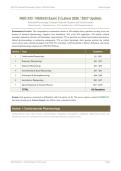
NSG 533 Advanced Pharmacology | Exam 2 | 2026/2027 Edition Wilkes University
NSG 533 / NSG533 Exam 2 (Latest Update)
Advanced Pharmacology | Complete Guide with Questions and Verified Answers
Wilkes University - Graduate Nursing - 100% Verified Correct - AACN Essentials Aligned
Examination Overview: This comprehensive examination consists of 100 multiple-choice questions covering seven core
domains of advanced pharmacology. Cognitive level distribution: 20% recall, 50% application, 30% analysis (clinical
reasoning, medication selection, and monitoring). Approximately 75% of questions are scenario-based patient presentations,
clinical decision-making, or medication management; 25% are direct knowledge. Each question provides the verified
correct answer and a rationale grounded in the NSG 533 curriculum, AACN Essentials of Master's Education, and current
advanced pharmacology competencies (2026/2027 Edition).
Section Topic Questions
1 Cardiovascular Pharmacology Q1 - Q20
2 Respiratory Pharmacology Q21 - Q32
3 Endocrine Pharmacology Q33 - Q50
4 Gastrointestinal & Renal Pharmacology Q51 - Q65
5 Neurological & Psychopharmacology Q66 - Q80
6 Anti-infective Pharmacology Q81 - Q92
7 Special Populations & Advanced Practice Q93 - Q100
TOTAL 100 Questions
Format: Each question is presented as Q[Number] with four options (A-D). The correct option is marked [CORRECT]
and shown in bold green. Correct Answer: line follows, then a rationale in italics.
Section 1: Cardiovascular Pharmacology
Antihypertensives, heart failure therapy, antidysrhythmics, antianginals, anticoagulants, antiplatelets, lipid-lowering agents, and
thrombolytics. Focus on mechanism-based selection, monitoring parameters, and patient safety.
NSG 533 Exam 2 - Verified Answers | 100% Correct Page 1
,NSG 533 Advanced Pharmacology | Exam 2 | 2026/2027 Edition Wilkes University
Q1: A 62-year-old African American male with hypertension (BP 158/96) and a history of dry cough while
taking an ACE inhibitor is prescribed an antihypertensive. The cough is most likely due to inhibition of which
enzyme pathway?
A. Inhibition of renin release
B. Inhibition of angiotensin II formation
C. Accumulation of bradykinin [CORRECT]
D. Stimulation of aldosterone secretion
Correct Answer: C
Rationale: ACE inhibitors block the conversion of angiotensin I to angiotensin II, but ACE also degrades bradykinin. The
accumulation of bradykinin in the respiratory tract produces a dry, persistent cough. African American patients have a higher
incidence of ACE inhibitor-induced cough. Switching to an ARB (which does not affect bradykinin) is appropriate. This aligns
with NSG 533 advanced pharmacology concepts of mechanism-based adverse effects.
Q2: A 58-year-old woman with HFrEF (EF 30%) develops a persistent dry cough on lisinopril. Which of the
following is the most appropriate alternative for guideline-directed medical therapy?
A. Discontinue ACE inhibitor; no replacement needed
B. Switch to losartan [CORRECT]
C. Add an ARB on top of the ACE inhibitor
D. Switch to a direct renin inhibitor
Correct Answer: B
Rationale: ACC/AHA HF guidelines recommend an ARB as a substitute for ACE inhibitors in patients who cannot tolerate them
due to cough or angioedema. Combining ACE and ARB increases renal failure and hyperkalemia risk and is contraindicated.
Direct renin inhibitors (aliskiren) are not recommended in HF. This is a key NSG 533 competency in managing RAAS therapy.
Q3: Which medication class is associated with first-dose syncope and should be initiated at bedtime?
A. Beta-blockers
B. Calcium channel blockers
C. Alpha-1 blockers [CORRECT]
D. Central alpha-2 agonists
Correct Answer: C
Rationale: Alpha-1 blockers (e.g., doxazosin, terazosin) cause profound orthostatic hypotension with the first dose due to
vasodilation. Initiation at bedtime minimizes injury from syncope. Beta-blockers and CCBs may cause hypotension but less
dramatically. This principle is reinforced in AACN Essentials for safe prescribing.
NSG 533 Exam 2 - Verified Answers | 100% Correct Page 2
,NSG 533 Advanced Pharmacology | Exam 2 | 2026/2027 Edition Wilkes University
Q4: A 71-year-old male with HFrEF, NYHA Class III, on maximal ACE inhibitor, beta-blocker, and
spironolactone continues to have symptoms and had a recent HF hospitalization. Which addition is most
appropriate per the 2022 AHA/ACC/HFSA guidelines?
A. Digoxin
B. Sacubitril/valsartan [CORRECT]
C. Nifedipine
D. Verapamil
Correct Answer: B
Rationale: ARNI (sacubitril/valsartan) is recommended to reduce morbidity and mortality in patients with HFrEF and NYHA
class II-III symptoms. It must replace the ACE inhibitor (not added) with a 36-hour washout period to prevent angioedema.
Non-dihydropyridine CCBs (verapamil) are contraindicated in HFrEF. Digoxin reduces hospitalizations but not mortality.
Q5: A 68-year-old patient with HFrEF and type 2 diabetes is being optimized per the 2022 AHA/ACC/HFSA
guidelines. The addition of which class has been shown to reduce HF hospitalization and cardiovascular
mortality regardless of diabetes status?
A. DPP-4 inhibitors
B. SGLT2 inhibitors [CORRECT]
C. Thiazolidinediones
D. Sulfonylureas
Correct Answer: B
Rationale: SGLT2 inhibitors (dapagliflozin, empagliflozin) are now guideline-directed medical therapy (GDMT) for HFrEF
regardless of diabetes status, based on DAPA-HF and EMPEROR-Reduced trials. Thiazolidinediones (pioglitazone) worsen HF.
DPP-4 inhibitors (saxagliptin) may increase HF risk. This is a key NSG 533 update aligning endocrine and CV pharmacology.
Q6: A 76-year-old female on digoxin 0.25 mg daily for atrial fibrillation presents with nausea, vomiting,
confusion, and yellow-green visual halos. Her serum potassium is 2.8 mEq/L. Which factor most likely
precipitated this presentation?
A. Concurrent use of amiodarone increasing digoxin clearance
B. Hypokalemia enhancing digoxin toxicity [CORRECT]
C. Development of hyperthyroidism
D. Co-administration with a non-DHP CCB reducing digoxin effect
Correct Answer: B
Rationale: Hypokalemia sensitizes the myocardium to digoxin by increasing its binding to Na+/K+-ATPase, precipitating toxicity.
Classic symptoms include GI distress, visual disturbances, and confusion. Concurrent amiodarone, verapamil, or quinidine
increases digoxin levels (not clearance). Treatment includes digoxin-specific antibody fragments (Fab) for severe toxicity.
NSG 533 Exam 2 - Verified Answers | 100% Correct Page 3
, NSG 533 Advanced Pharmacology | Exam 2 | 2026/2027 Edition Wilkes University
Q7: A 64-year-old male with atrial fibrillation, CKD with eGFR 28 mL/min, and CHA2DS2-VASc of 4
requires anticoagulation. Which is the preferred agent per current stroke prevention guidelines?
A. Warfarin with INR target 2-3
B. Apixaban [CORRECT]
C. Dabigatran 150 mg BID
D. Aspirin 325 mg daily
Correct Answer: B
Rationale: DOACs are preferred over warfarin in eligible patients with nonvalvular AF per 2023 ACC/AHA AF guidelines.
Apixaban has the most favorable renal clearance profile (~27% renal) and lower bleeding risk in CKD. Dabigatran 150 mg BID
is contraindicated below CrCl 30. Aspirin is insufficient for stroke prevention in AF with this CHA2DS2-VASc score.
Q8: A 70-year-old male on warfarin for a mechanical mitral valve presents with INR 8.5 (target 2.5-3.5) and
no bleeding. Which is the most appropriate management?
A. Administer fresh frozen plasma immediately
B. Hold warfarin and administer vitamin K 1-2.5 mg orally [CORRECT]
C. Hold warfarin and administer vitamin K 10 mg IV
D. Continue warfarin at the same dose
Correct Answer: B
Rationale: For INR > 5 without bleeding, hold warfarin and consider low-dose oral vitamin K (1-2.5 mg) to safely reverse. IV
vitamin K 10 mg causes overcorrection and prolonged warfarin resistance. FFP is reserved for major bleeding. Mechanical mitral
valves require INR 2.5-3.5; DOACs are contraindicated in mechanical valves.
Q9: A 55-year-old female with hyperlipidemia (LDL 165 mg/dL) and a 10-year ASCVD risk of 9% has tried
diet and exercise for 3 months with no improvement. Per 2018 ACC/AHA cholesterol guidelines, the most
appropriate therapy is:
A. High-intensity statin (atorvastatin 40-80 mg or rosuvastatin 20-40 mg)
B. Moderate-intensity statin [CORRECT]
C. Ezetimibe alone
D. PCSK9 inhibitor
Correct Answer: B
Rationale: For 10-year ASCVD risk 7.5-19.9% without clinical ASCVD, a moderate-intensity statin (atorvastatin 10-20 mg,
rosuvastatin 5-10 mg, simvastatin 20-40 mg) is indicated after risk discussion. High-intensity statin is reserved for ASCVD risk >=
20% or established disease. Ezetimibe and PCSK9 inhibitors are add-ons, not first-line.
Q10: A 65-year-old male on atorvastatin 80 mg presents with new-onset muscle aches and dark urine. CK is
5,000 U/L (normal < 200). Which is the most appropriate immediate management?
A. Continue statin and monitor CK weekly
B. Discontinue statin immediately and initiate IV hydration [CORRECT]
C. Switch to rosuvastatin 40 mg
D. Add ezetimibe to the current statin
Correct Answer: B
Rationale: Rhabdomyolysis (CK > 10x ULN with renal injury or dark urine from myoglobinuria) is a statin emergency.
Immediate discontinuation and IV hydration prevent acute kidney injury. Rechallenge with a different statin is contraindicated
until resolution. This is a critical NSG 533 safety competency.
NSG 533 Exam 2 - Verified Answers | 100% Correct Page 4
NSG 533 / NSG533 Exam 2 (Latest Update)
Advanced Pharmacology | Complete Guide with Questions and Verified Answers
Wilkes University - Graduate Nursing - 100% Verified Correct - AACN Essentials Aligned
Examination Overview: This comprehensive examination consists of 100 multiple-choice questions covering seven core
domains of advanced pharmacology. Cognitive level distribution: 20% recall, 50% application, 30% analysis (clinical
reasoning, medication selection, and monitoring). Approximately 75% of questions are scenario-based patient presentations,
clinical decision-making, or medication management; 25% are direct knowledge. Each question provides the verified
correct answer and a rationale grounded in the NSG 533 curriculum, AACN Essentials of Master's Education, and current
advanced pharmacology competencies (2026/2027 Edition).
Section Topic Questions
1 Cardiovascular Pharmacology Q1 - Q20
2 Respiratory Pharmacology Q21 - Q32
3 Endocrine Pharmacology Q33 - Q50
4 Gastrointestinal & Renal Pharmacology Q51 - Q65
5 Neurological & Psychopharmacology Q66 - Q80
6 Anti-infective Pharmacology Q81 - Q92
7 Special Populations & Advanced Practice Q93 - Q100
TOTAL 100 Questions
Format: Each question is presented as Q[Number] with four options (A-D). The correct option is marked [CORRECT]
and shown in bold green. Correct Answer: line follows, then a rationale in italics.
Section 1: Cardiovascular Pharmacology
Antihypertensives, heart failure therapy, antidysrhythmics, antianginals, anticoagulants, antiplatelets, lipid-lowering agents, and
thrombolytics. Focus on mechanism-based selection, monitoring parameters, and patient safety.
NSG 533 Exam 2 - Verified Answers | 100% Correct Page 1
,NSG 533 Advanced Pharmacology | Exam 2 | 2026/2027 Edition Wilkes University
Q1: A 62-year-old African American male with hypertension (BP 158/96) and a history of dry cough while
taking an ACE inhibitor is prescribed an antihypertensive. The cough is most likely due to inhibition of which
enzyme pathway?
A. Inhibition of renin release
B. Inhibition of angiotensin II formation
C. Accumulation of bradykinin [CORRECT]
D. Stimulation of aldosterone secretion
Correct Answer: C
Rationale: ACE inhibitors block the conversion of angiotensin I to angiotensin II, but ACE also degrades bradykinin. The
accumulation of bradykinin in the respiratory tract produces a dry, persistent cough. African American patients have a higher
incidence of ACE inhibitor-induced cough. Switching to an ARB (which does not affect bradykinin) is appropriate. This aligns
with NSG 533 advanced pharmacology concepts of mechanism-based adverse effects.
Q2: A 58-year-old woman with HFrEF (EF 30%) develops a persistent dry cough on lisinopril. Which of the
following is the most appropriate alternative for guideline-directed medical therapy?
A. Discontinue ACE inhibitor; no replacement needed
B. Switch to losartan [CORRECT]
C. Add an ARB on top of the ACE inhibitor
D. Switch to a direct renin inhibitor
Correct Answer: B
Rationale: ACC/AHA HF guidelines recommend an ARB as a substitute for ACE inhibitors in patients who cannot tolerate them
due to cough or angioedema. Combining ACE and ARB increases renal failure and hyperkalemia risk and is contraindicated.
Direct renin inhibitors (aliskiren) are not recommended in HF. This is a key NSG 533 competency in managing RAAS therapy.
Q3: Which medication class is associated with first-dose syncope and should be initiated at bedtime?
A. Beta-blockers
B. Calcium channel blockers
C. Alpha-1 blockers [CORRECT]
D. Central alpha-2 agonists
Correct Answer: C
Rationale: Alpha-1 blockers (e.g., doxazosin, terazosin) cause profound orthostatic hypotension with the first dose due to
vasodilation. Initiation at bedtime minimizes injury from syncope. Beta-blockers and CCBs may cause hypotension but less
dramatically. This principle is reinforced in AACN Essentials for safe prescribing.
NSG 533 Exam 2 - Verified Answers | 100% Correct Page 2
,NSG 533 Advanced Pharmacology | Exam 2 | 2026/2027 Edition Wilkes University
Q4: A 71-year-old male with HFrEF, NYHA Class III, on maximal ACE inhibitor, beta-blocker, and
spironolactone continues to have symptoms and had a recent HF hospitalization. Which addition is most
appropriate per the 2022 AHA/ACC/HFSA guidelines?
A. Digoxin
B. Sacubitril/valsartan [CORRECT]
C. Nifedipine
D. Verapamil
Correct Answer: B
Rationale: ARNI (sacubitril/valsartan) is recommended to reduce morbidity and mortality in patients with HFrEF and NYHA
class II-III symptoms. It must replace the ACE inhibitor (not added) with a 36-hour washout period to prevent angioedema.
Non-dihydropyridine CCBs (verapamil) are contraindicated in HFrEF. Digoxin reduces hospitalizations but not mortality.
Q5: A 68-year-old patient with HFrEF and type 2 diabetes is being optimized per the 2022 AHA/ACC/HFSA
guidelines. The addition of which class has been shown to reduce HF hospitalization and cardiovascular
mortality regardless of diabetes status?
A. DPP-4 inhibitors
B. SGLT2 inhibitors [CORRECT]
C. Thiazolidinediones
D. Sulfonylureas
Correct Answer: B
Rationale: SGLT2 inhibitors (dapagliflozin, empagliflozin) are now guideline-directed medical therapy (GDMT) for HFrEF
regardless of diabetes status, based on DAPA-HF and EMPEROR-Reduced trials. Thiazolidinediones (pioglitazone) worsen HF.
DPP-4 inhibitors (saxagliptin) may increase HF risk. This is a key NSG 533 update aligning endocrine and CV pharmacology.
Q6: A 76-year-old female on digoxin 0.25 mg daily for atrial fibrillation presents with nausea, vomiting,
confusion, and yellow-green visual halos. Her serum potassium is 2.8 mEq/L. Which factor most likely
precipitated this presentation?
A. Concurrent use of amiodarone increasing digoxin clearance
B. Hypokalemia enhancing digoxin toxicity [CORRECT]
C. Development of hyperthyroidism
D. Co-administration with a non-DHP CCB reducing digoxin effect
Correct Answer: B
Rationale: Hypokalemia sensitizes the myocardium to digoxin by increasing its binding to Na+/K+-ATPase, precipitating toxicity.
Classic symptoms include GI distress, visual disturbances, and confusion. Concurrent amiodarone, verapamil, or quinidine
increases digoxin levels (not clearance). Treatment includes digoxin-specific antibody fragments (Fab) for severe toxicity.
NSG 533 Exam 2 - Verified Answers | 100% Correct Page 3
, NSG 533 Advanced Pharmacology | Exam 2 | 2026/2027 Edition Wilkes University
Q7: A 64-year-old male with atrial fibrillation, CKD with eGFR 28 mL/min, and CHA2DS2-VASc of 4
requires anticoagulation. Which is the preferred agent per current stroke prevention guidelines?
A. Warfarin with INR target 2-3
B. Apixaban [CORRECT]
C. Dabigatran 150 mg BID
D. Aspirin 325 mg daily
Correct Answer: B
Rationale: DOACs are preferred over warfarin in eligible patients with nonvalvular AF per 2023 ACC/AHA AF guidelines.
Apixaban has the most favorable renal clearance profile (~27% renal) and lower bleeding risk in CKD. Dabigatran 150 mg BID
is contraindicated below CrCl 30. Aspirin is insufficient for stroke prevention in AF with this CHA2DS2-VASc score.
Q8: A 70-year-old male on warfarin for a mechanical mitral valve presents with INR 8.5 (target 2.5-3.5) and
no bleeding. Which is the most appropriate management?
A. Administer fresh frozen plasma immediately
B. Hold warfarin and administer vitamin K 1-2.5 mg orally [CORRECT]
C. Hold warfarin and administer vitamin K 10 mg IV
D. Continue warfarin at the same dose
Correct Answer: B
Rationale: For INR > 5 without bleeding, hold warfarin and consider low-dose oral vitamin K (1-2.5 mg) to safely reverse. IV
vitamin K 10 mg causes overcorrection and prolonged warfarin resistance. FFP is reserved for major bleeding. Mechanical mitral
valves require INR 2.5-3.5; DOACs are contraindicated in mechanical valves.
Q9: A 55-year-old female with hyperlipidemia (LDL 165 mg/dL) and a 10-year ASCVD risk of 9% has tried
diet and exercise for 3 months with no improvement. Per 2018 ACC/AHA cholesterol guidelines, the most
appropriate therapy is:
A. High-intensity statin (atorvastatin 40-80 mg or rosuvastatin 20-40 mg)
B. Moderate-intensity statin [CORRECT]
C. Ezetimibe alone
D. PCSK9 inhibitor
Correct Answer: B
Rationale: For 10-year ASCVD risk 7.5-19.9% without clinical ASCVD, a moderate-intensity statin (atorvastatin 10-20 mg,
rosuvastatin 5-10 mg, simvastatin 20-40 mg) is indicated after risk discussion. High-intensity statin is reserved for ASCVD risk >=
20% or established disease. Ezetimibe and PCSK9 inhibitors are add-ons, not first-line.
Q10: A 65-year-old male on atorvastatin 80 mg presents with new-onset muscle aches and dark urine. CK is
5,000 U/L (normal < 200). Which is the most appropriate immediate management?
A. Continue statin and monitor CK weekly
B. Discontinue statin immediately and initiate IV hydration [CORRECT]
C. Switch to rosuvastatin 40 mg
D. Add ezetimibe to the current statin
Correct Answer: B
Rationale: Rhabdomyolysis (CK > 10x ULN with renal injury or dark urine from myoglobinuria) is a statin emergency.
Immediate discontinuation and IV hydration prevent acute kidney injury. Rechallenge with a different statin is contraindicated
until resolution. This is a critical NSG 533 safety competency.
NSG 533 Exam 2 - Verified Answers | 100% Correct Page 4

