
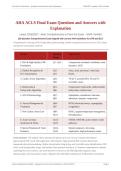
AHA ACLS Final Exam - Questions and Answers with Explanation 2026/2027 Update | 100% Verified
AHA ACLS Final Exam Questions and Answers with
Explanation
Latest 2026/2027 - Most Comprehensive to Pass the Exam - 100% Verified
135-Question Comprehensive Exam aligned with current AHA Guidelines for CPR and ECC
Comprehensive coverage of ACLS algorithms, pharmacology, rhythm recognition, post-arrest care, ACS, stroke,
and special resuscitation situations
Section Question Topic Focus
Range
1. BLS & High-Quality CPR Q1 - Q14 Compression rate/depth, ventilation, team
Foundations dynamics, AED
2. Rhythm Recognition & Q15 - Sinus, atrial, junctional, ventricular,
ECG Interpretation Q31 blocks
3. Cardiac Arrest Algorithms Q32 - VF/pVT, asystole/PEA, H's and T's
Q50 reversible causes
4. Bradycardia & Q51 - Symptomatic bradycardia, stable/unstable
Tachycardia Algorithms Q66 tachycardia, cardioversion
5. ACLS Pharmacology Q67 - Epinephrine, amiodarone, lidocaine,
Q83 adenosine, atropine, vasopressors
6. Airway Management & Q84 - BVM, advanced airways, capnography,
Ventilation Q97 oxygenation
7. Post-Cardiac Arrest Care Q98 - ROSC, targeted temperature management,
Q111 hemodynamics
8. Acute Coronary Q112 - STEMI, NSTEMI, acute ischemic stroke
Syndromes & Stroke Q123 pathways
9. Special Situations & Team Q124 - Opioid, pregnancy, drowning,
Dynamics Q135 anaphylaxis, high-performance teams
Exam structure: 135 multiple-choice questions (4 options each, one correct). Cognitive distribution
approximately 30% recall, 50% application, 20% analysis. Approximately 80% scenario-based items
(megacode-style decision-making, rhythm interpretation, drug dosing, and reversible cause identification); 20%
direct recall of algorithms, drugs, and rhythms. Each question includes a 3-5 sentence comprehensive rationale
explaining the correct answer, why each distractor is incorrect, the AHA algorithm sequence, drug
pharmacology, and resuscitation science. Aligned to the 2020 AHA Guidelines for CPR and ECC (continued
Most Comprehensive Edition - Aligned to Current AHA Guidelines for CPR and ECC Page 1
,AHA ACLS Final Exam - Questions and Answers with Explanation 2026/2027 Update | 100% Verified
2026/2027) and the AHA ACLS Provider Manual.
Section 1: BLS and High-Quality CPR Foundations (Compression Rate/Depth,
Ventilation, Team Dynamics, & AED Use)
Q1: A 55-year-old man collapses in the hospital lobby. He is unresponsive, not breathing normally,
and has no pulse. The code team is preparing to start chest compressions. What is the correct
compression rate and depth for high-quality CPR in this adult per the 2026/2027 AHA guidelines?
A. Rate 100-120 compressions per minute; depth 2-2.4 inches (5-6 cm); allow full chest recoil
between compressions [CORRECT]
B. Rate 80-100 compressions per minute; depth at least 1.5 inches
C. Rate 120-140 compressions per minute; depth 1.5-2 inches
D. Rate 100 compressions per minute; depth at least 3 inches
Correct Answer: A
Rationale: Per the 2020 AHA guidelines (carried forward in 2026/2027 updates), adult high-quality CPR uses a rate of
100-120 compressions/min and depth of 2-2.4 inches (5-6 cm) with full chest recoil. Option B is too slow and shallow.
Option C is too fast and shallow. Option D is too deep. The AHA emphasizes that excessive depth (>2.4 in) may cause
harm, while insufficient depth (<2 in) is ineffective.
Q2: During a code, the team leader observes that compressions are being paused for 15 seconds each
minute to allow pulse checks and intubation. What is the maximum acceptable chest compression
fraction (CCF), and what is the AHA target?
A. AHA recommends a chest compression fraction of at least 80% (target goal) with minimal
interruptions [CORRECT]
B. 60% is acceptable; interruptions are unavoidable
C. 90% is required; any interruption is unacceptable
D. 40% is acceptable because ventilation requires pauses
Correct Answer: A
Rationale: The AHA recommends a chest compression fraction of at least 80% during CPR to maximize perfusion.
Option B (60%) is too low and reflects poor technique. Option C (90%) is unrealistic and not the documented target.
Option D (40%) is dangerously low. The team should minimize interruptions for pulse checks, intubation, and rhythm
analysis.
Most Comprehensive Edition - Aligned to Current AHA Guidelines for CPR and ECC Page 2
,AHA ACLS Final Exam - Questions and Answers with Explanation 2026/2027 Update | 100% Verified
Q3: A patient in cardiac arrest has an advanced airway in place. What is the correct ventilation rate
per the AHA ACLS algorithm?
A. 1 breath every 6 seconds (10 breaths per minute) with continuous compressions [CORRECT]
B. 1 breath every 2 seconds (30 breaths per minute)
C. 1 breath every 10 seconds (6 breaths per minute)
D. 30 compressions followed by 2 breaths (30:2 ratio)
Correct Answer: A
Rationale: Once an advanced airway is in place, ventilation is 1 breath every 6 seconds (~10 breaths/min) with
continuous compressions, no longer pausing for ventilation. Option B hyperventilates. Option C underventilates.
Option D is the 30:2 ratio used only BEFORE an advanced airway is in place. Hyperventilation is harmful; it increases
intrathoracic pressure and decreases coronary perfusion.
Q4: Before an advanced airway is placed, what is the correct compression-to-ventilation ratio for an
adult victim with no advanced airway and two rescuers available?
A. 30 compressions to 2 ventilations (30:2) [CORRECT]
B. 15 compressions to 2 ventilations (15:2)
C. 30 compressions to 1 ventilation (30:1)
D. Continuous compressions with no ventilations
Correct Answer: A
Rationale: For an adult with two rescuers and no advanced airway, the ratio is 30:2. Option B (15:2) is the pediatric
two-rescuer ratio, not adult. Option C (30:1) is incorrect. Option D omits ventilation, which would lead to hypoxia. The
30:2 ratio balances circulation and oxygenation in the pre-advanced-airway phase.
Q5: An AED arrives at the scene of a cardiac arrest. After turning it on and applying pads, the AED
analyzes the rhythm and advises 'NO SHOCK ADVISED.' What is the next correct action?
A. Immediately resume CPR starting with chest compressions, continuing until the AED
prompts another analysis [CORRECT]
B. Wait for EMS to arrive before doing anything
C. Remove the AED pads and try a different AED
D. Check the pulse for 30 seconds before resuming compressions
Correct Answer: A
Rationale: When the AED advises 'No Shock,' immediately resume CPR starting with compressions. The AHA
emphasizes minimizing interruptions. Option B delays life-saving care. Option C wastes time and equipment. Option D
wastes 30 seconds with no therapeutic benefit. The AED will prompt the next rhythm analysis.
Most Comprehensive Edition - Aligned to Current AHA Guidelines for CPR and ECC Page 3
, AHA ACLS Final Exam - Questions and Answers with Explanation 2026/2027 Update | 100% Verified
Q6: Which is the correct AED pad placement for an adult victim in cardiac arrest?
A. One pad on the upper right side of the chest below the clavicle, the other on the lower left side
of the chest below the pectoral muscle (apex) [CORRECT]
B. Both pads on the front of the chest
C. Both pads on the back of the chest
D. One pad on the abdomen and one on the neck
Correct Answer: A
Rationale: Standard AED pad placement is one pad below the right clavicle and the other at the left lower chest/apex,
allowing current to traverse the heart. Option B and C (both pads on same side) do not direct current through the heart.
Option D (abdomen and neck) is anatomically wrong. Alternate placements (anteroposterior) are acceptable when
standard placement is impossible.
Q7: During a resuscitation, the team leader says, 'Epinephrine 1 mg IV push.' The medication nurse
responds, 'Epinephrine 1 mg IV push, drawing up now.' After administration, the nurse says,
'Epinephrine 1 mg IV push given at 10:32.' This communication pattern is best described as:
A. Closed-loop communication, with verbal order, repeat-back, and confirmation [CORRECT]
B. Open-loop communication without confirmation
C. Multitasking communication
D. Nonverbal communication only
Correct Answer: A
Rationale: Closed-loop communication requires the sender to state the order, the receiver to repeat it back, and the
receiver to confirm completion. Option B lacks confirmation. Option C is multitasking, not a communication style.
Option D is wrong because the communication is verbal. The AHA emphasizes closed-loop communication to prevent
medication errors during resuscitation.
Q8: Which action is most important to ensure full chest recoil during CPR?
A. Lift the hands slightly off the chest at the top of each compression, allowing the chest to return
to its neutral position [CORRECT]
B. Press harder into the chest at the top of each compression
C. Keep hands firmly in contact with the chest throughout the compression
D. Pause briefly between each compression cycle
Correct Answer: A
Rationale: Full chest recoil requires allowing the chest to return to its neutral position by lifting the hands slightly at
the top of the compression. Option B prevents recoil. Option C prevents recoil by keeping force on the chest. Option D
reduces compression fraction. Full recoil allows the heart to refill with blood between compressions.
Most Comprehensive Edition - Aligned to Current AHA Guidelines for CPR and ECC Page 4
AHA ACLS Final Exam Questions and Answers with
Explanation
Latest 2026/2027 - Most Comprehensive to Pass the Exam - 100% Verified
135-Question Comprehensive Exam aligned with current AHA Guidelines for CPR and ECC
Comprehensive coverage of ACLS algorithms, pharmacology, rhythm recognition, post-arrest care, ACS, stroke,
and special resuscitation situations
Section Question Topic Focus
Range
1. BLS & High-Quality CPR Q1 - Q14 Compression rate/depth, ventilation, team
Foundations dynamics, AED
2. Rhythm Recognition & Q15 - Sinus, atrial, junctional, ventricular,
ECG Interpretation Q31 blocks
3. Cardiac Arrest Algorithms Q32 - VF/pVT, asystole/PEA, H's and T's
Q50 reversible causes
4. Bradycardia & Q51 - Symptomatic bradycardia, stable/unstable
Tachycardia Algorithms Q66 tachycardia, cardioversion
5. ACLS Pharmacology Q67 - Epinephrine, amiodarone, lidocaine,
Q83 adenosine, atropine, vasopressors
6. Airway Management & Q84 - BVM, advanced airways, capnography,
Ventilation Q97 oxygenation
7. Post-Cardiac Arrest Care Q98 - ROSC, targeted temperature management,
Q111 hemodynamics
8. Acute Coronary Q112 - STEMI, NSTEMI, acute ischemic stroke
Syndromes & Stroke Q123 pathways
9. Special Situations & Team Q124 - Opioid, pregnancy, drowning,
Dynamics Q135 anaphylaxis, high-performance teams
Exam structure: 135 multiple-choice questions (4 options each, one correct). Cognitive distribution
approximately 30% recall, 50% application, 20% analysis. Approximately 80% scenario-based items
(megacode-style decision-making, rhythm interpretation, drug dosing, and reversible cause identification); 20%
direct recall of algorithms, drugs, and rhythms. Each question includes a 3-5 sentence comprehensive rationale
explaining the correct answer, why each distractor is incorrect, the AHA algorithm sequence, drug
pharmacology, and resuscitation science. Aligned to the 2020 AHA Guidelines for CPR and ECC (continued
Most Comprehensive Edition - Aligned to Current AHA Guidelines for CPR and ECC Page 1
,AHA ACLS Final Exam - Questions and Answers with Explanation 2026/2027 Update | 100% Verified
2026/2027) and the AHA ACLS Provider Manual.
Section 1: BLS and High-Quality CPR Foundations (Compression Rate/Depth,
Ventilation, Team Dynamics, & AED Use)
Q1: A 55-year-old man collapses in the hospital lobby. He is unresponsive, not breathing normally,
and has no pulse. The code team is preparing to start chest compressions. What is the correct
compression rate and depth for high-quality CPR in this adult per the 2026/2027 AHA guidelines?
A. Rate 100-120 compressions per minute; depth 2-2.4 inches (5-6 cm); allow full chest recoil
between compressions [CORRECT]
B. Rate 80-100 compressions per minute; depth at least 1.5 inches
C. Rate 120-140 compressions per minute; depth 1.5-2 inches
D. Rate 100 compressions per minute; depth at least 3 inches
Correct Answer: A
Rationale: Per the 2020 AHA guidelines (carried forward in 2026/2027 updates), adult high-quality CPR uses a rate of
100-120 compressions/min and depth of 2-2.4 inches (5-6 cm) with full chest recoil. Option B is too slow and shallow.
Option C is too fast and shallow. Option D is too deep. The AHA emphasizes that excessive depth (>2.4 in) may cause
harm, while insufficient depth (<2 in) is ineffective.
Q2: During a code, the team leader observes that compressions are being paused for 15 seconds each
minute to allow pulse checks and intubation. What is the maximum acceptable chest compression
fraction (CCF), and what is the AHA target?
A. AHA recommends a chest compression fraction of at least 80% (target goal) with minimal
interruptions [CORRECT]
B. 60% is acceptable; interruptions are unavoidable
C. 90% is required; any interruption is unacceptable
D. 40% is acceptable because ventilation requires pauses
Correct Answer: A
Rationale: The AHA recommends a chest compression fraction of at least 80% during CPR to maximize perfusion.
Option B (60%) is too low and reflects poor technique. Option C (90%) is unrealistic and not the documented target.
Option D (40%) is dangerously low. The team should minimize interruptions for pulse checks, intubation, and rhythm
analysis.
Most Comprehensive Edition - Aligned to Current AHA Guidelines for CPR and ECC Page 2
,AHA ACLS Final Exam - Questions and Answers with Explanation 2026/2027 Update | 100% Verified
Q3: A patient in cardiac arrest has an advanced airway in place. What is the correct ventilation rate
per the AHA ACLS algorithm?
A. 1 breath every 6 seconds (10 breaths per minute) with continuous compressions [CORRECT]
B. 1 breath every 2 seconds (30 breaths per minute)
C. 1 breath every 10 seconds (6 breaths per minute)
D. 30 compressions followed by 2 breaths (30:2 ratio)
Correct Answer: A
Rationale: Once an advanced airway is in place, ventilation is 1 breath every 6 seconds (~10 breaths/min) with
continuous compressions, no longer pausing for ventilation. Option B hyperventilates. Option C underventilates.
Option D is the 30:2 ratio used only BEFORE an advanced airway is in place. Hyperventilation is harmful; it increases
intrathoracic pressure and decreases coronary perfusion.
Q4: Before an advanced airway is placed, what is the correct compression-to-ventilation ratio for an
adult victim with no advanced airway and two rescuers available?
A. 30 compressions to 2 ventilations (30:2) [CORRECT]
B. 15 compressions to 2 ventilations (15:2)
C. 30 compressions to 1 ventilation (30:1)
D. Continuous compressions with no ventilations
Correct Answer: A
Rationale: For an adult with two rescuers and no advanced airway, the ratio is 30:2. Option B (15:2) is the pediatric
two-rescuer ratio, not adult. Option C (30:1) is incorrect. Option D omits ventilation, which would lead to hypoxia. The
30:2 ratio balances circulation and oxygenation in the pre-advanced-airway phase.
Q5: An AED arrives at the scene of a cardiac arrest. After turning it on and applying pads, the AED
analyzes the rhythm and advises 'NO SHOCK ADVISED.' What is the next correct action?
A. Immediately resume CPR starting with chest compressions, continuing until the AED
prompts another analysis [CORRECT]
B. Wait for EMS to arrive before doing anything
C. Remove the AED pads and try a different AED
D. Check the pulse for 30 seconds before resuming compressions
Correct Answer: A
Rationale: When the AED advises 'No Shock,' immediately resume CPR starting with compressions. The AHA
emphasizes minimizing interruptions. Option B delays life-saving care. Option C wastes time and equipment. Option D
wastes 30 seconds with no therapeutic benefit. The AED will prompt the next rhythm analysis.
Most Comprehensive Edition - Aligned to Current AHA Guidelines for CPR and ECC Page 3
, AHA ACLS Final Exam - Questions and Answers with Explanation 2026/2027 Update | 100% Verified
Q6: Which is the correct AED pad placement for an adult victim in cardiac arrest?
A. One pad on the upper right side of the chest below the clavicle, the other on the lower left side
of the chest below the pectoral muscle (apex) [CORRECT]
B. Both pads on the front of the chest
C. Both pads on the back of the chest
D. One pad on the abdomen and one on the neck
Correct Answer: A
Rationale: Standard AED pad placement is one pad below the right clavicle and the other at the left lower chest/apex,
allowing current to traverse the heart. Option B and C (both pads on same side) do not direct current through the heart.
Option D (abdomen and neck) is anatomically wrong. Alternate placements (anteroposterior) are acceptable when
standard placement is impossible.
Q7: During a resuscitation, the team leader says, 'Epinephrine 1 mg IV push.' The medication nurse
responds, 'Epinephrine 1 mg IV push, drawing up now.' After administration, the nurse says,
'Epinephrine 1 mg IV push given at 10:32.' This communication pattern is best described as:
A. Closed-loop communication, with verbal order, repeat-back, and confirmation [CORRECT]
B. Open-loop communication without confirmation
C. Multitasking communication
D. Nonverbal communication only
Correct Answer: A
Rationale: Closed-loop communication requires the sender to state the order, the receiver to repeat it back, and the
receiver to confirm completion. Option B lacks confirmation. Option C is multitasking, not a communication style.
Option D is wrong because the communication is verbal. The AHA emphasizes closed-loop communication to prevent
medication errors during resuscitation.
Q8: Which action is most important to ensure full chest recoil during CPR?
A. Lift the hands slightly off the chest at the top of each compression, allowing the chest to return
to its neutral position [CORRECT]
B. Press harder into the chest at the top of each compression
C. Keep hands firmly in contact with the chest throughout the compression
D. Pause briefly between each compression cycle
Correct Answer: A
Rationale: Full chest recoil requires allowing the chest to return to its neutral position by lifting the hands slightly at
the top of the compression. Option B prevents recoil. Option C prevents recoil by keeping force on the chest. Option D
reduces compression fraction. Full recoil allows the heart to refill with blood between compressions.
Most Comprehensive Edition - Aligned to Current AHA Guidelines for CPR and ECC Page 4

