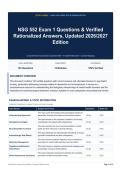
[STUDY GUIDE] • HIGH-YIELD PRACTICE & REVIEW EDITION
NSG 552 Exam 1 Questions & Verified
Rationalized Answers, Updated 2026/2027
Edition
Comprehensive Examination Question Bank • In-Depth Rationales • Concept Mapping
TOTAL QUESTIONS EXAM TOPICS RATIONALES
145 Questions 12 Modules 100% Verified
DOCUMENT OVERVIEW
This document contains 145 verified questions with correct answers and rationales focused on psychiatric
nursing, particularly addressing concepts related to depression and schizophrenia. It serves as a
comprehensive resource for understanding the biological underpinnings of mental health disorders and the
implications for pharmacological treatment, making it suitable for exam preparation and professional review.
EXAM BLUEPRINT & TOPIC DISTRIBUTION
Systematic breakdown of subject domains and exam coverage.
Topic Module Scope & Core Focus Questions Share (%)
This topic covers the biological and psychological aspects of
Understanding Depression depression, including its symptoms and treatment options. 12 Qs 8.3%
This topic focuses on the symptoms, treatment, and nursing
Schizophrenia Insights considerations for patients with schizophrenia. 14 Qs 9.7%
This topic examines the role of neurotransmitters in mental
Neurotransmitter Functions health and their relevance in pharmacotherapy. 12 Qs 8.3%
This topic addresses the anticholinergic side effects of various
Anticholinergic Side Effects psychiatric medications and their management. 12 Qs 8.3%
This topic includes questions regarding various medications
Medication Management prescribed for mental health disorders and their effects. 12 Qs 8.3%
Cognitive and Behavioral This topic focuses on cognitive and behavioral strategies used
Interventions in psychiatric nursing to assist patients. 12 Qs 8.3%
This topic emphasizes assessment strategies for evaluating
Patient Assessment Techniques psychiatric conditions and patient needs. 12 Qs 8.3%
Confidential • Student Study Edition • Practice & Review Guide Page 1 of 75
,STUDENT STUDY & MASTERY EDITION PRACTICE & REVIEW GUIDE
This topic discusses the principles of psychopharmacology,
Psychopharmacology Basics including the action of various drug classes. 12 Qs 8.3%
This topic covers the genetic factors influencing mental health
Genetics in Mental Health disorders, including family dynamics. 12 Qs 8.3%
This topic explores effective communication techniques used
Therapeutic Communication in psychiatric nursing practice. 12 Qs 8.3%
This topic addresses the rehabilitation needs and strategies
Psychiatric Rehabilitation for patients with severe mental health disorders. 12 Qs 8.3%
This topic discusses the indications and considerations for
Electroconvulsive Therapy (ECT) using ECT in treatment-resistant depression. 11 Qs 7.6%
Total Exam Coverage 12 Integrated Topic Modules 145 Qs 100.0%
Confidential • Student Study Edition • Practice & Review Guide Page 2 of 75
,STUDENT STUDY & MASTERY EDITION PRACTICE & REVIEW GUIDE
TOPIC 1: UNDERSTANDING DEPRESSION
12 Questions • 8.3% of Exam • This topic covers the biological and psychological aspects of depression, including its symptoms and
treatment options.
QUESTION 1
A patient with depression mentions to the nurse, My mother says depression is a
chemical disorder. What does she mean? The nurses response is based on the theory
that depression primarily involves which of the following neurotransmitters?
[a] Cortisol and GABA
[b] COMT and glutamate
[c] Monamine and glycine
[d] Serotonin and norepinephrine
Correct Answer: D. Serotonin and norepinephrine.
Rationale: The nurse's response is based on the theory of biogenic amine hypothesis, which suggests that depression is
associated with an imbalance of certain neurotransmitters in the brain, specifically serotonin and norepinephrine, which play
key roles in regulating mood.
This theory is supported by research indicating that medications targeting these neurotransmitters, such as selective
serotonin reuptake inhibitors (SSRIs), are effective in treating depression.
QUESTION 2
A patient with depression tells the nurse that he is to have a test that involves the
recording of an electroencephalogram (EEG) throughout the night. The 18. nurse most
likely identifies this testing as which of the following?
[A)] Sleep deprivation EEG
[B)] Polysomnography
[C)] Evoked potentials
[D)] Functional magnetic resonance imaging
Correct Answer: B) Polysomnography.
Rationale: Polysomnography is the correct answer because it involves the simultaneous recording of multiple physiological
activities, including an electroencephalogram (EEG), during sleep, which aligns with the test described in the scenario. This
comprehensive sleep study is used to diagnose and monitor sleep disorders, making it the most likely test for a patient with
depression who requires a nighttime EEG recording.
Confidential • Student Study Edition • Practice & Review Guide Page 3 of 75
, STUDENT STUDY & MASTERY EDITION PRACTICE & REVIEW GUIDE
QUESTION 3
A young male patient taking an antipsychotic is experiencing an oculogyric crisis. The
nurse prepares to administer:
[a] diphenhydramine.
[b] haloperidol.
[c] aripiprazole.
[d] risperidone.
Correct Answer: A. diphenhydramine.
Rationale: Oculogyric crisis is a side effect associated with antipsychotic medications, particularly first-generation or typical
antipsychotics like haloperidol, which can cause dystonic reactions, including oculogyric crisis. Diphenhydramine, an
antihistamine with anticholinergic properties, is often administered to counteract this side effect by blocking the acetylcholine
receptors that contribute to the dystonic reaction.
QUESTION 4
Which psychological manifestation of depression will improve in response to
antidepressant therapy?
[a] Loss of energy
[b] Palpitations
[c] Sleep disturbances
[d] Social
Correct Answer: D. Social.
Rationale: Antidepressant therapy primarily targets the cognitive and emotional aspects of depression, which is reflected in
the concept of "Social" manifestation, as it encompasses changes in an individual's interpersonal interactions, relationships,
and overall social
functioning. In contrast, physical symptoms like loss of energy, palpitations, and sleep disturbances are more related to the
somatic symptoms of depression, which tend to be less responsive to antidepressant therapy alone.
Confidential • Student Study Edition • Practice & Review Guide Page 4 of 75
NSG 552 Exam 1 Questions & Verified
Rationalized Answers, Updated 2026/2027
Edition
Comprehensive Examination Question Bank • In-Depth Rationales • Concept Mapping
TOTAL QUESTIONS EXAM TOPICS RATIONALES
145 Questions 12 Modules 100% Verified
DOCUMENT OVERVIEW
This document contains 145 verified questions with correct answers and rationales focused on psychiatric
nursing, particularly addressing concepts related to depression and schizophrenia. It serves as a
comprehensive resource for understanding the biological underpinnings of mental health disorders and the
implications for pharmacological treatment, making it suitable for exam preparation and professional review.
EXAM BLUEPRINT & TOPIC DISTRIBUTION
Systematic breakdown of subject domains and exam coverage.
Topic Module Scope & Core Focus Questions Share (%)
This topic covers the biological and psychological aspects of
Understanding Depression depression, including its symptoms and treatment options. 12 Qs 8.3%
This topic focuses on the symptoms, treatment, and nursing
Schizophrenia Insights considerations for patients with schizophrenia. 14 Qs 9.7%
This topic examines the role of neurotransmitters in mental
Neurotransmitter Functions health and their relevance in pharmacotherapy. 12 Qs 8.3%
This topic addresses the anticholinergic side effects of various
Anticholinergic Side Effects psychiatric medications and their management. 12 Qs 8.3%
This topic includes questions regarding various medications
Medication Management prescribed for mental health disorders and their effects. 12 Qs 8.3%
Cognitive and Behavioral This topic focuses on cognitive and behavioral strategies used
Interventions in psychiatric nursing to assist patients. 12 Qs 8.3%
This topic emphasizes assessment strategies for evaluating
Patient Assessment Techniques psychiatric conditions and patient needs. 12 Qs 8.3%
Confidential • Student Study Edition • Practice & Review Guide Page 1 of 75
,STUDENT STUDY & MASTERY EDITION PRACTICE & REVIEW GUIDE
This topic discusses the principles of psychopharmacology,
Psychopharmacology Basics including the action of various drug classes. 12 Qs 8.3%
This topic covers the genetic factors influencing mental health
Genetics in Mental Health disorders, including family dynamics. 12 Qs 8.3%
This topic explores effective communication techniques used
Therapeutic Communication in psychiatric nursing practice. 12 Qs 8.3%
This topic addresses the rehabilitation needs and strategies
Psychiatric Rehabilitation for patients with severe mental health disorders. 12 Qs 8.3%
This topic discusses the indications and considerations for
Electroconvulsive Therapy (ECT) using ECT in treatment-resistant depression. 11 Qs 7.6%
Total Exam Coverage 12 Integrated Topic Modules 145 Qs 100.0%
Confidential • Student Study Edition • Practice & Review Guide Page 2 of 75
,STUDENT STUDY & MASTERY EDITION PRACTICE & REVIEW GUIDE
TOPIC 1: UNDERSTANDING DEPRESSION
12 Questions • 8.3% of Exam • This topic covers the biological and psychological aspects of depression, including its symptoms and
treatment options.
QUESTION 1
A patient with depression mentions to the nurse, My mother says depression is a
chemical disorder. What does she mean? The nurses response is based on the theory
that depression primarily involves which of the following neurotransmitters?
[a] Cortisol and GABA
[b] COMT and glutamate
[c] Monamine and glycine
[d] Serotonin and norepinephrine
Correct Answer: D. Serotonin and norepinephrine.
Rationale: The nurse's response is based on the theory of biogenic amine hypothesis, which suggests that depression is
associated with an imbalance of certain neurotransmitters in the brain, specifically serotonin and norepinephrine, which play
key roles in regulating mood.
This theory is supported by research indicating that medications targeting these neurotransmitters, such as selective
serotonin reuptake inhibitors (SSRIs), are effective in treating depression.
QUESTION 2
A patient with depression tells the nurse that he is to have a test that involves the
recording of an electroencephalogram (EEG) throughout the night. The 18. nurse most
likely identifies this testing as which of the following?
[A)] Sleep deprivation EEG
[B)] Polysomnography
[C)] Evoked potentials
[D)] Functional magnetic resonance imaging
Correct Answer: B) Polysomnography.
Rationale: Polysomnography is the correct answer because it involves the simultaneous recording of multiple physiological
activities, including an electroencephalogram (EEG), during sleep, which aligns with the test described in the scenario. This
comprehensive sleep study is used to diagnose and monitor sleep disorders, making it the most likely test for a patient with
depression who requires a nighttime EEG recording.
Confidential • Student Study Edition • Practice & Review Guide Page 3 of 75
, STUDENT STUDY & MASTERY EDITION PRACTICE & REVIEW GUIDE
QUESTION 3
A young male patient taking an antipsychotic is experiencing an oculogyric crisis. The
nurse prepares to administer:
[a] diphenhydramine.
[b] haloperidol.
[c] aripiprazole.
[d] risperidone.
Correct Answer: A. diphenhydramine.
Rationale: Oculogyric crisis is a side effect associated with antipsychotic medications, particularly first-generation or typical
antipsychotics like haloperidol, which can cause dystonic reactions, including oculogyric crisis. Diphenhydramine, an
antihistamine with anticholinergic properties, is often administered to counteract this side effect by blocking the acetylcholine
receptors that contribute to the dystonic reaction.
QUESTION 4
Which psychological manifestation of depression will improve in response to
antidepressant therapy?
[a] Loss of energy
[b] Palpitations
[c] Sleep disturbances
[d] Social
Correct Answer: D. Social.
Rationale: Antidepressant therapy primarily targets the cognitive and emotional aspects of depression, which is reflected in
the concept of "Social" manifestation, as it encompasses changes in an individual's interpersonal interactions, relationships,
and overall social
functioning. In contrast, physical symptoms like loss of energy, palpitations, and sleep disturbances are more related to the
somatic symptoms of depression, which tend to be less responsive to antidepressant therapy alone.
Confidential • Student Study Edition • Practice & Review Guide Page 4 of 75