[STUDY GUIDE] • HIGH-YIELD PRACTICE & REVIEW EDITION
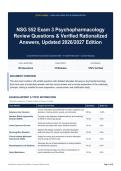
NSG 552 Exam 3 Psychopharmacology
Review Questions & Verified Rationalized
Answers, Updated 2026/2027 Edition
Comprehensive Examination Question Bank • In-Depth Rationales • Concept Mapping
TOTAL QUESTIONS EXAM TOPICS RATIONALES
149 Questions 10 Modules 100% Verified
DOCUMENT OVERVIEW
This document contains 149 verified questions with detailed rationales focusing on psychopharmacology.
Each item pairs a board-style question with the correct answer and a concise explanation of the underlying
principle, making it suitable for exam preparation, course review, and certification study.
EXAM BLUEPRINT & TOPIC DISTRIBUTION
Systematic breakdown of subject domains and exam coverage.
Topic Module Scope & Core Focus Questions Share (%)
Covers medications and treatments for various substance use
Substance Use Disorders disorders, including alcohol, opioids, and stimulants. 25 Qs 16.8%
Attention Deficit Hyperactivity Focuses on the diagnosis, treatment options, and monitoring
Disorder (ADHD) of ADHD in various age groups. 14 Qs 9.4%
Examines treatment options for managing disruptive
Autism Spectrum Disorder behaviors associated with autism spectrum disorder. 14 Qs 9.4%
Explores the etiology, symptoms, and pharmacological
Neurocognitive Disorders treatment options for various neurocognitive disorders. 14 Qs 9.4%
Clinical Institute Withdrawal Details the scoring and assessment of alcohol withdrawal
Assessment (CIWA) severity using the CIWA scale. 14 Qs 9.4%
Discusses the use of benzodiazepines in treating sedation
Benzodiazepines and Sedatives and withdrawal symptoms. 14 Qs 9.4%
Covers the pharmacology and clinical considerations for
Opioid Medications opioid medications and their effects. 14 Qs 9.4%
Confidential • Student Study Edition • Practice & Review Guide Page 1 of 49
,STUDENT STUDY & MASTERY EDITION PRACTICE & REVIEW GUIDE
Medications for Mood and Focuses on the use of antidepressants and their side effects
Anxiety Disorders in various populations, including the elderly. 14 Qs 9.4%
Examines pharmacological options for managing sexual
Sexual Dysfunction Treatment dysfunction related to various conditions. 13 Qs 8.7%
Covers general pharmacological principles relevant to
General Pharmacology psychopharmacology, including drug interactions and side
Principles effects. 13 Qs 8.7%
Total Exam Coverage 10 Integrated Topic Modules 149 Qs 100.0%
Confidential • Student Study Edition • Practice & Review Guide Page 2 of 49
,STUDENT STUDY & MASTERY EDITION PRACTICE & REVIEW GUIDE
TOPIC 1: SUBSTANCE USE DISORDERS
25 Questions • 16.8% of Exam • Covers medications and treatments for various substance use disorders, including alcohol, opioids,
and stimulants.
QUESTION 1
Naltrexone class
Correct Answer: Opioid receptor antagonist.
Rationale: Naltrexone works by binding to opioid receptors, but instead of activating them, it blocks them, thereby
preventing opioids from exerting their typical effects. This mechanism of action is characteristic of opioid receptor
antagonists, which bind to opioid receptors without activating them, effectively reversing or blocking the effects of opioids.
QUESTION 2
Naltrexone can be used for
Correct Answer: Both ETOH and opioid use disorders.
Rationale: Naltrexone is an opioid receptor antagonist that blocks the effects of opioids, making it effective in treating opioid
use disorders. Its mechanism of action is similar when used in conjunction with alcohol dependence, as it also targets the
brain's reward system, thus making it suitable for both ETOH (ethanol) and opioid use disorders.
QUESTION 3
First line treatment in maintaining abstinence after detox
Correct Answer: Acamprosate.
Rationale: Acamprosate is the correct choice because it is a medication specifically designed to help maintain abstinence in
individuals who have undergone detoxification from alcohol, as it modulates the glutamate and GABA neurotransmitter
systems to reduce cravings and withdrawal symptoms. Its primary use is to prevent relapse in alcohol dependence, making
it a first-line treatment for maintaining abstinence after detox.
Confidential • Student Study Edition • Practice & Review Guide Page 3 of 49
, STUDENT STUDY & MASTERY EDITION PRACTICE & REVIEW GUIDE
QUESTION 4
Acamprosate Contraindicated in
Correct Answer: Severe renal disease.
Rationale: Acamprosate is primarily used to treat alcohol dependence by modulating glutamate and GABA
neurotransmission, which helps to alleviate symptoms of alcohol withdrawal. However, in severe renal disease,
acamprosate's metabolites are not adequately cleared from the body, potentially leading to toxicity and adverse effects, thus
making it contraindicated in this condition.
QUESTION 5
ETOH 2nd line treatment
Correct Answer: Disulfiram (Antabuse)
Rationale: Disulfiram (Antabuse) is used as a second-line treatment for ETOH (ethanol) dependence because it works by
inducing an aversive reaction when alcohol is consumed, thereby discouraging the individual from drinking. This is in
contrast to first-line treatments like acamprosate or naltrexone, which primarily aim to reduce cravings or block the effects of
alcohol, but do not induce a direct aversive response.
QUESTION 6
Disulfiram (Antabuse) Do not
Correct Answer: Administer until the person has been alcohol free at least 12 hours.
Rationale: Disulfiram (Antabuse) works by inhibiting the enzyme acetaldehyde dehydrogenase, which is responsible for
breaking down acetaldehyde, a toxic byproduct of alcohol metabolism. If administered to someone who has recently
consumed alcohol, disulfiram can cause a severe adverse reaction, so it must be given after the person has been
alcohol-free for at least 12 hours to prevent this reaction.
QUESTION 7
ETOH withdrawal- Benzos
Correct Answer: To keep patient calm and lightly sedated.
Rationale: This answer is correct because ETOH withdrawal, or ethanol withdrawal, is typically managed with
benzodiazepines to alleviate severe symptoms such as tremors, agitation, and seizures. By keeping the patient lightly
sedated with benzodiazepines, clinicians can effectively reduce the risk of seizures and control withdrawal symptoms,
promoting a safer and more manageable withdrawal process.
Confidential • Student Study Edition • Practice & Review Guide Page 4 of 49
NSG 552 Exam 3 Psychopharmacology
Review Questions & Verified Rationalized
Answers, Updated 2026/2027 Edition
Comprehensive Examination Question Bank • In-Depth Rationales • Concept Mapping
TOTAL QUESTIONS EXAM TOPICS RATIONALES
149 Questions 10 Modules 100% Verified
DOCUMENT OVERVIEW
This document contains 149 verified questions with detailed rationales focusing on psychopharmacology.
Each item pairs a board-style question with the correct answer and a concise explanation of the underlying
principle, making it suitable for exam preparation, course review, and certification study.
EXAM BLUEPRINT & TOPIC DISTRIBUTION
Systematic breakdown of subject domains and exam coverage.
Topic Module Scope & Core Focus Questions Share (%)
Covers medications and treatments for various substance use
Substance Use Disorders disorders, including alcohol, opioids, and stimulants. 25 Qs 16.8%
Attention Deficit Hyperactivity Focuses on the diagnosis, treatment options, and monitoring
Disorder (ADHD) of ADHD in various age groups. 14 Qs 9.4%
Examines treatment options for managing disruptive
Autism Spectrum Disorder behaviors associated with autism spectrum disorder. 14 Qs 9.4%
Explores the etiology, symptoms, and pharmacological
Neurocognitive Disorders treatment options for various neurocognitive disorders. 14 Qs 9.4%
Clinical Institute Withdrawal Details the scoring and assessment of alcohol withdrawal
Assessment (CIWA) severity using the CIWA scale. 14 Qs 9.4%
Discusses the use of benzodiazepines in treating sedation
Benzodiazepines and Sedatives and withdrawal symptoms. 14 Qs 9.4%
Covers the pharmacology and clinical considerations for
Opioid Medications opioid medications and their effects. 14 Qs 9.4%
Confidential • Student Study Edition • Practice & Review Guide Page 1 of 49
,STUDENT STUDY & MASTERY EDITION PRACTICE & REVIEW GUIDE
Medications for Mood and Focuses on the use of antidepressants and their side effects
Anxiety Disorders in various populations, including the elderly. 14 Qs 9.4%
Examines pharmacological options for managing sexual
Sexual Dysfunction Treatment dysfunction related to various conditions. 13 Qs 8.7%
Covers general pharmacological principles relevant to
General Pharmacology psychopharmacology, including drug interactions and side
Principles effects. 13 Qs 8.7%
Total Exam Coverage 10 Integrated Topic Modules 149 Qs 100.0%
Confidential • Student Study Edition • Practice & Review Guide Page 2 of 49
,STUDENT STUDY & MASTERY EDITION PRACTICE & REVIEW GUIDE
TOPIC 1: SUBSTANCE USE DISORDERS
25 Questions • 16.8% of Exam • Covers medications and treatments for various substance use disorders, including alcohol, opioids,
and stimulants.
QUESTION 1
Naltrexone class
Correct Answer: Opioid receptor antagonist.
Rationale: Naltrexone works by binding to opioid receptors, but instead of activating them, it blocks them, thereby
preventing opioids from exerting their typical effects. This mechanism of action is characteristic of opioid receptor
antagonists, which bind to opioid receptors without activating them, effectively reversing or blocking the effects of opioids.
QUESTION 2
Naltrexone can be used for
Correct Answer: Both ETOH and opioid use disorders.
Rationale: Naltrexone is an opioid receptor antagonist that blocks the effects of opioids, making it effective in treating opioid
use disorders. Its mechanism of action is similar when used in conjunction with alcohol dependence, as it also targets the
brain's reward system, thus making it suitable for both ETOH (ethanol) and opioid use disorders.
QUESTION 3
First line treatment in maintaining abstinence after detox
Correct Answer: Acamprosate.
Rationale: Acamprosate is the correct choice because it is a medication specifically designed to help maintain abstinence in
individuals who have undergone detoxification from alcohol, as it modulates the glutamate and GABA neurotransmitter
systems to reduce cravings and withdrawal symptoms. Its primary use is to prevent relapse in alcohol dependence, making
it a first-line treatment for maintaining abstinence after detox.
Confidential • Student Study Edition • Practice & Review Guide Page 3 of 49
, STUDENT STUDY & MASTERY EDITION PRACTICE & REVIEW GUIDE
QUESTION 4
Acamprosate Contraindicated in
Correct Answer: Severe renal disease.
Rationale: Acamprosate is primarily used to treat alcohol dependence by modulating glutamate and GABA
neurotransmission, which helps to alleviate symptoms of alcohol withdrawal. However, in severe renal disease,
acamprosate's metabolites are not adequately cleared from the body, potentially leading to toxicity and adverse effects, thus
making it contraindicated in this condition.
QUESTION 5
ETOH 2nd line treatment
Correct Answer: Disulfiram (Antabuse)
Rationale: Disulfiram (Antabuse) is used as a second-line treatment for ETOH (ethanol) dependence because it works by
inducing an aversive reaction when alcohol is consumed, thereby discouraging the individual from drinking. This is in
contrast to first-line treatments like acamprosate or naltrexone, which primarily aim to reduce cravings or block the effects of
alcohol, but do not induce a direct aversive response.
QUESTION 6
Disulfiram (Antabuse) Do not
Correct Answer: Administer until the person has been alcohol free at least 12 hours.
Rationale: Disulfiram (Antabuse) works by inhibiting the enzyme acetaldehyde dehydrogenase, which is responsible for
breaking down acetaldehyde, a toxic byproduct of alcohol metabolism. If administered to someone who has recently
consumed alcohol, disulfiram can cause a severe adverse reaction, so it must be given after the person has been
alcohol-free for at least 12 hours to prevent this reaction.
QUESTION 7
ETOH withdrawal- Benzos
Correct Answer: To keep patient calm and lightly sedated.
Rationale: This answer is correct because ETOH withdrawal, or ethanol withdrawal, is typically managed with
benzodiazepines to alleviate severe symptoms such as tremors, agitation, and seizures. By keeping the patient lightly
sedated with benzodiazepines, clinicians can effectively reduce the risk of seizures and control withdrawal symptoms,
promoting a safer and more manageable withdrawal process.
Confidential • Student Study Edition • Practice & Review Guide Page 4 of 49