
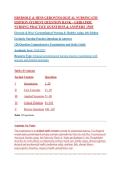
EBERSOLE & HESS GERONTOLOGICAL NURSING 6TH
EDITION STUDENT QUESTION BANK – GERIATRIC
NURSING PRACTICE QUESTIONS & ANSWERS | PDF
Ebersole & Hess' Gerontological Nursing & Healthy Aging, 6th Edition
Geriatric Nursing Practice Questions & Answers
120-Question Comprehensive Examination and Study Guide
Academic Year: 2026/2027
Resource Type: Original gerontological nursing practice examination with
answers and detailed rationales
Table of Contents
Section Content Questions
I Introduction 1–20
II Core Concepts 21–50
III Applied Scenarios 51–80
IV Critical Thinking 81–105
V Review Questions 106–120
Total: 120 questions
Academic Use Notice
This examination is an original study resource created for educational practice. It is designed
around major gerontological nursing concepts represented in Ebersole and Hess' Gerontological
Nursing & Healthy Aging, 6th Edition by Theris A. Touhy and Kathleen F. Jett. The publisher
describes the sixth edition as emphasizing wellness-based care, healthy aging, clinical judgment,
physical and psychosocial health, medication safety, nutrition, falls, chronic illness,
neurocognitive disorders, caregiver health, and palliative care.
,SECTION I — INTRODUCTION
Questions 1–20
Question 1
Which statement best reflects a wellness-oriented approach to gerontological nursing?
A. Aging should primarily be managed by treating disease.
B. Wellness is possible only when an older adult is free of chronic illness.
C. Nursing care should support the older adult's highest attainable level of health and function.
D. Older adults should avoid activities that involve any health risk.
Correct Answer: C
Rationale: Wellness is broader than the absence of disease. Gerontological nursing emphasizes
function, autonomy, adaptation, quality of life, and the individual's goals. An older adult can
experience wellness while living with chronic illness.
Question 2
Which factor is most appropriate for determining whether an age-related change should be
considered a normal part of aging?
A. The person's chronological age alone
B. The degree to which the change affects function and health
C. Whether the change occurs in every older adult
D. Whether the change requires hospitalization
Correct Answer: B
Rationale: Chronological age alone does not determine health status. Nurses distinguish
expected physiologic changes from pathological changes by considering symptoms, functional
impact, onset, severity, and individual variation.
Question 3
A nurse is assessing an older adult from a different cultural background. Which action best
demonstrates culturally responsive nursing?
A. Applying the nurse's usual practices without modification
B. Assuming family members make all healthcare decisions
C. Asking the patient about personal health beliefs and preferences
D. Avoiding discussion of cultural beliefs because they may be sensitive
,Correct Answer: C
Rationale: Cultural assessment should be individualized. Nurses should ask rather than assume
how culture, family, spirituality, communication, and health beliefs influence care.
Question 4
Which statement about chronological age is most accurate?
A. It reliably predicts functional ability.
B. It is the primary determinant of health status.
C. It is only one component of understanding an individual's aging experience.
D. It determines whether an individual can live independently.
Correct Answer: C
Rationale: Older adults differ substantially in health, function, cognition, social resources, and
life experiences. Chronological age is therefore insufficient for predicting an individual's
capabilities.
Question 5
Which nursing assessment provides the clearest information about an older adult's ability to
maintain independence?
A. Hair color
B. Ability to perform activities of daily living
C. Number of previous hospitalizations alone
D. Marital status
Correct Answer: B
Rationale: Functional assessment examines what the patient can actually do. Activities of daily
living and instrumental activities of daily living are important indicators of independence and
care needs.
Question 6
An older adult says, “My doctor knows what is best, so I don't need to participate in the
decisions.” What is the nurse's best response?
A. “That is appropriate because physicians make healthcare decisions.”
B. “You should allow your family to decide for you.”
, C. “Let's discuss what matters most to you so you can participate in your care decisions.”
D. “You should research every possible treatment before deciding.”
Correct Answer: C
Rationale: Person-centered care supports autonomy and shared decision-making. The nurse
helps the patient understand choices and communicate goals without imposing a decision.
Question 7
Which concept describes the ability of an older adult to adapt successfully to changes associated
with aging?
A. Resilience
B. Dependency
C. Frailty
D. Social isolation
Correct Answer: A
Rationale: Resilience refers to the capacity to adapt and recover in response to adversity or
change. Resilience can be influenced by social support, coping strategies, resources, and personal
meaning.
Question 8
Which nursing behavior is most likely to reduce ageism?
A. Speaking to the family instead of the patient
B. Assuming cognitive impairment because the patient is old
C. Using respectful, individualized communication
D. Avoiding discussions about sexuality
Correct Answer: C
Rationale: Ageism involves stereotypes or discrimination based on age. Individualized
communication recognizes that older adults have diverse abilities, identities, preferences, and
experiences.
Question 9
An older adult with multiple chronic illnesses asks whether healthy aging is still possible. Which
response is most appropriate?
EDITION STUDENT QUESTION BANK – GERIATRIC
NURSING PRACTICE QUESTIONS & ANSWERS | PDF
Ebersole & Hess' Gerontological Nursing & Healthy Aging, 6th Edition
Geriatric Nursing Practice Questions & Answers
120-Question Comprehensive Examination and Study Guide
Academic Year: 2026/2027
Resource Type: Original gerontological nursing practice examination with
answers and detailed rationales
Table of Contents
Section Content Questions
I Introduction 1–20
II Core Concepts 21–50
III Applied Scenarios 51–80
IV Critical Thinking 81–105
V Review Questions 106–120
Total: 120 questions
Academic Use Notice
This examination is an original study resource created for educational practice. It is designed
around major gerontological nursing concepts represented in Ebersole and Hess' Gerontological
Nursing & Healthy Aging, 6th Edition by Theris A. Touhy and Kathleen F. Jett. The publisher
describes the sixth edition as emphasizing wellness-based care, healthy aging, clinical judgment,
physical and psychosocial health, medication safety, nutrition, falls, chronic illness,
neurocognitive disorders, caregiver health, and palliative care.
,SECTION I — INTRODUCTION
Questions 1–20
Question 1
Which statement best reflects a wellness-oriented approach to gerontological nursing?
A. Aging should primarily be managed by treating disease.
B. Wellness is possible only when an older adult is free of chronic illness.
C. Nursing care should support the older adult's highest attainable level of health and function.
D. Older adults should avoid activities that involve any health risk.
Correct Answer: C
Rationale: Wellness is broader than the absence of disease. Gerontological nursing emphasizes
function, autonomy, adaptation, quality of life, and the individual's goals. An older adult can
experience wellness while living with chronic illness.
Question 2
Which factor is most appropriate for determining whether an age-related change should be
considered a normal part of aging?
A. The person's chronological age alone
B. The degree to which the change affects function and health
C. Whether the change occurs in every older adult
D. Whether the change requires hospitalization
Correct Answer: B
Rationale: Chronological age alone does not determine health status. Nurses distinguish
expected physiologic changes from pathological changes by considering symptoms, functional
impact, onset, severity, and individual variation.
Question 3
A nurse is assessing an older adult from a different cultural background. Which action best
demonstrates culturally responsive nursing?
A. Applying the nurse's usual practices without modification
B. Assuming family members make all healthcare decisions
C. Asking the patient about personal health beliefs and preferences
D. Avoiding discussion of cultural beliefs because they may be sensitive
,Correct Answer: C
Rationale: Cultural assessment should be individualized. Nurses should ask rather than assume
how culture, family, spirituality, communication, and health beliefs influence care.
Question 4
Which statement about chronological age is most accurate?
A. It reliably predicts functional ability.
B. It is the primary determinant of health status.
C. It is only one component of understanding an individual's aging experience.
D. It determines whether an individual can live independently.
Correct Answer: C
Rationale: Older adults differ substantially in health, function, cognition, social resources, and
life experiences. Chronological age is therefore insufficient for predicting an individual's
capabilities.
Question 5
Which nursing assessment provides the clearest information about an older adult's ability to
maintain independence?
A. Hair color
B. Ability to perform activities of daily living
C. Number of previous hospitalizations alone
D. Marital status
Correct Answer: B
Rationale: Functional assessment examines what the patient can actually do. Activities of daily
living and instrumental activities of daily living are important indicators of independence and
care needs.
Question 6
An older adult says, “My doctor knows what is best, so I don't need to participate in the
decisions.” What is the nurse's best response?
A. “That is appropriate because physicians make healthcare decisions.”
B. “You should allow your family to decide for you.”
, C. “Let's discuss what matters most to you so you can participate in your care decisions.”
D. “You should research every possible treatment before deciding.”
Correct Answer: C
Rationale: Person-centered care supports autonomy and shared decision-making. The nurse
helps the patient understand choices and communicate goals without imposing a decision.
Question 7
Which concept describes the ability of an older adult to adapt successfully to changes associated
with aging?
A. Resilience
B. Dependency
C. Frailty
D. Social isolation
Correct Answer: A
Rationale: Resilience refers to the capacity to adapt and recover in response to adversity or
change. Resilience can be influenced by social support, coping strategies, resources, and personal
meaning.
Question 8
Which nursing behavior is most likely to reduce ageism?
A. Speaking to the family instead of the patient
B. Assuming cognitive impairment because the patient is old
C. Using respectful, individualized communication
D. Avoiding discussions about sexuality
Correct Answer: C
Rationale: Ageism involves stereotypes or discrimination based on age. Individualized
communication recognizes that older adults have diverse abilities, identities, preferences, and
experiences.
Question 9
An older adult with multiple chronic illnesses asks whether healthy aging is still possible. Which
response is most appropriate?

