[STUDY GUIDE] • HIGH-YIELD PRACTICE & REVIEW EDITION
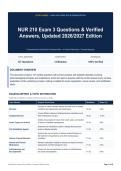
NUR 210 Exam 3 Questions & Verified
Answers, Updated 2026/2027 Edition
Comprehensive Examination Question Bank • In-Depth Rationales • Concept Mapping
TOTAL QUESTIONS EXAM TOPICS RATIONALES
137 Questions 12 Modules 100% Verified
DOCUMENT OVERVIEW
This document contains 137 verified questions with correct answers and detailed rationales covering
pharmacological principles and medications. Each item pairs a question with the correct answer and a concise
explanation of the underlying concept, making it suitable for exam preparation, course review, and certification
study.
EXAM BLUEPRINT & TOPIC DISTRIBUTION
Systematic breakdown of subject domains and exam coverage.
Topic Module Scope & Core Focus Questions Share (%)
Focuses on various diuretic classes and their uses in treating
Diuretics conditions like hypertension and heart failure. 12 Qs 8.8%
Covers different classes of antihypertensive medications and
Antihypertensives their mechanisms of action. 14 Qs 10.2%
Details various types of insulin, their onset, peak, and duration
Insulin Types and Actions of action for diabetes management. 12 Qs 8.8%
Examines oral medications used to manage blood glucose
Oral Antidiabetic Agents levels in diabetes patients. 11 Qs 8.0%
Explores the use and action of calcium channel blockers in
the treatment of hypertension and other cardiovascular
Calcium Channel Blockers conditions. 11 Qs 8.0%
Adrenal and Thyroid Reviews medications related to adrenal and thyroid hormone
Medications replacement and their therapeutic uses. 11 Qs 8.0%
Antihistamines and Covers the use and mechanism of action of antihistamines
Decongestants and nasal decongestants. 11 Qs 8.0%
Confidential • Student Study Edition • Practice & Review Guide Page 1 of 46
,STUDENT STUDY & MASTERY EDITION PRACTICE & REVIEW GUIDE
Bronchodilators and Respiratory Focuses on bronchodilators and other medications used in
Agents respiratory conditions. 11 Qs 8.0%
Examines drugs that increase blood glucose levels and their
Hypoglycemic Agents clinical applications. 11 Qs 8.0%
Drug Interactions and Side Addresses potential side effects and interactions of various
Effects pharmacological agents. 11 Qs 8.0%
Monitoring and Patient Emphasizes the importance of monitoring and educating
Education patients on medications and their effects. 11 Qs 8.0%
Miscellaneous Pharmacological Includes various pharmacological facts and definitions
Concepts relevant to drug administration and action. 11 Qs 8.0%
Total Exam Coverage 12 Integrated Topic Modules 137 Qs 100.0%
Confidential • Student Study Edition • Practice & Review Guide Page 2 of 46
,STUDENT STUDY & MASTERY EDITION PRACTICE & REVIEW GUIDE
TOPIC 1: DIURETICS
12 Questions • 8.8% of Exam • Focuses on various diuretic classes and their uses in treating conditions like hypertension and heart
failure.
QUESTION 1
Thiazide diuretic
Correct Answer: Hydrochlorothiazide.
Rationale: "Hydrochlorothiazide" is a correct answer because it is a medication that specifically belongs to the thiazide
diuretic class, a group of diuretics that work by inhibiting the sodium-chloride transporter in the kidneys. This classification is
due to its chemical structure, mechanism of action, and therapeutic use, all of which align with the characteristics of thiazide
diuretics.
QUESTION 2
Loop diuretic
Correct Answer: Furosemide.
Rationale: Furosemide is a loop diuretic because it acts on the Loop of Henle in the kidneys, a specific region where water
and electrolyte reabsorption primarily occurs, to inhibit sodium and chloride reabsorption, leading to increased urine
production. This mechanism of action is unique to loop diuretics, distinguishing them from other types of diuretics that act on
different regions of the nephron.
QUESTION 3
Potassium sparing diuretic
Correct Answer: Spironolactone.
Rationale: Spironolactone works by blocking the action of aldosterone, a hormone that promotes sodium retention and
potassium excretion, thereby allowing potassium levels to be preserved and not excreted, which is a key characteristic of
potassium-sparing diuretics. This mechanism of action helps to counteract the effects of aldosterone, resulting in the
retention of potassium and water in the body.
Confidential • Student Study Edition • Practice & Review Guide Page 3 of 46
, STUDENT STUDY & MASTERY EDITION PRACTICE & REVIEW GUIDE
QUESTION 4
Hydrochlorthiazide (Thiazide diuretics) Uses
Correct Answer: Treat hypertension
-edema from heart failure
-hepatic cirrhosis.
Rationale: Hydrochlorothiazide, a thiazide diuretic, is used to treat hypertension as it helps reduce blood volume and lowers
blood pressure. The other options, edema from heart failure and hepatic cirrhosis, are conditions where thiazide diuretics
can alleviate symptoms such as fluid retention and swelling, making them secondary uses of the medication.
QUESTION 5
Furosemide (loop diuretics) uses
Correct Answer: Treat fluid retention caused by heart failure
-renal dysfunction
-cirrhosis
-hypertension
-pulmonary edema.
Rationale: Furosemide, as a loop diuretic, works by inhibiting the sodium-potassium-chloride cotransporter in the distal
convoluted tubule of the kidneys, leading to increased urine production and decreased fluid retention in conditions such as
heart failure, renal dysfunction, cirrhosis, hypertension, and pulmonary edema, which are characterized by excessive fluid
accumulation. This mechanism of action makes furosemide an effective treatment for these conditions, resulting in its
specific use in managing fluid retention caused by these conditions.
QUESTION 6
Spironolactone (potassium-sparing diuretics) action
Correct Answer: Promote sodium and water excretion and potassium retention.
Rationale: Spironolactone acts as a potassium-sparing diuretic by inhibiting the action of aldosterone, a hormone that
promotes sodium and water reabsorption and potassium excretion in the kidneys. By blocking aldosterone, spironolactone
ultimately leads to increased excretion of sodium and water, while allowing potassium to be retained in the body.
Confidential • Student Study Edition • Practice & Review Guide Page 4 of 46
NUR 210 Exam 3 Questions & Verified
Answers, Updated 2026/2027 Edition
Comprehensive Examination Question Bank • In-Depth Rationales • Concept Mapping
TOTAL QUESTIONS EXAM TOPICS RATIONALES
137 Questions 12 Modules 100% Verified
DOCUMENT OVERVIEW
This document contains 137 verified questions with correct answers and detailed rationales covering
pharmacological principles and medications. Each item pairs a question with the correct answer and a concise
explanation of the underlying concept, making it suitable for exam preparation, course review, and certification
study.
EXAM BLUEPRINT & TOPIC DISTRIBUTION
Systematic breakdown of subject domains and exam coverage.
Topic Module Scope & Core Focus Questions Share (%)
Focuses on various diuretic classes and their uses in treating
Diuretics conditions like hypertension and heart failure. 12 Qs 8.8%
Covers different classes of antihypertensive medications and
Antihypertensives their mechanisms of action. 14 Qs 10.2%
Details various types of insulin, their onset, peak, and duration
Insulin Types and Actions of action for diabetes management. 12 Qs 8.8%
Examines oral medications used to manage blood glucose
Oral Antidiabetic Agents levels in diabetes patients. 11 Qs 8.0%
Explores the use and action of calcium channel blockers in
the treatment of hypertension and other cardiovascular
Calcium Channel Blockers conditions. 11 Qs 8.0%
Adrenal and Thyroid Reviews medications related to adrenal and thyroid hormone
Medications replacement and their therapeutic uses. 11 Qs 8.0%
Antihistamines and Covers the use and mechanism of action of antihistamines
Decongestants and nasal decongestants. 11 Qs 8.0%
Confidential • Student Study Edition • Practice & Review Guide Page 1 of 46
,STUDENT STUDY & MASTERY EDITION PRACTICE & REVIEW GUIDE
Bronchodilators and Respiratory Focuses on bronchodilators and other medications used in
Agents respiratory conditions. 11 Qs 8.0%
Examines drugs that increase blood glucose levels and their
Hypoglycemic Agents clinical applications. 11 Qs 8.0%
Drug Interactions and Side Addresses potential side effects and interactions of various
Effects pharmacological agents. 11 Qs 8.0%
Monitoring and Patient Emphasizes the importance of monitoring and educating
Education patients on medications and their effects. 11 Qs 8.0%
Miscellaneous Pharmacological Includes various pharmacological facts and definitions
Concepts relevant to drug administration and action. 11 Qs 8.0%
Total Exam Coverage 12 Integrated Topic Modules 137 Qs 100.0%
Confidential • Student Study Edition • Practice & Review Guide Page 2 of 46
,STUDENT STUDY & MASTERY EDITION PRACTICE & REVIEW GUIDE
TOPIC 1: DIURETICS
12 Questions • 8.8% of Exam • Focuses on various diuretic classes and their uses in treating conditions like hypertension and heart
failure.
QUESTION 1
Thiazide diuretic
Correct Answer: Hydrochlorothiazide.
Rationale: "Hydrochlorothiazide" is a correct answer because it is a medication that specifically belongs to the thiazide
diuretic class, a group of diuretics that work by inhibiting the sodium-chloride transporter in the kidneys. This classification is
due to its chemical structure, mechanism of action, and therapeutic use, all of which align with the characteristics of thiazide
diuretics.
QUESTION 2
Loop diuretic
Correct Answer: Furosemide.
Rationale: Furosemide is a loop diuretic because it acts on the Loop of Henle in the kidneys, a specific region where water
and electrolyte reabsorption primarily occurs, to inhibit sodium and chloride reabsorption, leading to increased urine
production. This mechanism of action is unique to loop diuretics, distinguishing them from other types of diuretics that act on
different regions of the nephron.
QUESTION 3
Potassium sparing diuretic
Correct Answer: Spironolactone.
Rationale: Spironolactone works by blocking the action of aldosterone, a hormone that promotes sodium retention and
potassium excretion, thereby allowing potassium levels to be preserved and not excreted, which is a key characteristic of
potassium-sparing diuretics. This mechanism of action helps to counteract the effects of aldosterone, resulting in the
retention of potassium and water in the body.
Confidential • Student Study Edition • Practice & Review Guide Page 3 of 46
, STUDENT STUDY & MASTERY EDITION PRACTICE & REVIEW GUIDE
QUESTION 4
Hydrochlorthiazide (Thiazide diuretics) Uses
Correct Answer: Treat hypertension
-edema from heart failure
-hepatic cirrhosis.
Rationale: Hydrochlorothiazide, a thiazide diuretic, is used to treat hypertension as it helps reduce blood volume and lowers
blood pressure. The other options, edema from heart failure and hepatic cirrhosis, are conditions where thiazide diuretics
can alleviate symptoms such as fluid retention and swelling, making them secondary uses of the medication.
QUESTION 5
Furosemide (loop diuretics) uses
Correct Answer: Treat fluid retention caused by heart failure
-renal dysfunction
-cirrhosis
-hypertension
-pulmonary edema.
Rationale: Furosemide, as a loop diuretic, works by inhibiting the sodium-potassium-chloride cotransporter in the distal
convoluted tubule of the kidneys, leading to increased urine production and decreased fluid retention in conditions such as
heart failure, renal dysfunction, cirrhosis, hypertension, and pulmonary edema, which are characterized by excessive fluid
accumulation. This mechanism of action makes furosemide an effective treatment for these conditions, resulting in its
specific use in managing fluid retention caused by these conditions.
QUESTION 6
Spironolactone (potassium-sparing diuretics) action
Correct Answer: Promote sodium and water excretion and potassium retention.
Rationale: Spironolactone acts as a potassium-sparing diuretic by inhibiting the action of aldosterone, a hormone that
promotes sodium and water reabsorption and potassium excretion in the kidneys. By blocking aldosterone, spironolactone
ultimately leads to increased excretion of sodium and water, while allowing potassium to be retained in the body.
Confidential • Student Study Edition • Practice & Review Guide Page 4 of 46