
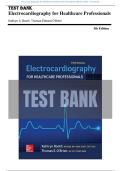
Electrocardiography for Healthcare Professionals 5th Edition (Booth, 2020) - Test Bank
TEST BANK
Electrocardiography for Healthcare Professionals
Kathryn A. Booth, Thomas Edward O'Brien
5th Edition
, Electrocardiography for Healthcare Professionals 5th Edition (Booth, 2020) - Test Bank
Table of Contents
Chapter 1 Electrocardiography
Chapter 2 The Cardiovascular System
Chapter 3 The Electrocardiograph
Chapter 4 Performing an ECG
Chapter 5 Rhythm Strip Interpretation and Sinus Rhythms
Chapter 6 Atrial Dysrhythmias
Chapter 7 Junctional Dysrhythmias
Chapter 8 Heart Block Dysrhythmias
Chapter 9 Ventricular Dysrhythmias
Chapter 10 Bundle Branch Block
Chapter 11 Pacemaker Rhythms
Chapter 12 Cardiac Stress Testing
Chapter 13 Ambulatory Monitoring
Chapter 14 Clinical Presentation and Management of the Cardiac Patient
Chapter 15 Basic 12-Lead ECG Interpretation
, Electrocardiography for Healthcare Professionals 5th Edition (Booth, 2020) - Test Bank
TEST BANK FOR ELECTROCARDIOGRAPHY FOR
HEALTHCARE PROFESSIONALS, 5TH EDITION
KATHRYN BOOTH, THOMAS O’BRIEN
(With Answer Key)
Chapter 01 Electrocardiography
Multiple Choice Questions
1. What is the number one cause of death in the United States?
A. Cancer
B. Diabetes
C. Cardiovascular disease
D. Accidents
2. The abbreviation CAD stands for:
A. Cold appendage disorder
B. Coronary application disease
C. Cerebral artery disease
D. Coronary artery disease
3. What does the electrocardiogram or ECG study?
A. The electrical activity of the heart
B. The muscle contractions of the heart
C. High blood pressure readings
D. All of the above
4. The first electrocardiograph was invented by:
A. Sir Thomas Lewis
B. Wilhelm Einthoven
C. Thomas Edison
D. Dr. James Herrick
5. The abbreviation for myocardial infarction, also known as a heart attack, is:
A. IM
B. HA
1-1
, Electrocardiography for Healthcare Professionals 5th Edition (Booth, 2020) - Test Bank
Chapter 01 Role of the Electrocardiographer
C. MI
D. MCI
6. An electrocardiograph (ECG) technician should be able to:
A. Determine if an ECG tracing is accurate
B. Recognize abnormalities in an ECG tracing
C. Prepare the ECG tracing for the physician
D. All of the above
7. An ECG monitor technician's main responsibility is to:
A. View the ECG tracings and alert the health care professional of an abnormal heart
rhythm
B. Assist the physicians with invasive cardiovascular diagnostic tests
C. Perform ultrasounds of the heart and blood vessels
D. Repair hospital telemetry monitors
8. A "stat" ECG is done:
A. Yearly, as part of a routine physical
B. Immediately
C. In the early morning
D. Before surgery
9. Continuous ECG monitoring done in a hospital setting is known as:
A. Holter monitoring
B. Telemetry monitoring
C. Exercise electrocardiography
D. Echocardiogram
10. Which of these ECGs is done in a doctor's office?
A. Treadmill stress testing
B. Holter monitor
1-2
, Electrocardiography for Healthcare Professionals 5th Edition (Booth, 2020) - Test Bank
Chapter 01 Role of the Electrocardiographer
C. 12-lead ECG
D. All of the above
11. What symptoms would indicate the use of a telemedicine monitor?
A. Palpitations
B. Chest pain
C. Dizziness
D. All of the above
12. What device enables lay rescuers to help a patient with sudden cardiac arrest?
A. Automatic external defibrillator (AED)
B. Telemedicine monitor
C. Pacemaker
D. 12-lead ECG
13. An ECG technician needs to have a basic understanding of which of the following items?
A. Medical law and ethics
B. Patient safety and infection control
C. The procedure and the ECG machine
D. All of the above
14. What is the best way to become familiar with the ECG machine you are using?
A. Ask a co-worker
B. Refer to instructions on or with the ECG machine
C. Go to the website of the manufacturer
D. Practice ECG tracings on yourself
15. Standard precautions include which of the following?
1-3
, Electrocardiography for Healthcare Professionals 5th Edition (Booth, 2020) - Test Bank
Chapter 01 Role of the Electrocardiographer
A. Proper hand washing
B. Use of gloves
C. Wearing gown, mask, and eye protection
D. All of the above
16. If the patient asks questions after you have explained the ECG procedure, you should:
A. Repeat the instructions and clarify any questions the patient has
B. Ask the physician to answer the patient's questions
C. Perform the ECG as ordered
D. Have a co-worker explain the procedure to the patient
17. Ethics are:
A. Rules of conduct that are enforced by an authority
B. Cultural values
C. Standards of behavior and concepts of right and wrong
D. All of the above
18. HIPAA stands for:
A. Health Information Privacy and Availability Act
B. Health Insurance Professionals Accounting Act
C. Health Insurance Portability and Accountability Act
D. Health Information Portability and Alternative Act
19. Which of the following defines practicing ethics as a health care professional?
A. Patient respect and dignity
B. Practicing professionalism and cooperation
C. Maintaining patient confidentiality
D. All of the above
20. Which of the following is NOT implied consent?
A. Patient agreeing to be treated by the physician
1-4
, Electrocardiography for Healthcare Professionals 5th Edition (Booth, 2020) - Test Bank
Chapter 01 Role of the Electrocardiographer
B. Patient signing a consent form for a treadmill stress test
C. Patient agreeing to have an ECG
D. Patient coming to the doctor's office for care
21. Your patient states "I do not want that electricity going through me!" as you are getting
ready to perform an ECG on him. The best response is:
A. Explain that the ECG machine is not harmful and does not produce electricity
B. Ask the patient to please lie down and be still
C. Show the patient you will not plug the ECG machine into the wall outlet D. Go get the
doctor and have him explain the procedure to the patient
22. Who should sign the consent form if a patient cannot read or write?
A. The patient's physician
B. Your co-worker
C. A family member of the patient
D. All of the above
23. You have a patient that can only sign an "X" on the consent form. You need to:
A. Leave consent form blank
B. Explain the procedure to the patient with a witness present, have the patient place an X
on the form, and have the witness sign the form also
C. Explain the reason the patient only signed an "X" on the consent form
D. Have the physician sign the consent form
24. Which instrument was developed by a Dutch physiologist prior to the invention of the
electrocardiograph?
A. Pacemaker
B. Carburetor
C. Galvanometer
D. Telegraph machine
1-5
, Electrocardiography for Healthcare Professionals 5th Edition (Booth, 2020) - Test Bank
Chapter 01 Role of the Electrocardiographer
25. The term for an abnormal heartbeat is:
A. Angioplasty
B. Arrhythmia
C. Angina
D. Artifact
26. Angioplasty is:
A. An abnormal ECG tracing
B. The surgical repair of blood vessels
C. An ultrasound of the heart
D. Narrowing of the arteries surrounding the heart
27. An artificial is a device that initiates the heartbeat.
A. Defibrillator
B. Galvanometer
C. Pacemaker
D. Oscilloscope
28. What does the term "Code Blue" mean when used in a hospital setting?
A. A biohazard spill has occurred in the hospital
B. Severe weather is imminent
C. A patient is experiencing pain around the heart
D. A patient is unresponsive and needs immediate assistance
29. The monitor allows the patient to participate in normal daily activities while the
electrical activity of the heart is being recorded.
A. Holter
B. Biphasic
C. Multichannel
D. Telemetry
1-6
, Electrocardiography for Healthcare Professionals 5th Edition (Booth, 2020) - Test Bank
Chapter 01 Role of the Electrocardiographer
30. Which of the following is NOT a reason for performing an ECG?
A. To determine if there is a blockage in a coronary artery
B. To check for heart rhythm abnormalities
C. To document irregular heartbeats
D. As part of a yearly, routine physical exam
31. Slander is an illegal and unethical act and is defined as:
A. Writing defamatory words
B. Violating patient confidentiality
C. Making derogatory remarks about someone
D. All of the above
32. means writing defamatory words. It is illegal and unethical and could result in the
loss of your job.
A. HIPAA
B. Libel
C. Consent
D. Liability
33. Which device recognizes an abnormal rhythm and can deliver an electric shock to the
heart if necessary?
A. ECG
B. CAD
C. MSET
D. AED
34. PPE is used to reduce the risk of transmission of infection. PPE stands for:
A. Personal protection equipment
1-7
, Electrocardiography for Healthcare Professionals 5th Edition (Booth, 2020) - Test Bank
Chapter 01 Role of the Electrocardiographer
B. Possible percutaneous exposure
C. Pulmonary protection equipment
D. Patient protective electrocardiograph
35. The problem-solving process includes which of the following steps?
A. Identify possible solutions
B. Identify and define the problem
C. Implement the selected solution
D. All of the above
36. Who is recognized as having performed the first ECG on a human?
A. Wilhelm Einthoven
B. Dr. Augusta Waller
C. Sir Thomas Lewis
D. Dr. James Herrick
37. When caring for patients and recording an ECG, you may encounter many situations
that require you to:
A. Think critically about the situation
B. Always follow the same steps each time
C. Not worry about what the patient may tell you
D. All of the above
38. Which of the following are measures to ensure that patients' health information is
protected?
A. Standard precautions
B. Isolation procedures
C. HIPAA
D. Patient's bill of rights
1-8
TEST BANK
Electrocardiography for Healthcare Professionals
Kathryn A. Booth, Thomas Edward O'Brien
5th Edition
, Electrocardiography for Healthcare Professionals 5th Edition (Booth, 2020) - Test Bank
Table of Contents
Chapter 1 Electrocardiography
Chapter 2 The Cardiovascular System
Chapter 3 The Electrocardiograph
Chapter 4 Performing an ECG
Chapter 5 Rhythm Strip Interpretation and Sinus Rhythms
Chapter 6 Atrial Dysrhythmias
Chapter 7 Junctional Dysrhythmias
Chapter 8 Heart Block Dysrhythmias
Chapter 9 Ventricular Dysrhythmias
Chapter 10 Bundle Branch Block
Chapter 11 Pacemaker Rhythms
Chapter 12 Cardiac Stress Testing
Chapter 13 Ambulatory Monitoring
Chapter 14 Clinical Presentation and Management of the Cardiac Patient
Chapter 15 Basic 12-Lead ECG Interpretation
, Electrocardiography for Healthcare Professionals 5th Edition (Booth, 2020) - Test Bank
TEST BANK FOR ELECTROCARDIOGRAPHY FOR
HEALTHCARE PROFESSIONALS, 5TH EDITION
KATHRYN BOOTH, THOMAS O’BRIEN
(With Answer Key)
Chapter 01 Electrocardiography
Multiple Choice Questions
1. What is the number one cause of death in the United States?
A. Cancer
B. Diabetes
C. Cardiovascular disease
D. Accidents
2. The abbreviation CAD stands for:
A. Cold appendage disorder
B. Coronary application disease
C. Cerebral artery disease
D. Coronary artery disease
3. What does the electrocardiogram or ECG study?
A. The electrical activity of the heart
B. The muscle contractions of the heart
C. High blood pressure readings
D. All of the above
4. The first electrocardiograph was invented by:
A. Sir Thomas Lewis
B. Wilhelm Einthoven
C. Thomas Edison
D. Dr. James Herrick
5. The abbreviation for myocardial infarction, also known as a heart attack, is:
A. IM
B. HA
1-1
, Electrocardiography for Healthcare Professionals 5th Edition (Booth, 2020) - Test Bank
Chapter 01 Role of the Electrocardiographer
C. MI
D. MCI
6. An electrocardiograph (ECG) technician should be able to:
A. Determine if an ECG tracing is accurate
B. Recognize abnormalities in an ECG tracing
C. Prepare the ECG tracing for the physician
D. All of the above
7. An ECG monitor technician's main responsibility is to:
A. View the ECG tracings and alert the health care professional of an abnormal heart
rhythm
B. Assist the physicians with invasive cardiovascular diagnostic tests
C. Perform ultrasounds of the heart and blood vessels
D. Repair hospital telemetry monitors
8. A "stat" ECG is done:
A. Yearly, as part of a routine physical
B. Immediately
C. In the early morning
D. Before surgery
9. Continuous ECG monitoring done in a hospital setting is known as:
A. Holter monitoring
B. Telemetry monitoring
C. Exercise electrocardiography
D. Echocardiogram
10. Which of these ECGs is done in a doctor's office?
A. Treadmill stress testing
B. Holter monitor
1-2
, Electrocardiography for Healthcare Professionals 5th Edition (Booth, 2020) - Test Bank
Chapter 01 Role of the Electrocardiographer
C. 12-lead ECG
D. All of the above
11. What symptoms would indicate the use of a telemedicine monitor?
A. Palpitations
B. Chest pain
C. Dizziness
D. All of the above
12. What device enables lay rescuers to help a patient with sudden cardiac arrest?
A. Automatic external defibrillator (AED)
B. Telemedicine monitor
C. Pacemaker
D. 12-lead ECG
13. An ECG technician needs to have a basic understanding of which of the following items?
A. Medical law and ethics
B. Patient safety and infection control
C. The procedure and the ECG machine
D. All of the above
14. What is the best way to become familiar with the ECG machine you are using?
A. Ask a co-worker
B. Refer to instructions on or with the ECG machine
C. Go to the website of the manufacturer
D. Practice ECG tracings on yourself
15. Standard precautions include which of the following?
1-3
, Electrocardiography for Healthcare Professionals 5th Edition (Booth, 2020) - Test Bank
Chapter 01 Role of the Electrocardiographer
A. Proper hand washing
B. Use of gloves
C. Wearing gown, mask, and eye protection
D. All of the above
16. If the patient asks questions after you have explained the ECG procedure, you should:
A. Repeat the instructions and clarify any questions the patient has
B. Ask the physician to answer the patient's questions
C. Perform the ECG as ordered
D. Have a co-worker explain the procedure to the patient
17. Ethics are:
A. Rules of conduct that are enforced by an authority
B. Cultural values
C. Standards of behavior and concepts of right and wrong
D. All of the above
18. HIPAA stands for:
A. Health Information Privacy and Availability Act
B. Health Insurance Professionals Accounting Act
C. Health Insurance Portability and Accountability Act
D. Health Information Portability and Alternative Act
19. Which of the following defines practicing ethics as a health care professional?
A. Patient respect and dignity
B. Practicing professionalism and cooperation
C. Maintaining patient confidentiality
D. All of the above
20. Which of the following is NOT implied consent?
A. Patient agreeing to be treated by the physician
1-4
, Electrocardiography for Healthcare Professionals 5th Edition (Booth, 2020) - Test Bank
Chapter 01 Role of the Electrocardiographer
B. Patient signing a consent form for a treadmill stress test
C. Patient agreeing to have an ECG
D. Patient coming to the doctor's office for care
21. Your patient states "I do not want that electricity going through me!" as you are getting
ready to perform an ECG on him. The best response is:
A. Explain that the ECG machine is not harmful and does not produce electricity
B. Ask the patient to please lie down and be still
C. Show the patient you will not plug the ECG machine into the wall outlet D. Go get the
doctor and have him explain the procedure to the patient
22. Who should sign the consent form if a patient cannot read or write?
A. The patient's physician
B. Your co-worker
C. A family member of the patient
D. All of the above
23. You have a patient that can only sign an "X" on the consent form. You need to:
A. Leave consent form blank
B. Explain the procedure to the patient with a witness present, have the patient place an X
on the form, and have the witness sign the form also
C. Explain the reason the patient only signed an "X" on the consent form
D. Have the physician sign the consent form
24. Which instrument was developed by a Dutch physiologist prior to the invention of the
electrocardiograph?
A. Pacemaker
B. Carburetor
C. Galvanometer
D. Telegraph machine
1-5
, Electrocardiography for Healthcare Professionals 5th Edition (Booth, 2020) - Test Bank
Chapter 01 Role of the Electrocardiographer
25. The term for an abnormal heartbeat is:
A. Angioplasty
B. Arrhythmia
C. Angina
D. Artifact
26. Angioplasty is:
A. An abnormal ECG tracing
B. The surgical repair of blood vessels
C. An ultrasound of the heart
D. Narrowing of the arteries surrounding the heart
27. An artificial is a device that initiates the heartbeat.
A. Defibrillator
B. Galvanometer
C. Pacemaker
D. Oscilloscope
28. What does the term "Code Blue" mean when used in a hospital setting?
A. A biohazard spill has occurred in the hospital
B. Severe weather is imminent
C. A patient is experiencing pain around the heart
D. A patient is unresponsive and needs immediate assistance
29. The monitor allows the patient to participate in normal daily activities while the
electrical activity of the heart is being recorded.
A. Holter
B. Biphasic
C. Multichannel
D. Telemetry
1-6
, Electrocardiography for Healthcare Professionals 5th Edition (Booth, 2020) - Test Bank
Chapter 01 Role of the Electrocardiographer
30. Which of the following is NOT a reason for performing an ECG?
A. To determine if there is a blockage in a coronary artery
B. To check for heart rhythm abnormalities
C. To document irregular heartbeats
D. As part of a yearly, routine physical exam
31. Slander is an illegal and unethical act and is defined as:
A. Writing defamatory words
B. Violating patient confidentiality
C. Making derogatory remarks about someone
D. All of the above
32. means writing defamatory words. It is illegal and unethical and could result in the
loss of your job.
A. HIPAA
B. Libel
C. Consent
D. Liability
33. Which device recognizes an abnormal rhythm and can deliver an electric shock to the
heart if necessary?
A. ECG
B. CAD
C. MSET
D. AED
34. PPE is used to reduce the risk of transmission of infection. PPE stands for:
A. Personal protection equipment
1-7
, Electrocardiography for Healthcare Professionals 5th Edition (Booth, 2020) - Test Bank
Chapter 01 Role of the Electrocardiographer
B. Possible percutaneous exposure
C. Pulmonary protection equipment
D. Patient protective electrocardiograph
35. The problem-solving process includes which of the following steps?
A. Identify possible solutions
B. Identify and define the problem
C. Implement the selected solution
D. All of the above
36. Who is recognized as having performed the first ECG on a human?
A. Wilhelm Einthoven
B. Dr. Augusta Waller
C. Sir Thomas Lewis
D. Dr. James Herrick
37. When caring for patients and recording an ECG, you may encounter many situations
that require you to:
A. Think critically about the situation
B. Always follow the same steps each time
C. Not worry about what the patient may tell you
D. All of the above
38. Which of the following are measures to ensure that patients' health information is
protected?
A. Standard precautions
B. Isolation procedures
C. HIPAA
D. Patient's bill of rights
1-8

