[STUDY GUIDE] • HIGH-YIELD PRACTICE & REVIEW EDITION
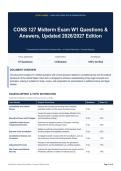
CONS 127 Midterm Exam W1 Questions &
Answers, Updated 2026/2027 Edition
Comprehensive Examination Question Bank • In-Depth Rationales • Concept Mapping
TOTAL QUESTIONS EXAM TOPICS RATIONALES
67 Questions 12 Modules 100% Verified
DOCUMENT OVERVIEW
This document contains 67 verified questions with correct answers related to constitutional law and the political
framework of the United States. Each item is designed to enhance understanding of key legal concepts and
principles, making it suitable for study, review, and preparation for examinations in political science and legal
studies.
EXAM BLUEPRINT & TOPIC DISTRIBUTION
Systematic breakdown of subject domains and exam coverage.
Topic Module Scope & Core Focus Questions Share (%)
Justiciability and Judicial Explores the principles surrounding what constitutes
Review justiciable matters and the power of judicial review. 6 Qs 9.0%
Covers the range of powers and privileges afforded to the
executive branch, including executive agreements and
Executive Powers and Privileges communications privilege. 6 Qs 9.0%
Legislative Authority and Examines the legislative powers of Congress, including
Congressional Powers impeachment and the passage of laws. 6 Qs 9.0%
Details the authority and jurisdiction of the Supreme Court,
Supreme Court Jurisdiction including original and appellate jurisdiction. 6 Qs 9.0%
Constitutional Clauses and Investigates specific clauses within the Constitution, such as
Provisions the Supremacy Clause and the Bicameralism Clause. 5 Qs 7.5%
Focuses on the impeachment process, the grounds for
Impeachment Process impeachment, and its classification as a political question. 5 Qs 7.5%
War Powers and National Analyzes the legal frameworks governing war powers and the
Security President's authority in matters of national security. 5 Qs 7.5%
Confidential • Student Study Edition • Practice & Review Guide Page 1 of 18
,STUDENT STUDY & MASTERY EDITION PRACTICE & REVIEW GUIDE
Political Questions and Addresses instances where courts may refrain from
Nonjusticiability adjudicating certain political questions. 5 Qs 7.5%
Federal Elections and Looks into the establishment and constitutional considerations
Commissions of federal election commissions. 5 Qs 7.5%
Treaties and Executive Discusses the constitutional requirements and implications of
Agreements treaties and executive agreements. 5 Qs 7.5%
Explores the legal concepts of standing, jurisdiction, and the
Standing and Jurisdiction requirements for bringing a case to court. 5 Qs 7.5%
Miscellaneous Constitutional Covers various constitutional questions that do not neatly fit
Issues into other categories. 8 Qs 11.9%
Total Exam Coverage 12 Integrated Topic Modules 67 Qs 100.0%
Confidential • Student Study Edition • Practice & Review Guide Page 2 of 18
, STUDENT STUDY & MASTERY EDITION PRACTICE & REVIEW GUIDE
TOPIC 1: JUSTICIABILITY AND JUDICIAL REVIEW
6 Questions • 9.0% of Exam • Explores the principles surrounding what constitutes justiciable matters and the power of judicial review.
QUESTION 1
Justiciability
Correct Answer: Types of matters the court can adjudicate. Political questions are non-justiciable.
QUESTION 2
Judicial Review
Correct Answer: Allows the court to determine the constitutionality of laws.
QUESTION 3
What is not an element of justiciability?
Correct Answer: Jurisdiction.
QUESTION 4
War Powers Resolution
Correct Answer: The War Powers Resolution requires the President to consult with Congress before
introducing troops to hostility; submit report to Congress within 48 hours after introducing troops to
hostility; terminate the use of armed forces within 60 days unless Congress has declared war.
QUESTION 5
Avoiding the Constitutional Issues
Correct Answer: The Court will not pass on a constitutional question, if there is some other ground on which
the case may be disposed of. If a case can be decided on either of two grounds: one involving a
constitutional question, the other a question of statutory constitution or general law, the Court will decide
only on the latter.
Confidential • Student Study Edition • Practice & Review Guide Page 3 of 18
CONS 127 Midterm Exam W1 Questions &
Answers, Updated 2026/2027 Edition
Comprehensive Examination Question Bank • In-Depth Rationales • Concept Mapping
TOTAL QUESTIONS EXAM TOPICS RATIONALES
67 Questions 12 Modules 100% Verified
DOCUMENT OVERVIEW
This document contains 67 verified questions with correct answers related to constitutional law and the political
framework of the United States. Each item is designed to enhance understanding of key legal concepts and
principles, making it suitable for study, review, and preparation for examinations in political science and legal
studies.
EXAM BLUEPRINT & TOPIC DISTRIBUTION
Systematic breakdown of subject domains and exam coverage.
Topic Module Scope & Core Focus Questions Share (%)
Justiciability and Judicial Explores the principles surrounding what constitutes
Review justiciable matters and the power of judicial review. 6 Qs 9.0%
Covers the range of powers and privileges afforded to the
executive branch, including executive agreements and
Executive Powers and Privileges communications privilege. 6 Qs 9.0%
Legislative Authority and Examines the legislative powers of Congress, including
Congressional Powers impeachment and the passage of laws. 6 Qs 9.0%
Details the authority and jurisdiction of the Supreme Court,
Supreme Court Jurisdiction including original and appellate jurisdiction. 6 Qs 9.0%
Constitutional Clauses and Investigates specific clauses within the Constitution, such as
Provisions the Supremacy Clause and the Bicameralism Clause. 5 Qs 7.5%
Focuses on the impeachment process, the grounds for
Impeachment Process impeachment, and its classification as a political question. 5 Qs 7.5%
War Powers and National Analyzes the legal frameworks governing war powers and the
Security President's authority in matters of national security. 5 Qs 7.5%
Confidential • Student Study Edition • Practice & Review Guide Page 1 of 18
,STUDENT STUDY & MASTERY EDITION PRACTICE & REVIEW GUIDE
Political Questions and Addresses instances where courts may refrain from
Nonjusticiability adjudicating certain political questions. 5 Qs 7.5%
Federal Elections and Looks into the establishment and constitutional considerations
Commissions of federal election commissions. 5 Qs 7.5%
Treaties and Executive Discusses the constitutional requirements and implications of
Agreements treaties and executive agreements. 5 Qs 7.5%
Explores the legal concepts of standing, jurisdiction, and the
Standing and Jurisdiction requirements for bringing a case to court. 5 Qs 7.5%
Miscellaneous Constitutional Covers various constitutional questions that do not neatly fit
Issues into other categories. 8 Qs 11.9%
Total Exam Coverage 12 Integrated Topic Modules 67 Qs 100.0%
Confidential • Student Study Edition • Practice & Review Guide Page 2 of 18
, STUDENT STUDY & MASTERY EDITION PRACTICE & REVIEW GUIDE
TOPIC 1: JUSTICIABILITY AND JUDICIAL REVIEW
6 Questions • 9.0% of Exam • Explores the principles surrounding what constitutes justiciable matters and the power of judicial review.
QUESTION 1
Justiciability
Correct Answer: Types of matters the court can adjudicate. Political questions are non-justiciable.
QUESTION 2
Judicial Review
Correct Answer: Allows the court to determine the constitutionality of laws.
QUESTION 3
What is not an element of justiciability?
Correct Answer: Jurisdiction.
QUESTION 4
War Powers Resolution
Correct Answer: The War Powers Resolution requires the President to consult with Congress before
introducing troops to hostility; submit report to Congress within 48 hours after introducing troops to
hostility; terminate the use of armed forces within 60 days unless Congress has declared war.
QUESTION 5
Avoiding the Constitutional Issues
Correct Answer: The Court will not pass on a constitutional question, if there is some other ground on which
the case may be disposed of. If a case can be decided on either of two grounds: one involving a
constitutional question, the other a question of statutory constitution or general law, the Court will decide
only on the latter.
Confidential • Student Study Edition • Practice & Review Guide Page 3 of 18