[STUDY GUIDE] • HIGH-YIELD PRACTICE & REVIEW EDITION
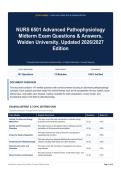
NURS 6501 Advanced Pathophysiology
Midterm Exam Questions & Answers,
Walden University, Updated 2026/2027
Edition
Comprehensive Examination Question Bank • In-Depth Rationales • Concept Mapping
TOTAL QUESTIONS EXAM TOPICS RATIONALES
147 Questions 12 Modules 100% Verified
DOCUMENT OVERVIEW
This document contains 147 verified questions with correct answers focusing on advanced pathophysiology
concepts. Each question provides insight into critical themes such as the sympathetic nervous system, acute
kidney injury, and peptic ulcer disease, making it suitable for exam preparation, course review, and
foundational study in the field of pathophysiology.
EXAM BLUEPRINT & TOPIC DISTRIBUTION
Systematic breakdown of subject domains and exam coverage.
Topic Module Scope & Core Focus Questions Share (%)
Cellular Function and Energy This topic covers the basic mechanisms of cellular energy
Metabolism production and membrane dynamics. 13 Qs 8.8%
Genetic and Chromosomal This topic focuses on the genetic basis of diseases and the
Disorders implications of chromosomal abnormalities. 13 Qs 8.8%
This topic examines the roles of hormones and glands in
Endocrine System Regulation regulating body functions. 13 Qs 8.8%
This topic delves into diseases affecting the heart and blood
Cardiovascular Pathophysiology vessels, including heart failure and valve disorders. 12 Qs 8.2%
Pulmonary Function and This topic covers the mechanics of respiration and various
Disorders lung diseases. 12 Qs 8.2%
This topic focuses on kidney function, acute kidney injury, and
Renal Function and Disorders related pathologies. 12 Qs 8.2%
Confidential • Student Study Edition • Practice & Review Guide Page 1 of 31
,STUDENT STUDY & MASTERY EDITION PRACTICE & REVIEW GUIDE
Gastrointestinal This topic addresses disorders of the gastrointestinal tract,
Pathophysiology including ulcers and inflammatory diseases. 12 Qs 8.2%
This topic explores disorders related to metabolism, including
Metabolic Disorders diabetes and hormonal imbalances. 12 Qs 8.2%
Vascular and Hematologic This topic reviews conditions affecting blood vessels and the
Disorders hematologic system. 12 Qs 8.2%
This topic includes disorders of the nervous system and their
Neurological Pathophysiology pathophysiological underpinnings. 12 Qs 8.2%
Infectious Diseases and Immune This topic looks at the immune response and its relation to
Response infectious diseases. 12 Qs 8.2%
This topic focuses on the pathophysiology of cancer and
Oncological Pathophysiology tumor biology. 12 Qs 8.2%
Total Exam Coverage 12 Integrated Topic Modules 147 Qs 100.0%
Confidential • Student Study Edition • Practice & Review Guide Page 2 of 31
,STUDENT STUDY & MASTERY EDITION PRACTICE & REVIEW GUIDE
TOPIC 1: CELLULAR FUNCTION AND ENERGY METABOLISM
13 Questions • 8.8% of Exam • This topic covers the basic mechanisms of cellular energy production and membrane dynamics.
QUESTION 1
A runner has depleted all the oxygen available for muscle energy. Which of the
following will facilitate his continued muscle performance?
Correct Answer: Answer: Anaerobic glycolysis.
QUESTION 2
What causes the rapid change in the resting membrane potential that initiates an action
potential?
Correct Answer: Answer: Sodium gates open, and sodium rushes into the cell, changing the membrane
potential from negative to positive.
QUESTION 3
How are potassium and sodium transported across plasma membranes?
Correct Answer: Answer: By adenosine triphosphate enzyme (ATPase)
QUESTION 4
Sodium and water accumulation in an injured cell are a direct result of:
Correct Answer: Answer: Decreased ATP production.
QUESTION 5
The ion transporter that moves Na + and Ca²+ simultaneously in the same direction is
an example of which of the following types of transport?
Correct Answer: Answer: Symport.
Confidential • Student Study Edition • Practice & Review Guide Page 3 of 31
, STUDENT STUDY & MASTERY EDITION PRACTICE & REVIEW GUIDE
QUESTION 6
Adrenal cortex
Correct Answer: Outer section of each adrenal gland; secretes cortisol, aldosterone, and sex hormones.
QUESTION 7
Addison's
Correct Answer: ___ Symptoms:
brownish hyperpigmentation of skin diarrhea, nausea hyponatremia d/t low aldosterone levels -->
hyperkalemia hypoglycemia d/t low cortisol low bp, risk for vascular collapse going into shock.
QUESTION 8
Mitral stenosis
Correct Answer: Narrowing of the mitral valve orifice that impedes blood flow from the left atrium to the left
vetricle.
QUESTION 9
Airway resistance
Correct Answer: The increase in pressure that occurs as the diameter of the airways decreases from
mouth/nose to alveoli.
QUESTION 10
Proximal convoluted tubule
Correct Answer: Reabsorbs 60% to 70% of filtered sodium and water.
Confidential • Student Study Edition • Practice & Review Guide Page 4 of 31
NURS 6501 Advanced Pathophysiology
Midterm Exam Questions & Answers,
Walden University, Updated 2026/2027
Edition
Comprehensive Examination Question Bank • In-Depth Rationales • Concept Mapping
TOTAL QUESTIONS EXAM TOPICS RATIONALES
147 Questions 12 Modules 100% Verified
DOCUMENT OVERVIEW
This document contains 147 verified questions with correct answers focusing on advanced pathophysiology
concepts. Each question provides insight into critical themes such as the sympathetic nervous system, acute
kidney injury, and peptic ulcer disease, making it suitable for exam preparation, course review, and
foundational study in the field of pathophysiology.
EXAM BLUEPRINT & TOPIC DISTRIBUTION
Systematic breakdown of subject domains and exam coverage.
Topic Module Scope & Core Focus Questions Share (%)
Cellular Function and Energy This topic covers the basic mechanisms of cellular energy
Metabolism production and membrane dynamics. 13 Qs 8.8%
Genetic and Chromosomal This topic focuses on the genetic basis of diseases and the
Disorders implications of chromosomal abnormalities. 13 Qs 8.8%
This topic examines the roles of hormones and glands in
Endocrine System Regulation regulating body functions. 13 Qs 8.8%
This topic delves into diseases affecting the heart and blood
Cardiovascular Pathophysiology vessels, including heart failure and valve disorders. 12 Qs 8.2%
Pulmonary Function and This topic covers the mechanics of respiration and various
Disorders lung diseases. 12 Qs 8.2%
This topic focuses on kidney function, acute kidney injury, and
Renal Function and Disorders related pathologies. 12 Qs 8.2%
Confidential • Student Study Edition • Practice & Review Guide Page 1 of 31
,STUDENT STUDY & MASTERY EDITION PRACTICE & REVIEW GUIDE
Gastrointestinal This topic addresses disorders of the gastrointestinal tract,
Pathophysiology including ulcers and inflammatory diseases. 12 Qs 8.2%
This topic explores disorders related to metabolism, including
Metabolic Disorders diabetes and hormonal imbalances. 12 Qs 8.2%
Vascular and Hematologic This topic reviews conditions affecting blood vessels and the
Disorders hematologic system. 12 Qs 8.2%
This topic includes disorders of the nervous system and their
Neurological Pathophysiology pathophysiological underpinnings. 12 Qs 8.2%
Infectious Diseases and Immune This topic looks at the immune response and its relation to
Response infectious diseases. 12 Qs 8.2%
This topic focuses on the pathophysiology of cancer and
Oncological Pathophysiology tumor biology. 12 Qs 8.2%
Total Exam Coverage 12 Integrated Topic Modules 147 Qs 100.0%
Confidential • Student Study Edition • Practice & Review Guide Page 2 of 31
,STUDENT STUDY & MASTERY EDITION PRACTICE & REVIEW GUIDE
TOPIC 1: CELLULAR FUNCTION AND ENERGY METABOLISM
13 Questions • 8.8% of Exam • This topic covers the basic mechanisms of cellular energy production and membrane dynamics.
QUESTION 1
A runner has depleted all the oxygen available for muscle energy. Which of the
following will facilitate his continued muscle performance?
Correct Answer: Answer: Anaerobic glycolysis.
QUESTION 2
What causes the rapid change in the resting membrane potential that initiates an action
potential?
Correct Answer: Answer: Sodium gates open, and sodium rushes into the cell, changing the membrane
potential from negative to positive.
QUESTION 3
How are potassium and sodium transported across plasma membranes?
Correct Answer: Answer: By adenosine triphosphate enzyme (ATPase)
QUESTION 4
Sodium and water accumulation in an injured cell are a direct result of:
Correct Answer: Answer: Decreased ATP production.
QUESTION 5
The ion transporter that moves Na + and Ca²+ simultaneously in the same direction is
an example of which of the following types of transport?
Correct Answer: Answer: Symport.
Confidential • Student Study Edition • Practice & Review Guide Page 3 of 31
, STUDENT STUDY & MASTERY EDITION PRACTICE & REVIEW GUIDE
QUESTION 6
Adrenal cortex
Correct Answer: Outer section of each adrenal gland; secretes cortisol, aldosterone, and sex hormones.
QUESTION 7
Addison's
Correct Answer: ___ Symptoms:
brownish hyperpigmentation of skin diarrhea, nausea hyponatremia d/t low aldosterone levels -->
hyperkalemia hypoglycemia d/t low cortisol low bp, risk for vascular collapse going into shock.
QUESTION 8
Mitral stenosis
Correct Answer: Narrowing of the mitral valve orifice that impedes blood flow from the left atrium to the left
vetricle.
QUESTION 9
Airway resistance
Correct Answer: The increase in pressure that occurs as the diameter of the airways decreases from
mouth/nose to alveoli.
QUESTION 10
Proximal convoluted tubule
Correct Answer: Reabsorbs 60% to 70% of filtered sodium and water.
Confidential • Student Study Edition • Practice & Review Guide Page 4 of 31