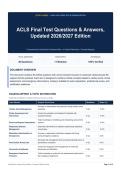
[STUDY GUIDE] • HIGH-YIELD PRACTICE & REVIEW EDITION
ACLS Final Test Questions & Answers,
Updated 2026/2027 Edition
Comprehensive Examination Question Bank • In-Depth Rationales • Concept Mapping
TOTAL QUESTIONS EXAM TOPICS RATIONALES
48 Questions 11 Modules 100% Verified
DOCUMENT OVERVIEW
This document contains 48 verified questions with correct answers focused on advanced cardiovascular life
support (ACLS) practices. Each item is designed to reinforce critical concepts related to cardiac arrest, stroke
assessment, and emergency interventions, making it suitable for exam preparation, professional review, and
certification readiness.
EXAM BLUEPRINT & TOPIC DISTRIBUTION
Systematic breakdown of subject domains and exam coverage.
Topic Module Scope & Core Focus Questions Share (%)
Focuses on interventions and protocols during cardiac arrest
Cardiac Arrest Management scenarios. 5 Qs 10.4%
Stroke Assessment and Covers the evaluation and treatment of patients with
Intervention suspected strokes. 5 Qs 10.4%
Tests knowledge on identifying and interpreting various ECG
Electrocardiogram Interpretation rhythms. 5 Qs 10.4%
Respiratory Distress Examines interventions for patients experiencing respiratory
Management compromise. 5 Qs 10.4%
Medication Administration in Focuses on appropriate medication dosages and timing
Emergencies during emergency situations. 4 Qs 8.3%
Discusses the management and monitoring following return of
Post-Cardiac Arrest Care spontaneous circulation. 4 Qs 8.3%
Covers the recognition and management of ventricular
Ventricular Arrhythmias tachycardia and fibrillation. 4 Qs 8.3%
Emergency Department Tests knowledge on protocols and assessments performed in
Protocols the emergency department. 4 Qs 8.3%
Confidential • Student Study Edition • Practice & Review Guide Page 1 of 19
,STUDENT STUDY & MASTERY EDITION PRACTICE & REVIEW GUIDE
Focuses on the use of capnography in assessing respiratory
Capnography and Monitoring status. 4 Qs 8.3%
Acute Coronary Syndrome Examines the assessment and management of patients with
Management acute coronary syndromes. 4 Qs 8.3%
Covers the roles and responsibilities of the resuscitation team
Team Dynamics in Resuscitation during emergencies. 4 Qs 8.3%
Total Exam Coverage 11 Integrated Topic Modules 48 Qs 100.0%
Confidential • Student Study Edition • Practice & Review Guide Page 2 of 19
, STUDENT STUDY & MASTERY EDITION PRACTICE & REVIEW GUIDE
TOPIC 1: CARDIAC ARREST MANAGEMENT
5 Questions • 10.4% of Exam • Focuses on interventions and protocols during cardiac arrest scenarios.
QUESTION 1
A patient experiences cardiac arrest, and the resuscitation team initiates ventilations
using a bag-valve-mask (BVM) resuscitator. The development of which condition during
the provision of care would lead the team to suspect that improper BVM technique is
being used? Select the correct answer to this question. Rib fracture Esophageal injury
Pneumothorax Hypertension
Correct Answer: Pneumothorax.
QUESTION 2
1 A member of the resuscitation team is preparing to administer medications
intravenously to a patient in cardiac arrest. The team member follows each medication
administration with a bolus of fluid. How much would the team member give? Select the
correct answer to this question. 5 to 10 mL 10 to 20 mL 20 to 30 mL 30 to 40 mL
Correct Answer: When administering medications during a cardiac arrest, all medications administrated
through the IV or intraosseous infusion route should be followed by a 10- to 20-mL fluid bolus.
QUESTION 3
After cardiac arrest and successful resuscitation, the patient has a return of
spontaneous circulation. The patient is unable to follow verbal commands. Targeted
temperature management is initiated. Which method(s) would be appropriate for the
resuscitation team to use? Giving an ice-cold IV fluid bolus Applying cooling blankets
to the patient's body Administering cool-mist oxygen therapy Applying a cool
compress to the patient's forehead Using an endovascular catheter
Correct Answer: Giving an ice-cold IV fluid bolus
Applying cooling blankets to the patient's body Using an endovascular catheter.
Confidential • Student Study Edition • Practice & Review Guide Page 3 of 19
ACLS Final Test Questions & Answers,
Updated 2026/2027 Edition
Comprehensive Examination Question Bank • In-Depth Rationales • Concept Mapping
TOTAL QUESTIONS EXAM TOPICS RATIONALES
48 Questions 11 Modules 100% Verified
DOCUMENT OVERVIEW
This document contains 48 verified questions with correct answers focused on advanced cardiovascular life
support (ACLS) practices. Each item is designed to reinforce critical concepts related to cardiac arrest, stroke
assessment, and emergency interventions, making it suitable for exam preparation, professional review, and
certification readiness.
EXAM BLUEPRINT & TOPIC DISTRIBUTION
Systematic breakdown of subject domains and exam coverage.
Topic Module Scope & Core Focus Questions Share (%)
Focuses on interventions and protocols during cardiac arrest
Cardiac Arrest Management scenarios. 5 Qs 10.4%
Stroke Assessment and Covers the evaluation and treatment of patients with
Intervention suspected strokes. 5 Qs 10.4%
Tests knowledge on identifying and interpreting various ECG
Electrocardiogram Interpretation rhythms. 5 Qs 10.4%
Respiratory Distress Examines interventions for patients experiencing respiratory
Management compromise. 5 Qs 10.4%
Medication Administration in Focuses on appropriate medication dosages and timing
Emergencies during emergency situations. 4 Qs 8.3%
Discusses the management and monitoring following return of
Post-Cardiac Arrest Care spontaneous circulation. 4 Qs 8.3%
Covers the recognition and management of ventricular
Ventricular Arrhythmias tachycardia and fibrillation. 4 Qs 8.3%
Emergency Department Tests knowledge on protocols and assessments performed in
Protocols the emergency department. 4 Qs 8.3%
Confidential • Student Study Edition • Practice & Review Guide Page 1 of 19
,STUDENT STUDY & MASTERY EDITION PRACTICE & REVIEW GUIDE
Focuses on the use of capnography in assessing respiratory
Capnography and Monitoring status. 4 Qs 8.3%
Acute Coronary Syndrome Examines the assessment and management of patients with
Management acute coronary syndromes. 4 Qs 8.3%
Covers the roles and responsibilities of the resuscitation team
Team Dynamics in Resuscitation during emergencies. 4 Qs 8.3%
Total Exam Coverage 11 Integrated Topic Modules 48 Qs 100.0%
Confidential • Student Study Edition • Practice & Review Guide Page 2 of 19
, STUDENT STUDY & MASTERY EDITION PRACTICE & REVIEW GUIDE
TOPIC 1: CARDIAC ARREST MANAGEMENT
5 Questions • 10.4% of Exam • Focuses on interventions and protocols during cardiac arrest scenarios.
QUESTION 1
A patient experiences cardiac arrest, and the resuscitation team initiates ventilations
using a bag-valve-mask (BVM) resuscitator. The development of which condition during
the provision of care would lead the team to suspect that improper BVM technique is
being used? Select the correct answer to this question. Rib fracture Esophageal injury
Pneumothorax Hypertension
Correct Answer: Pneumothorax.
QUESTION 2
1 A member of the resuscitation team is preparing to administer medications
intravenously to a patient in cardiac arrest. The team member follows each medication
administration with a bolus of fluid. How much would the team member give? Select the
correct answer to this question. 5 to 10 mL 10 to 20 mL 20 to 30 mL 30 to 40 mL
Correct Answer: When administering medications during a cardiac arrest, all medications administrated
through the IV or intraosseous infusion route should be followed by a 10- to 20-mL fluid bolus.
QUESTION 3
After cardiac arrest and successful resuscitation, the patient has a return of
spontaneous circulation. The patient is unable to follow verbal commands. Targeted
temperature management is initiated. Which method(s) would be appropriate for the
resuscitation team to use? Giving an ice-cold IV fluid bolus Applying cooling blankets
to the patient's body Administering cool-mist oxygen therapy Applying a cool
compress to the patient's forehead Using an endovascular catheter
Correct Answer: Giving an ice-cold IV fluid bolus
Applying cooling blankets to the patient's body Using an endovascular catheter.
Confidential • Student Study Edition • Practice & Review Guide Page 3 of 19