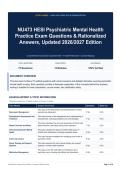
[STUDY GUIDE] • HIGH-YIELD PRACTICE & REVIEW EDITION
NU473 HESI Psychiatric Mental Health
Practice Exam Questions & Rationalized
Answers, Updated 2026/2027 Edition
Comprehensive Examination Question Bank • In-Depth Rationales • Concept Mapping
TOTAL QUESTIONS EXAM TOPICS RATIONALES
75 Questions 12 Modules 100% Verified
DOCUMENT OVERVIEW
This document contains 75 verified questions with correct answers and detailed rationales covering psychiatric
mental health nursing. Each question provides a thorough explanation of the concepts behind the answers,
making it suitable for exam preparation, course review, and certification study.
EXAM BLUEPRINT & TOPIC DISTRIBUTION
Systematic breakdown of subject domains and exam coverage.
Topic Module Scope & Core Focus Questions Share (%)
This topic covers interventions and assessments for clients
Depression Management experiencing depression. 7 Qs 9.3%
Schizophrenia Assessment and This topic focuses on the management and understanding of
Treatment schizophrenia, including symptoms and care strategies. 7 Qs 9.3%
This topic addresses the care and assessment of clients with
Bipolar Disorder and Mania bipolar disorder, particularly during manic episodes. 7 Qs 9.3%
Child and Adolescent Mental This topic evaluates the signs of mental health issues in
Health children and adolescents, including suspected abuse. 6 Qs 8.0%
This topic discusses strategies for managing acute crises in
Crisis Intervention psychiatric clients. 6 Qs 8.0%
Group Therapy and Support This topic examines the role of group therapy and support
Systems systems in mental health treatment. 6 Qs 8.0%
This topic covers the implications of medication use in
Medication Management psychiatric care, including side effects and interactions. 6 Qs 8.0%
Confidential • Student Study Edition • Practice & Review Guide Page 1 of 34
,STUDENT STUDY & MASTERY EDITION PRACTICE & REVIEW GUIDE
Mental Status and Cognitive This topic focuses on assessing mental status and cognitive
Assessment functioning in clients. 6 Qs 8.0%
This topic addresses the assessment and management of
Anxiety Disorders anxiety disorders, including obsessive-compulsive disorder. 6 Qs 8.0%
Substance Abuse and This topic explores the relationship between mental health
Dependency and substance abuse, including withdrawal management. 6 Qs 8.0%
This topic examines the care for clients with dementia and
Dementia and Cognitive Decline related cognitive impairments. 6 Qs 8.0%
This topic reviews fundamental principles of psychiatric
Mental Health Nursing Principles nursing and ethical considerations. 6 Qs 8.0%
Total Exam Coverage 12 Integrated Topic Modules 75 Qs 100.0%
Confidential • Student Study Edition • Practice & Review Guide Page 2 of 34
,STUDENT STUDY & MASTERY EDITION PRACTICE & REVIEW GUIDE
TOPIC 1: DEPRESSION MANAGEMENT
7 Questions • 9.3% of Exam • This topic covers interventions and assessments for clients experiencing depression.
QUESTION 1
The nurse should include which interventions in the plan of care for a severely
depressed client with neurovegetative symptoms? (Select all that apply.) o Permit rest
periods as needed. o Speaking slowly and simply. o Place the client on suicide
precautions. o Observe and encourage food and fluid intake. o Encourage vigorous
exercise and long walks on the unit.
Correct Answer: O Permit rest periods as needed. o Speaking slowly and simply. o Place the client on
suicide precautions. o Observe and encourage food and fluid intake.
· Neurovegetative symptoms that accompany the mood disorder of depression include physiological
disruptions, such as anorexia, constipation, sleep disturbance, and psychomotor retardation. The client's
plan of care should include measures that promote the client's comfort and well-being, such as rest,
nutrition, suicide precautions, and simple
communications. Vigorous exercise and long walks are not indicated for clients in a neurovegetative state.
QUESTION 2
Which diet selection by a client who is depressed and taking the MAO inhibitor
tranylcypromine sulfate (Parnate) indicates to the nurse that the client understands the
dietary restrictions imposed by this medication regimen? o Hamburger, French fries,
and chocolate milkshake. oLiver and onions, broccoli, and decaffeinated coffee. o
Pepperoni and cheese pizza, tossed salad, and a soft drink. o Roast beef, baked potato
with butter, and iced tea.
Correct Answer: O Roast beef, baked potato with butter, and iced tea.
· Foods with tyramine interact with MAOI antidepressant, such as Parnate, and can cause a hypertensive
crisis that is life-threatening. Roast beef, potatoes, butter, and tea do not contain tyramine. The other
selections contain tyramine and should be avoided by the client who is taking Parnate.
Confidential • Student Study Edition • Practice & Review Guide Page 3 of 34
, STUDENT STUDY & MASTERY EDITION PRACTICE & REVIEW GUIDE
QUESTION 3
The nurse is assessing a client who is admitted with a diagnosis of depression. Which
findings is characteristic of depression? o Grandiose ideation. o Self-destructive
thoughts. o Suspiciousness of others. o A negative view of self and the future.
Correct Answer: O A negative view of self and the future.
· Negative self-image and feelings of hopelessness about the future are specific findings in depression. The
other findings are not the underlying manifestations in depression.
QUESTION 4
A male client is admitted to the mental health unit because he was feeling depressed
about the loss of his wife and job. The client has a history of alcohol dependency and
admits that he was drinking alcohol 12 hours ago. Vital signs are: temperature100o F,
pulse 100 beats/minute, and blood pressure 142/100. The nurse plans to give the client
lorazepam (Ativan) based on which priority client problem? o Risk for injury related to
suicidal ideation. o Risk for injury related to alcohol detoxification. o Knowledge deficit
related to ineffective coping. o Health seeking behaviors related to personal crisis.
Correct Answer: O Risk for injury related to alcohol detoxification.
· The most important client problem is alcohol detoxification because the client has elevated vital signs, a
sign of alcohol detoxification. Maintaining client safety is the priority, and the risk for injury should be
addressed after giving the client Ativan for elevated vital signs secondary to alcohol withdrawal. The other
problems are not the priority.
QUESTION 5
An older female client is admitted to the psychiatric unit with a diagnosis of major
depression. Which client statement indicates to the nurse that further assessment is
indicated? o I will die if my cat dies. o I don't feel like eating this morning. o I just went
to my friend's funeral. o Don't you have more important things to do?
Correct Answer: O I will die if my cat dies.
· Clients who use an analogy, such as a cat's death, may be describing themselves and can indicate the
client's thought of suicide, which needs further assessment. The other statements are examples of decreased
energy and mood levels and are not suicidal ideation at this time.
Confidential • Student Study Edition • Practice & Review Guide Page 4 of 34
NU473 HESI Psychiatric Mental Health
Practice Exam Questions & Rationalized
Answers, Updated 2026/2027 Edition
Comprehensive Examination Question Bank • In-Depth Rationales • Concept Mapping
TOTAL QUESTIONS EXAM TOPICS RATIONALES
75 Questions 12 Modules 100% Verified
DOCUMENT OVERVIEW
This document contains 75 verified questions with correct answers and detailed rationales covering psychiatric
mental health nursing. Each question provides a thorough explanation of the concepts behind the answers,
making it suitable for exam preparation, course review, and certification study.
EXAM BLUEPRINT & TOPIC DISTRIBUTION
Systematic breakdown of subject domains and exam coverage.
Topic Module Scope & Core Focus Questions Share (%)
This topic covers interventions and assessments for clients
Depression Management experiencing depression. 7 Qs 9.3%
Schizophrenia Assessment and This topic focuses on the management and understanding of
Treatment schizophrenia, including symptoms and care strategies. 7 Qs 9.3%
This topic addresses the care and assessment of clients with
Bipolar Disorder and Mania bipolar disorder, particularly during manic episodes. 7 Qs 9.3%
Child and Adolescent Mental This topic evaluates the signs of mental health issues in
Health children and adolescents, including suspected abuse. 6 Qs 8.0%
This topic discusses strategies for managing acute crises in
Crisis Intervention psychiatric clients. 6 Qs 8.0%
Group Therapy and Support This topic examines the role of group therapy and support
Systems systems in mental health treatment. 6 Qs 8.0%
This topic covers the implications of medication use in
Medication Management psychiatric care, including side effects and interactions. 6 Qs 8.0%
Confidential • Student Study Edition • Practice & Review Guide Page 1 of 34
,STUDENT STUDY & MASTERY EDITION PRACTICE & REVIEW GUIDE
Mental Status and Cognitive This topic focuses on assessing mental status and cognitive
Assessment functioning in clients. 6 Qs 8.0%
This topic addresses the assessment and management of
Anxiety Disorders anxiety disorders, including obsessive-compulsive disorder. 6 Qs 8.0%
Substance Abuse and This topic explores the relationship between mental health
Dependency and substance abuse, including withdrawal management. 6 Qs 8.0%
This topic examines the care for clients with dementia and
Dementia and Cognitive Decline related cognitive impairments. 6 Qs 8.0%
This topic reviews fundamental principles of psychiatric
Mental Health Nursing Principles nursing and ethical considerations. 6 Qs 8.0%
Total Exam Coverage 12 Integrated Topic Modules 75 Qs 100.0%
Confidential • Student Study Edition • Practice & Review Guide Page 2 of 34
,STUDENT STUDY & MASTERY EDITION PRACTICE & REVIEW GUIDE
TOPIC 1: DEPRESSION MANAGEMENT
7 Questions • 9.3% of Exam • This topic covers interventions and assessments for clients experiencing depression.
QUESTION 1
The nurse should include which interventions in the plan of care for a severely
depressed client with neurovegetative symptoms? (Select all that apply.) o Permit rest
periods as needed. o Speaking slowly and simply. o Place the client on suicide
precautions. o Observe and encourage food and fluid intake. o Encourage vigorous
exercise and long walks on the unit.
Correct Answer: O Permit rest periods as needed. o Speaking slowly and simply. o Place the client on
suicide precautions. o Observe and encourage food and fluid intake.
· Neurovegetative symptoms that accompany the mood disorder of depression include physiological
disruptions, such as anorexia, constipation, sleep disturbance, and psychomotor retardation. The client's
plan of care should include measures that promote the client's comfort and well-being, such as rest,
nutrition, suicide precautions, and simple
communications. Vigorous exercise and long walks are not indicated for clients in a neurovegetative state.
QUESTION 2
Which diet selection by a client who is depressed and taking the MAO inhibitor
tranylcypromine sulfate (Parnate) indicates to the nurse that the client understands the
dietary restrictions imposed by this medication regimen? o Hamburger, French fries,
and chocolate milkshake. oLiver and onions, broccoli, and decaffeinated coffee. o
Pepperoni and cheese pizza, tossed salad, and a soft drink. o Roast beef, baked potato
with butter, and iced tea.
Correct Answer: O Roast beef, baked potato with butter, and iced tea.
· Foods with tyramine interact with MAOI antidepressant, such as Parnate, and can cause a hypertensive
crisis that is life-threatening. Roast beef, potatoes, butter, and tea do not contain tyramine. The other
selections contain tyramine and should be avoided by the client who is taking Parnate.
Confidential • Student Study Edition • Practice & Review Guide Page 3 of 34
, STUDENT STUDY & MASTERY EDITION PRACTICE & REVIEW GUIDE
QUESTION 3
The nurse is assessing a client who is admitted with a diagnosis of depression. Which
findings is characteristic of depression? o Grandiose ideation. o Self-destructive
thoughts. o Suspiciousness of others. o A negative view of self and the future.
Correct Answer: O A negative view of self and the future.
· Negative self-image and feelings of hopelessness about the future are specific findings in depression. The
other findings are not the underlying manifestations in depression.
QUESTION 4
A male client is admitted to the mental health unit because he was feeling depressed
about the loss of his wife and job. The client has a history of alcohol dependency and
admits that he was drinking alcohol 12 hours ago. Vital signs are: temperature100o F,
pulse 100 beats/minute, and blood pressure 142/100. The nurse plans to give the client
lorazepam (Ativan) based on which priority client problem? o Risk for injury related to
suicidal ideation. o Risk for injury related to alcohol detoxification. o Knowledge deficit
related to ineffective coping. o Health seeking behaviors related to personal crisis.
Correct Answer: O Risk for injury related to alcohol detoxification.
· The most important client problem is alcohol detoxification because the client has elevated vital signs, a
sign of alcohol detoxification. Maintaining client safety is the priority, and the risk for injury should be
addressed after giving the client Ativan for elevated vital signs secondary to alcohol withdrawal. The other
problems are not the priority.
QUESTION 5
An older female client is admitted to the psychiatric unit with a diagnosis of major
depression. Which client statement indicates to the nurse that further assessment is
indicated? o I will die if my cat dies. o I don't feel like eating this morning. o I just went
to my friend's funeral. o Don't you have more important things to do?
Correct Answer: O I will die if my cat dies.
· Clients who use an analogy, such as a cat's death, may be describing themselves and can indicate the
client's thought of suicide, which needs further assessment. The other statements are examples of decreased
energy and mood levels and are not suicidal ideation at this time.
Confidential • Student Study Edition • Practice & Review Guide Page 4 of 34