[STUDY GUIDE] • HIGH-YIELD PRACTICE & REVIEW EDITION
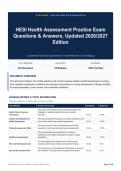
HESI Health Assessment Practice Exam
Questions & Answers, Updated 2026/2027
Edition
Comprehensive Examination Question Bank • In-Depth Rationales • Concept Mapping
TOTAL QUESTIONS EXAM TOPICS RATIONALES
124 Questions 10 Modules 100% Verified
DOCUMENT OVERVIEW
This document contains 124 verified questions with correct answers related to health assessment in nursing.
Each question is designed to reinforce key concepts and practices in nursing assessments, making it suitable
for exam preparation, course review, and certification readiness.
EXAM BLUEPRINT & TOPIC DISTRIBUTION
Systematic breakdown of subject domains and exam coverage.
Topic Module Scope & Core Focus Questions Share (%)
This topic covers effective communication techniques and
Health History Interview strategies for gathering health history during patient
Techniques interviews. 13 Qs 10.5%
Cultural Considerations in This topic explores the importance of cultural competency and
Health Assessment how cultural beliefs impact health assessments. 13 Qs 10.5%
This topic focuses on the various techniques and skills
Physical Assessment Skills required for conducting thorough physical assessments. 13 Qs 10.5%
This topic addresses the significance of nutritional
assessments and related physiological changes in aging
Nutritional Assessment populations. 13 Qs 10.5%
This topic highlights the assessment of skin and nails,
Skin and Nail Assessments including common abnormalities and expected findings. 12 Qs 9.7%
This topic delves into the assessment techniques for eye and
Eye and Ear Assessments ear conditions, including common findings and disorders. 12 Qs 9.7%
Confidential • Student Study Edition • Practice & Review Guide Page 1 of 60
,STUDENT STUDY & MASTERY EDITION PRACTICE & REVIEW GUIDE
Respiratory Assessment This topic emphasizes the methods used to assess
Techniques respiratory function and recognize abnormal findings. 12 Qs 9.7%
This topic covers the techniques used in cardiovascular
Cardiovascular Assessment assessments, including auscultation and palpation. 12 Qs 9.7%
Abdominal Assessment This topic focuses on the skills required to assess abdominal
Techniques conditions, including palpation and auscultation. 12 Qs 9.7%
This topic explores the assessment of neurological function,
Neurological Assessment including mental status and reflex testing. 12 Qs 9.7%
Total Exam Coverage 10 Integrated Topic Modules 124 Qs 100.0%
Confidential • Student Study Edition • Practice & Review Guide Page 2 of 60
,STUDENT STUDY & MASTERY EDITION PRACTICE & REVIEW GUIDE
TOPIC 1: HEALTH HISTORY INTERVIEW TECHNIQUES
13 Questions • 10.5% of Exam • This topic covers effective communication techniques and strategies for gathering health history
during patient interviews.
QUESTION 1
In an interview, the nurse may find it necessary to take notes to aid his or her memory
later. Which statement is true regarding note-taking?
[A)] Note-taking may impede the nurse's observation of the patient's nonverbal behaviors.
[B)] Note-taking allows the patient to continue at his or her own pace as the nurse records what is said.
[C)] Note-taking allows the nurse to shift attention away from the patient, resulting in an increased comfort level.
[D)] Note-taking allows the nurse to break eye contact with the patient, which may increase his or her level of comfort.
Correct Answer: A) Note-taking may impede the nurse's observation of the patient's nonverbal behaviors.
Page: 31 Some use of history forms and note-taking may be unavoidable. But be aware that note-taking
during the interview has disadvantages. It breaks eye contact too often, and it shifts attention away from the
patient, which diminishes his or her sense of importance. It also may interrupt the patient's narrative flow,
and it impedes the observation of the patient's nonverbal behavior.
QUESTION 2
During an interview, the nurse states, "You mentioned shortness of breath. Tell me
more about that." Which verbal skill is used with this statement?
[A)] Reflection
[B)] Facilitation
[C)] Direct question
[D)] Open-ended question
Correct Answer: D) Open-ended question
Page: 32 The open-ended question asks for narrative information. It states the topic to be discussed but only
in general terms. The nurse should use it to begin the interview, to introduce a new section of questions, and
whenever the person introduces a new topic.
Confidential • Student Study Edition • Practice & Review Guide Page 3 of 60
, STUDENT STUDY & MASTERY EDITION PRACTICE & REVIEW GUIDE
QUESTION 3
During an interview, a parent of a hospitalized child is sitting in an open position. As
the interviewer begins to discuss his son's treatment, however, he suddenly crosses
his arms against his chest and crosses his legs. This would suggest that the parent is:
[A)] just changing positions.
[B)] more comfortable in this position.
[C)] tired and needs a break from the interview.
[D)] uncomfortable talking about his son's treatment.
Correct Answer: D) uncomfortable talking about his son's treatment.
Page: 37 Note the person's position. An open position with the extension of large muscle groups shows
relaxation, physical comfort, and a willingness to share information. A closed position with the arms and legs
crossed tends to look defensive and anxious. Note any change in posture. If a person in a relaxed position
suddenly tenses, it suggests possible discomfort with the new topic.
QUESTION 4
The nurse is interviewing a patient who has a hearing impairment. What techniques
would be most beneficial in communicating with this patient?
[A)] Determine the communication method he prefers.
[B)] Avoid using facial and hand gestures because most hearing-impaired people find this degrading.
[C)] Request a sign language interpreter before meeting with him to help facilitate the communication.
[D)] Speak loudly and with exaggerated facial movement when talking with him because this helps with lip reading.
Correct Answer: A) Determine the communication method he prefers.
Pages: 40-41 The nurse should ask the deaf person the preferred way to communicate—by signing, lip
reading, or
writing. If the person prefers lip reading, then the nurse should be sure to face him or her squarely and have
good lighting on the nurse's face. The nurse should not exaggerate lip movements because this distorts
words. Similarly, shouting distorts the reception of a hearing aid the person may wear. The nurse should
speak slowly and should supplement his or her voice with appropriate hand gestures or pantomime.
Confidential • Student Study Edition • Practice & Review Guide Page 4 of 60
HESI Health Assessment Practice Exam
Questions & Answers, Updated 2026/2027
Edition
Comprehensive Examination Question Bank • In-Depth Rationales • Concept Mapping
TOTAL QUESTIONS EXAM TOPICS RATIONALES
124 Questions 10 Modules 100% Verified
DOCUMENT OVERVIEW
This document contains 124 verified questions with correct answers related to health assessment in nursing.
Each question is designed to reinforce key concepts and practices in nursing assessments, making it suitable
for exam preparation, course review, and certification readiness.
EXAM BLUEPRINT & TOPIC DISTRIBUTION
Systematic breakdown of subject domains and exam coverage.
Topic Module Scope & Core Focus Questions Share (%)
This topic covers effective communication techniques and
Health History Interview strategies for gathering health history during patient
Techniques interviews. 13 Qs 10.5%
Cultural Considerations in This topic explores the importance of cultural competency and
Health Assessment how cultural beliefs impact health assessments. 13 Qs 10.5%
This topic focuses on the various techniques and skills
Physical Assessment Skills required for conducting thorough physical assessments. 13 Qs 10.5%
This topic addresses the significance of nutritional
assessments and related physiological changes in aging
Nutritional Assessment populations. 13 Qs 10.5%
This topic highlights the assessment of skin and nails,
Skin and Nail Assessments including common abnormalities and expected findings. 12 Qs 9.7%
This topic delves into the assessment techniques for eye and
Eye and Ear Assessments ear conditions, including common findings and disorders. 12 Qs 9.7%
Confidential • Student Study Edition • Practice & Review Guide Page 1 of 60
,STUDENT STUDY & MASTERY EDITION PRACTICE & REVIEW GUIDE
Respiratory Assessment This topic emphasizes the methods used to assess
Techniques respiratory function and recognize abnormal findings. 12 Qs 9.7%
This topic covers the techniques used in cardiovascular
Cardiovascular Assessment assessments, including auscultation and palpation. 12 Qs 9.7%
Abdominal Assessment This topic focuses on the skills required to assess abdominal
Techniques conditions, including palpation and auscultation. 12 Qs 9.7%
This topic explores the assessment of neurological function,
Neurological Assessment including mental status and reflex testing. 12 Qs 9.7%
Total Exam Coverage 10 Integrated Topic Modules 124 Qs 100.0%
Confidential • Student Study Edition • Practice & Review Guide Page 2 of 60
,STUDENT STUDY & MASTERY EDITION PRACTICE & REVIEW GUIDE
TOPIC 1: HEALTH HISTORY INTERVIEW TECHNIQUES
13 Questions • 10.5% of Exam • This topic covers effective communication techniques and strategies for gathering health history
during patient interviews.
QUESTION 1
In an interview, the nurse may find it necessary to take notes to aid his or her memory
later. Which statement is true regarding note-taking?
[A)] Note-taking may impede the nurse's observation of the patient's nonverbal behaviors.
[B)] Note-taking allows the patient to continue at his or her own pace as the nurse records what is said.
[C)] Note-taking allows the nurse to shift attention away from the patient, resulting in an increased comfort level.
[D)] Note-taking allows the nurse to break eye contact with the patient, which may increase his or her level of comfort.
Correct Answer: A) Note-taking may impede the nurse's observation of the patient's nonverbal behaviors.
Page: 31 Some use of history forms and note-taking may be unavoidable. But be aware that note-taking
during the interview has disadvantages. It breaks eye contact too often, and it shifts attention away from the
patient, which diminishes his or her sense of importance. It also may interrupt the patient's narrative flow,
and it impedes the observation of the patient's nonverbal behavior.
QUESTION 2
During an interview, the nurse states, "You mentioned shortness of breath. Tell me
more about that." Which verbal skill is used with this statement?
[A)] Reflection
[B)] Facilitation
[C)] Direct question
[D)] Open-ended question
Correct Answer: D) Open-ended question
Page: 32 The open-ended question asks for narrative information. It states the topic to be discussed but only
in general terms. The nurse should use it to begin the interview, to introduce a new section of questions, and
whenever the person introduces a new topic.
Confidential • Student Study Edition • Practice & Review Guide Page 3 of 60
, STUDENT STUDY & MASTERY EDITION PRACTICE & REVIEW GUIDE
QUESTION 3
During an interview, a parent of a hospitalized child is sitting in an open position. As
the interviewer begins to discuss his son's treatment, however, he suddenly crosses
his arms against his chest and crosses his legs. This would suggest that the parent is:
[A)] just changing positions.
[B)] more comfortable in this position.
[C)] tired and needs a break from the interview.
[D)] uncomfortable talking about his son's treatment.
Correct Answer: D) uncomfortable talking about his son's treatment.
Page: 37 Note the person's position. An open position with the extension of large muscle groups shows
relaxation, physical comfort, and a willingness to share information. A closed position with the arms and legs
crossed tends to look defensive and anxious. Note any change in posture. If a person in a relaxed position
suddenly tenses, it suggests possible discomfort with the new topic.
QUESTION 4
The nurse is interviewing a patient who has a hearing impairment. What techniques
would be most beneficial in communicating with this patient?
[A)] Determine the communication method he prefers.
[B)] Avoid using facial and hand gestures because most hearing-impaired people find this degrading.
[C)] Request a sign language interpreter before meeting with him to help facilitate the communication.
[D)] Speak loudly and with exaggerated facial movement when talking with him because this helps with lip reading.
Correct Answer: A) Determine the communication method he prefers.
Pages: 40-41 The nurse should ask the deaf person the preferred way to communicate—by signing, lip
reading, or
writing. If the person prefers lip reading, then the nurse should be sure to face him or her squarely and have
good lighting on the nurse's face. The nurse should not exaggerate lip movements because this distorts
words. Similarly, shouting distorts the reception of a hearing aid the person may wear. The nurse should
speak slowly and should supplement his or her voice with appropriate hand gestures or pantomime.
Confidential • Student Study Edition • Practice & Review Guide Page 4 of 60