[STUDY GUIDE] • HIGH-YIELD PRACTICE & REVIEW EDITION
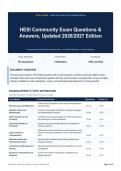
HESI Community Exam Questions &
Answers, Updated 2026/2027 Edition
Comprehensive Examination Question Bank • In-Depth Rationales • Concept Mapping
TOTAL QUESTIONS EXAM TOPICS RATIONALES
193 Questions 15 Modules 100% Verified
DOCUMENT OVERVIEW
This document contains 193 verified questions with correct answers covering community health nursing
principles. Each item pairs a board-style question with the correct answer, ensuring clarity on key concepts,
making it suitable for exam preparation, review, and professional development in nursing practice.
EXAM BLUEPRINT & TOPIC DISTRIBUTION
Systematic breakdown of subject domains and exam coverage.
Topic Module Scope & Core Focus Questions Share (%)
Covers various medications, their uses, and implications in
Pharmacology and Medications nursing practice. 13 Qs 6.7%
Infection Control and Focuses on the spread of infections, prevention strategies,
Epidemiology and epidemiological concepts. 13 Qs 6.7%
Health Assessment and Includes techniques and strategies for health assessments
Screening and screenings in diverse populations. 13 Qs 6.7%
Community Health and Examines community health initiatives and strategies for
Prevention disease prevention. 13 Qs 6.7%
Addresses the legal and ethical frameworks guiding nursing
Legal and Ethical practice, including documentation and the Good Samaritan
Considerations Law. 13 Qs 6.7%
Behavioral Health and Explores factors affecting mental health and behavioral
Psychosocial Factors changes in patients. 13 Qs 6.7%
Leadership and Management in Discusses leadership styles and their application in nursing
Nursing management. 13 Qs 6.7%
Emergency Preparedness and Covers the principles of emergency management and
Response disaster response. 13 Qs 6.7%
Confidential • Student Study Edition • Practice & Review Guide Page 1 of 43
,STUDENT STUDY & MASTERY EDITION PRACTICE & REVIEW GUIDE
Focuses on the role of nutrition in health promotion and
Nutrition and Health Promotion disease management. 13 Qs 6.7%
Examines the role of nurses as advocates for patients' rights
Patient Advocacy and Rights and well-being. 13 Qs 6.7%
Research and Evidence-Based Explores the importance of research in nursing and the
Practice application of evidence-based practices. 13 Qs 6.7%
Health Care Systems and Looks at the structure of healthcare systems and the policies
Policies that affect health care delivery. 13 Qs 6.7%
Discusses various chronic and infectious diseases, their
Chronic and Infectious Diseases management, and implications for public health. 13 Qs 6.7%
Special Populations and Focuses on health considerations and needs of special
Vulnerable Groups populations, including children and the elderly. 12 Qs 6.2%
Assessment Techniques and Covers various assessment techniques used in nursing
Tools practice to gather patient data. 12 Qs 6.2%
Total Exam Coverage 15 Integrated Topic Modules 193 Qs 100.0%
Confidential • Student Study Edition • Practice & Review Guide Page 2 of 43
,STUDENT STUDY & MASTERY EDITION PRACTICE & REVIEW GUIDE
TOPIC 1: PHARMACOLOGY AND MEDICATIONS
13 Questions • 6.7% of Exam • Covers various medications, their uses, and implications in nursing practice.
QUESTION 1
Scopolamine (Transderm-V)
Correct Answer: Medication used to control motion sickness. Must be taken prior to the onset of nausea and
vomiting. Most effective if taken 12 hours before expected travel or activity. Skin patch is applied behind the
ear.
QUESTION 2
Indirect transmission
Correct Answer: Involves the spread of infection through an intermediate source, such as vehicles, fomites,
or vectors. Example:
contracting malaria following exposure in a mosquito-infested area.
QUESTION 3
Informed consent not needed
Correct Answer: In general, there are two situations that apply: when an emergency is present and delaying
treatment for the purpose of obtaining informed consent would result in injury or death of the client; when the
client waives the right to give informed consent.
QUESTION 4
Democratic leader
Correct Answer: A leader who is participative and would likely meet with each staff person individually to
determine the staff member's perception of the problem. This leader would also speak with the staff about
any issues and ask the staff for input with developing a plan. This style empowers staff toward excellence
because this style of leadership allows nursed an opportunity to grow professionally.
Confidential • Student Study Edition • Practice & Review Guide Page 3 of 43
, STUDENT STUDY & MASTERY EDITION PRACTICE & REVIEW GUIDE
QUESTION 5
Infiltration
Correct Answer: Signs & Symptoms: Blanching, coolness, and edema of the IV site. Interventions: Remove
IV catheter (priority) to prevent further damage. Warm compresses may be applied to the area only after the IV
catheter is removed and only if the infiltrated solution is not damaging to the surrounding tissues. Measure
the area of infiltration after IV catheter removal to assess for any further tissue damage.
QUESTION 6
Actions to take when a diabetic patient reports feeling hungry, shaky, and weak
Correct Answer: 1. Check the client's blood glucose level.
2. Give the client 1/2 cup of fruit juice to drink.
3. Take the client's vital signs.
4. Retest the blood glucose level.
5. Give the client a small snack of carbohydrates and protein.
6. Document the client's complaints, actions taken, and outcome.
QUESTION 7
Coercive power
Correct Answer: The manager takes a "do this or else" type of approach.
QUESTION 8
Factors that influence a community's potential for violence
Correct Answer: Social conditions and multiple demands on the population's economic conditions, such as
unemployment, social isolation, media influence, rigid religious beliefs, and population density.
QUESTION 9
Exposure
Correct Answer: Disease progression stage that occurs when individuals have been exposed to a disease
but are asymptomatic.
Confidential • Student Study Edition • Practice & Review Guide Page 4 of 43
HESI Community Exam Questions &
Answers, Updated 2026/2027 Edition
Comprehensive Examination Question Bank • In-Depth Rationales • Concept Mapping
TOTAL QUESTIONS EXAM TOPICS RATIONALES
193 Questions 15 Modules 100% Verified
DOCUMENT OVERVIEW
This document contains 193 verified questions with correct answers covering community health nursing
principles. Each item pairs a board-style question with the correct answer, ensuring clarity on key concepts,
making it suitable for exam preparation, review, and professional development in nursing practice.
EXAM BLUEPRINT & TOPIC DISTRIBUTION
Systematic breakdown of subject domains and exam coverage.
Topic Module Scope & Core Focus Questions Share (%)
Covers various medications, their uses, and implications in
Pharmacology and Medications nursing practice. 13 Qs 6.7%
Infection Control and Focuses on the spread of infections, prevention strategies,
Epidemiology and epidemiological concepts. 13 Qs 6.7%
Health Assessment and Includes techniques and strategies for health assessments
Screening and screenings in diverse populations. 13 Qs 6.7%
Community Health and Examines community health initiatives and strategies for
Prevention disease prevention. 13 Qs 6.7%
Addresses the legal and ethical frameworks guiding nursing
Legal and Ethical practice, including documentation and the Good Samaritan
Considerations Law. 13 Qs 6.7%
Behavioral Health and Explores factors affecting mental health and behavioral
Psychosocial Factors changes in patients. 13 Qs 6.7%
Leadership and Management in Discusses leadership styles and their application in nursing
Nursing management. 13 Qs 6.7%
Emergency Preparedness and Covers the principles of emergency management and
Response disaster response. 13 Qs 6.7%
Confidential • Student Study Edition • Practice & Review Guide Page 1 of 43
,STUDENT STUDY & MASTERY EDITION PRACTICE & REVIEW GUIDE
Focuses on the role of nutrition in health promotion and
Nutrition and Health Promotion disease management. 13 Qs 6.7%
Examines the role of nurses as advocates for patients' rights
Patient Advocacy and Rights and well-being. 13 Qs 6.7%
Research and Evidence-Based Explores the importance of research in nursing and the
Practice application of evidence-based practices. 13 Qs 6.7%
Health Care Systems and Looks at the structure of healthcare systems and the policies
Policies that affect health care delivery. 13 Qs 6.7%
Discusses various chronic and infectious diseases, their
Chronic and Infectious Diseases management, and implications for public health. 13 Qs 6.7%
Special Populations and Focuses on health considerations and needs of special
Vulnerable Groups populations, including children and the elderly. 12 Qs 6.2%
Assessment Techniques and Covers various assessment techniques used in nursing
Tools practice to gather patient data. 12 Qs 6.2%
Total Exam Coverage 15 Integrated Topic Modules 193 Qs 100.0%
Confidential • Student Study Edition • Practice & Review Guide Page 2 of 43
,STUDENT STUDY & MASTERY EDITION PRACTICE & REVIEW GUIDE
TOPIC 1: PHARMACOLOGY AND MEDICATIONS
13 Questions • 6.7% of Exam • Covers various medications, their uses, and implications in nursing practice.
QUESTION 1
Scopolamine (Transderm-V)
Correct Answer: Medication used to control motion sickness. Must be taken prior to the onset of nausea and
vomiting. Most effective if taken 12 hours before expected travel or activity. Skin patch is applied behind the
ear.
QUESTION 2
Indirect transmission
Correct Answer: Involves the spread of infection through an intermediate source, such as vehicles, fomites,
or vectors. Example:
contracting malaria following exposure in a mosquito-infested area.
QUESTION 3
Informed consent not needed
Correct Answer: In general, there are two situations that apply: when an emergency is present and delaying
treatment for the purpose of obtaining informed consent would result in injury or death of the client; when the
client waives the right to give informed consent.
QUESTION 4
Democratic leader
Correct Answer: A leader who is participative and would likely meet with each staff person individually to
determine the staff member's perception of the problem. This leader would also speak with the staff about
any issues and ask the staff for input with developing a plan. This style empowers staff toward excellence
because this style of leadership allows nursed an opportunity to grow professionally.
Confidential • Student Study Edition • Practice & Review Guide Page 3 of 43
, STUDENT STUDY & MASTERY EDITION PRACTICE & REVIEW GUIDE
QUESTION 5
Infiltration
Correct Answer: Signs & Symptoms: Blanching, coolness, and edema of the IV site. Interventions: Remove
IV catheter (priority) to prevent further damage. Warm compresses may be applied to the area only after the IV
catheter is removed and only if the infiltrated solution is not damaging to the surrounding tissues. Measure
the area of infiltration after IV catheter removal to assess for any further tissue damage.
QUESTION 6
Actions to take when a diabetic patient reports feeling hungry, shaky, and weak
Correct Answer: 1. Check the client's blood glucose level.
2. Give the client 1/2 cup of fruit juice to drink.
3. Take the client's vital signs.
4. Retest the blood glucose level.
5. Give the client a small snack of carbohydrates and protein.
6. Document the client's complaints, actions taken, and outcome.
QUESTION 7
Coercive power
Correct Answer: The manager takes a "do this or else" type of approach.
QUESTION 8
Factors that influence a community's potential for violence
Correct Answer: Social conditions and multiple demands on the population's economic conditions, such as
unemployment, social isolation, media influence, rigid religious beliefs, and population density.
QUESTION 9
Exposure
Correct Answer: Disease progression stage that occurs when individuals have been exposed to a disease
but are asymptomatic.
Confidential • Student Study Edition • Practice & Review Guide Page 4 of 43