
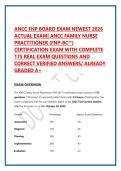
ANCC FNP BOARD EXAM NEWEST 2026
ACTUAL EXAM| ANCC FAMILY NURSE
PRACTITIONER (FNP-BC™)
CERTIFICATION EXAM WITH COMPLETE
175 REAL EXAM QUESTIONS AND
CORRECT VERIFIED ANSWERS/ ALREADY
GRADED A+
EXAM OVERVIEW
The ANCC Family Nurse Practitioner (FNP-BC™) certification exam consists of 175
questions (150 scored, 25 unscored pretest items) with 3.5 hours of testing time. The
exam is organized into five core domains based on the 2026 Test Content Outline,
effective for exams on or after October 30, 2026:
Domain Percentage Approx. Scored Questions
Assessment 19% ~29
Diagnosis 17% ~26
Planning 19% ~29
Implementation 29% ~43
Evaluation 15% ~23
,Total Scored: 150 | Total Exam Questions: 175
DOMAIN 1: ASSESSMENT (Questions 1–34)
Health History, Physical Examination, Screening, and Diagnostic Testing
1. A 72-year-old male presents for a routine physical examination. He has a 40-
pack-year smoking history and reports a chronic cough with occasional blood-
tinged sputum. Which screening test is most appropriate for this patient?
• A) Chest X-ray annually
• B) Low-dose CT chest annually
• C) Sputum cytology every 6 months
• D) PET-CT scan
Correct Answer: B
Rationale: The USPSTF recommends annual lung cancer screening with low-dose
computed tomography (LDCT) for adults aged 50–80 years with a 20-pack-year smoking
history who currently smoke or have quit within the past 15 years. This patient meets
criteria.
2. A 45-year-old woman reports irregular menstrual periods, hot flashes, and night
sweats. Her last menstrual period was 8 months ago. Which laboratory test is most
appropriate to confirm perimenopause?
, • A) Thyroid-stimulating hormone (TSH)
• B) Follicle-stimulating hormone (FSH)
• C) Estradiol level
• D) Progesterone level
Correct Answer: B
Rationale: Elevated FSH levels (>25 IU/L) in a woman with amenorrhea for at least 6
months is consistent with perimenopause/menopause. TSH should be checked to rule
out thyroid dysfunction, but FSH is the primary diagnostic test for menopause.
3. A 6-month-old infant is brought in for a well-child visit. Which developmental
milestone should the FNP expect this infant to have achieved?
• A) Sitting without support
• B) Rolling over front to back
• C) Walking with assistance
• D) Saying "mama" and "dada" specifically
Correct Answer: B
Rationale: By 6 months, most infants can roll over both ways (front to back and back to
front). Sitting without support typically occurs at 7–8 months, and walking with
assistance at 9–12 months.
4. A 58-year-old male with a history of hypertension presents with sudden onset
of severe headache, nausea, and photophobia. On examination, he has nuchal
rigidity. What is the most appropriate initial diagnostic test?
• A) CT head without contrast
, • B) Lumbar puncture
• C) MRI brain
• D) Carotid ultrasound
Correct Answer: A
Rationale: For suspected subarachnoid hemorrhage, a non-contrast CT head is the first-
line diagnostic test. If negative, a lumbar puncture is performed to check for
xanthochromia.
5. A 34-year-old woman presents with fatigue, weight gain, cold intolerance, and
constipation. On examination, she has dry skin and bradycardia. Which laboratory
finding would confirm the diagnosis?
• A) Elevated free T4
• B) Elevated TSH
• C) Decreased TSH
• D) Elevated T3
Correct Answer: B
Rationale: Primary hypothyroidism is diagnosed by an elevated TSH with low free T4.
The symptoms described (fatigue, weight gain, cold intolerance, constipation) are classic
for hypothyroidism.
6. A 16-year-old female is brought in by her mother for a sports physical. She
reports no periods yet. On examination, she has normal breast development and
pubic hair. What is the most appropriate next step?
• A) Reassure the mother that this is normal
ACTUAL EXAM| ANCC FAMILY NURSE
PRACTITIONER (FNP-BC™)
CERTIFICATION EXAM WITH COMPLETE
175 REAL EXAM QUESTIONS AND
CORRECT VERIFIED ANSWERS/ ALREADY
GRADED A+
EXAM OVERVIEW
The ANCC Family Nurse Practitioner (FNP-BC™) certification exam consists of 175
questions (150 scored, 25 unscored pretest items) with 3.5 hours of testing time. The
exam is organized into five core domains based on the 2026 Test Content Outline,
effective for exams on or after October 30, 2026:
Domain Percentage Approx. Scored Questions
Assessment 19% ~29
Diagnosis 17% ~26
Planning 19% ~29
Implementation 29% ~43
Evaluation 15% ~23
,Total Scored: 150 | Total Exam Questions: 175
DOMAIN 1: ASSESSMENT (Questions 1–34)
Health History, Physical Examination, Screening, and Diagnostic Testing
1. A 72-year-old male presents for a routine physical examination. He has a 40-
pack-year smoking history and reports a chronic cough with occasional blood-
tinged sputum. Which screening test is most appropriate for this patient?
• A) Chest X-ray annually
• B) Low-dose CT chest annually
• C) Sputum cytology every 6 months
• D) PET-CT scan
Correct Answer: B
Rationale: The USPSTF recommends annual lung cancer screening with low-dose
computed tomography (LDCT) for adults aged 50–80 years with a 20-pack-year smoking
history who currently smoke or have quit within the past 15 years. This patient meets
criteria.
2. A 45-year-old woman reports irregular menstrual periods, hot flashes, and night
sweats. Her last menstrual period was 8 months ago. Which laboratory test is most
appropriate to confirm perimenopause?
, • A) Thyroid-stimulating hormone (TSH)
• B) Follicle-stimulating hormone (FSH)
• C) Estradiol level
• D) Progesterone level
Correct Answer: B
Rationale: Elevated FSH levels (>25 IU/L) in a woman with amenorrhea for at least 6
months is consistent with perimenopause/menopause. TSH should be checked to rule
out thyroid dysfunction, but FSH is the primary diagnostic test for menopause.
3. A 6-month-old infant is brought in for a well-child visit. Which developmental
milestone should the FNP expect this infant to have achieved?
• A) Sitting without support
• B) Rolling over front to back
• C) Walking with assistance
• D) Saying "mama" and "dada" specifically
Correct Answer: B
Rationale: By 6 months, most infants can roll over both ways (front to back and back to
front). Sitting without support typically occurs at 7–8 months, and walking with
assistance at 9–12 months.
4. A 58-year-old male with a history of hypertension presents with sudden onset
of severe headache, nausea, and photophobia. On examination, he has nuchal
rigidity. What is the most appropriate initial diagnostic test?
• A) CT head without contrast
, • B) Lumbar puncture
• C) MRI brain
• D) Carotid ultrasound
Correct Answer: A
Rationale: For suspected subarachnoid hemorrhage, a non-contrast CT head is the first-
line diagnostic test. If negative, a lumbar puncture is performed to check for
xanthochromia.
5. A 34-year-old woman presents with fatigue, weight gain, cold intolerance, and
constipation. On examination, she has dry skin and bradycardia. Which laboratory
finding would confirm the diagnosis?
• A) Elevated free T4
• B) Elevated TSH
• C) Decreased TSH
• D) Elevated T3
Correct Answer: B
Rationale: Primary hypothyroidism is diagnosed by an elevated TSH with low free T4.
The symptoms described (fatigue, weight gain, cold intolerance, constipation) are classic
for hypothyroidism.
6. A 16-year-old female is brought in by her mother for a sports physical. She
reports no periods yet. On examination, she has normal breast development and
pubic hair. What is the most appropriate next step?
• A) Reassure the mother that this is normal

