[STUDY GUIDE] • HIGH-YIELD PRACTICE & REVIEW EDITION
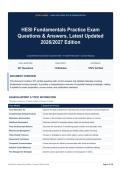
HESI Fundamentals Practice Exam
Questions & Answers, Latest Updated
2026/2027 Edition
Comprehensive Examination Question Bank • In-Depth Rationales • Concept Mapping
TOTAL QUESTIONS EXAM TOPICS RATIONALES
327 Questions 12 Modules 100% Verified
DOCUMENT OVERVIEW
This document contains 327 verified questions with correct answers and detailed rationales covering
fundamental nursing concepts. It provides a comprehensive overview of essential nursing knowledge, making
it suitable for exam preparation, course review, and certification readiness.
EXAM BLUEPRINT & TOPIC DISTRIBUTION
Systematic breakdown of subject domains and exam coverage.
Topic Module Scope & Core Focus
Good Samaritan Act Explores the legal protections for individuals who provide assistance during emergencies.
Complimentary Healing Practices Covers alternative therapies that complement traditional medical treatments.
Medication Administration Focuses on the principles and practices of safe medication delivery in nursing.
Nutritional Assessment Examines methods for evaluating dietary intake and nutritional status.
Fluid and Electrolyte Balance Discusses the importance of maintaining proper hydration and electrolyte levels.
Wound Care Management Covers best practices for assessing and treating various types of wounds.
Patient Safety Protocols Focuses on strategies to ensure client safety in various healthcare settings.
Assessment Techniques Explores effective methods for conducting comprehensive health assessments.
Therapeutic Communication Covers techniques for effective communication with clients and families.
Infection Control Measures Discusses practices to prevent the spread of infections in healthcare settings.
Pain Management Strategies Explores various approaches to assess and manage pain in clients.
Confidential • Student Study Edition • Practice & Review Guide Page 1 of 130
,STUDENT STUDY & MASTERY EDITION PRACTICE & REVIEW GUIDE
Covers the principles and practices for providing compassionate care during the dying
End-of-Life Care process.
Total Exam Coverage 12 Integrated Topic Modules • 327 Examination Questions
Confidential • Student Study Edition • Practice & Review Guide Page 2 of 130
,STUDENT STUDY & MASTERY EDITION PRACTICE & REVIEW GUIDE
QUESTION 1
When turning an immobile bedridden client without assistance, which action by the
nurse best ensures client safety?
[A] Securely grasp the client's arm and leg.
[B] Put bed rails up on the side of bed opposite from the nurse.
[C] Correctly position and use a turn sheet.
[D] Lower the head of the client's bed slowly.
Correct Answer: B.
Rationale: Because the nurse can only stand on one side of the bed, bed rails should be up on the opposite side to ensure
that the client does not fall out of bed. Option A can cause client injury to the skin or joint. Options C and D are useful
techniques while turning a client but have less priority in terms of safety than use of the bed rails.
QUESTION 2
The nurse identifies a potential for infection in a client with partial-thickness
(second-degree) and full-thickness (thirddegree) burns. What intervention has the
highest priority in decreasing the client's risk of infection?
[A] Administration of plasma expanders
[B] Use of careful handwashing technique
[C] Application of a topical antibacterial cream
[D] Limiting visitors to the client with burns
Correct Answer: B.
Rationale: Careful handwashing technique is the single most effective intervention for the prevention of contamination to all
clients. Option A reverses the hypovolemia that initially accompanies burn trauma but is not related to decreasing the
proliferation of infective organisms. Options C and D are recommended by various burn centers as possible ways to reduce
the chance of infection. Option B is a proven technique to prevent infection.
Confidential • Student Study Edition • Practice & Review Guide Page 3 of 130
, STUDENT STUDY & MASTERY EDITION PRACTICE & REVIEW GUIDE
QUESTION 3
The nurse is aware that malnutrition is a common problem among clients served by a
community health clinic for the homeless. Which laboratory value is the most reliable
indicator of chronic protein malnutrition?
[A] Low serum albumin level
[B] Low serum transferrin level
[C] High hemoglobin level
[D] High cholesterol level
Correct Answer: A.
Rationale: Long-term protein deficiency is required to cause significantly lowered serum albumin levels. Albumin is made by
the liver only when adequate amounts of amino acids (from protein breakdown) are available. Albumin has a long half-life,
so acute protein loss does not significantly alter serum levels. Option B is a serum protein with a halflife of only 8 to 10 days,
so it will drop with an acute protein deficiency. Options C and D are not clinical measures of protein malnutrition.
QUESTION 4
In completing a client's preoperative routine, the nurse finds that the operative permit is
not signed. The client begins to ask more questions about the surgical procedure.
Which action should the nurse take next?
[A] Witness the client's signature to the permit.
[B] Answer the client's questions about the surgery.
[C] Inform the surgeon that the operative permit is not signed and the client has questions about the surgery.
[D] Reassure the client that the surgeon will answer any questions before the anesthesia is administered.
Correct Answer: C.
Rationale: The surgeon should be informed immediately that the permit is not signed. It is the surgeon's responsibility to
explain the procedure to the client and obtain the client's signature on the permit. Although the nurse can witness an
operative permit, the procedure must first be explained by the health care provider or surgeon, including answering the
client's questions. The client's questions should be addressed before the permit is signed.
Confidential • Student Study Edition • Practice & Review Guide Page 4 of 130
HESI Fundamentals Practice Exam
Questions & Answers, Latest Updated
2026/2027 Edition
Comprehensive Examination Question Bank • In-Depth Rationales • Concept Mapping
TOTAL QUESTIONS EXAM TOPICS RATIONALES
327 Questions 12 Modules 100% Verified
DOCUMENT OVERVIEW
This document contains 327 verified questions with correct answers and detailed rationales covering
fundamental nursing concepts. It provides a comprehensive overview of essential nursing knowledge, making
it suitable for exam preparation, course review, and certification readiness.
EXAM BLUEPRINT & TOPIC DISTRIBUTION
Systematic breakdown of subject domains and exam coverage.
Topic Module Scope & Core Focus
Good Samaritan Act Explores the legal protections for individuals who provide assistance during emergencies.
Complimentary Healing Practices Covers alternative therapies that complement traditional medical treatments.
Medication Administration Focuses on the principles and practices of safe medication delivery in nursing.
Nutritional Assessment Examines methods for evaluating dietary intake and nutritional status.
Fluid and Electrolyte Balance Discusses the importance of maintaining proper hydration and electrolyte levels.
Wound Care Management Covers best practices for assessing and treating various types of wounds.
Patient Safety Protocols Focuses on strategies to ensure client safety in various healthcare settings.
Assessment Techniques Explores effective methods for conducting comprehensive health assessments.
Therapeutic Communication Covers techniques for effective communication with clients and families.
Infection Control Measures Discusses practices to prevent the spread of infections in healthcare settings.
Pain Management Strategies Explores various approaches to assess and manage pain in clients.
Confidential • Student Study Edition • Practice & Review Guide Page 1 of 130
,STUDENT STUDY & MASTERY EDITION PRACTICE & REVIEW GUIDE
Covers the principles and practices for providing compassionate care during the dying
End-of-Life Care process.
Total Exam Coverage 12 Integrated Topic Modules • 327 Examination Questions
Confidential • Student Study Edition • Practice & Review Guide Page 2 of 130
,STUDENT STUDY & MASTERY EDITION PRACTICE & REVIEW GUIDE
QUESTION 1
When turning an immobile bedridden client without assistance, which action by the
nurse best ensures client safety?
[A] Securely grasp the client's arm and leg.
[B] Put bed rails up on the side of bed opposite from the nurse.
[C] Correctly position and use a turn sheet.
[D] Lower the head of the client's bed slowly.
Correct Answer: B.
Rationale: Because the nurse can only stand on one side of the bed, bed rails should be up on the opposite side to ensure
that the client does not fall out of bed. Option A can cause client injury to the skin or joint. Options C and D are useful
techniques while turning a client but have less priority in terms of safety than use of the bed rails.
QUESTION 2
The nurse identifies a potential for infection in a client with partial-thickness
(second-degree) and full-thickness (thirddegree) burns. What intervention has the
highest priority in decreasing the client's risk of infection?
[A] Administration of plasma expanders
[B] Use of careful handwashing technique
[C] Application of a topical antibacterial cream
[D] Limiting visitors to the client with burns
Correct Answer: B.
Rationale: Careful handwashing technique is the single most effective intervention for the prevention of contamination to all
clients. Option A reverses the hypovolemia that initially accompanies burn trauma but is not related to decreasing the
proliferation of infective organisms. Options C and D are recommended by various burn centers as possible ways to reduce
the chance of infection. Option B is a proven technique to prevent infection.
Confidential • Student Study Edition • Practice & Review Guide Page 3 of 130
, STUDENT STUDY & MASTERY EDITION PRACTICE & REVIEW GUIDE
QUESTION 3
The nurse is aware that malnutrition is a common problem among clients served by a
community health clinic for the homeless. Which laboratory value is the most reliable
indicator of chronic protein malnutrition?
[A] Low serum albumin level
[B] Low serum transferrin level
[C] High hemoglobin level
[D] High cholesterol level
Correct Answer: A.
Rationale: Long-term protein deficiency is required to cause significantly lowered serum albumin levels. Albumin is made by
the liver only when adequate amounts of amino acids (from protein breakdown) are available. Albumin has a long half-life,
so acute protein loss does not significantly alter serum levels. Option B is a serum protein with a halflife of only 8 to 10 days,
so it will drop with an acute protein deficiency. Options C and D are not clinical measures of protein malnutrition.
QUESTION 4
In completing a client's preoperative routine, the nurse finds that the operative permit is
not signed. The client begins to ask more questions about the surgical procedure.
Which action should the nurse take next?
[A] Witness the client's signature to the permit.
[B] Answer the client's questions about the surgery.
[C] Inform the surgeon that the operative permit is not signed and the client has questions about the surgery.
[D] Reassure the client that the surgeon will answer any questions before the anesthesia is administered.
Correct Answer: C.
Rationale: The surgeon should be informed immediately that the permit is not signed. It is the surgeon's responsibility to
explain the procedure to the client and obtain the client's signature on the permit. Although the nurse can witness an
operative permit, the procedure must first be explained by the health care provider or surgeon, including answering the
client's questions. The client's questions should be addressed before the permit is signed.
Confidential • Student Study Edition • Practice & Review Guide Page 4 of 130