[STUDY GUIDE] • HIGH-YIELD PRACTICE & REVIEW EDITION
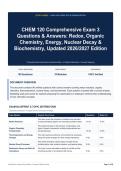
CHEM 120 Comprehensive Exam 3
Questions & Answers: Redox, Organic
Chemistry, Energy, Nuclear Decay &
Biochemistry, Updated 2026/2027 Edition
Comprehensive Examination Question Bank • In-Depth Rationales • Concept Mapping
TOTAL QUESTIONS EXAM TOPICS RATIONALES
96 Questions 10 Modules 100% Verified
DOCUMENT OVERVIEW
This document contains 96 verified questions with correct answers covering redox reactions, organic
chemistry, thermodynamics, nuclear decay, and biochemistry. Each question is paired with a concise answer,
facilitating study and review for students preparing for examinations or seeking to reinforce their understanding
of core chemistry concepts.
EXAM BLUEPRINT & TOPIC DISTRIBUTION
Systematic breakdown of subject domains and exam coverage.
Topic Module Scope & Core Focus Questions Share (%)
This topic covers the principles of oxidation and reduction,
Redox Reactions including identifying agents and calculating oxidation states. 10 Qs 10.4%
This section focuses on the structure, nomenclature, and
Organic Chemistry types of organic compounds, including hydrocarbons and
Fundamentals functional groups. 12 Qs 12.5%
Thermodynamics and Energy This topic explores exothermic and endothermic processes,
Changes along with phase changes and their energy implications. 9 Qs 9.4%
This section examines various types of nuclear decay,
Nuclear Decay Processes including alpha, beta, positron emission, and gamma decay. 9 Qs 9.4%
Radioactive Decay and Half-Life This topic involves calculations related to half-life and the
Calculations remaining quantity of a substance after decay. 9 Qs 9.4%
Confidential • Student Study Edition • Practice & Review Guide Page 1 of 20
,STUDENT STUDY & MASTERY EDITION PRACTICE & REVIEW GUIDE
This section covers ionizing and non-ionizing radiation, their
Radiation Types and Effects examples, and the biological effects of radiation exposure. 9 Qs 9.4%
This topic discusses the four primary biological
Biological Macromolecules macromolecules and their roles in biological systems. 9 Qs 9.4%
This section explores the structure and function of proteins,
Proteins and Their Structures including bonding and levels of protein organization. 9 Qs 9.4%
Nucleic Acids and Genetic This topic focuses on the structure and function of DNA and
Information RNA, including gene expression processes. 11 Qs 11.5%
This section covers the processes involved in protein
Translation and Protein synthesis from mRNA, including the translation of genetic
Synthesis code. 9 Qs 9.4%
Total Exam Coverage 10 Integrated Topic Modules 96 Qs 100.0%
Confidential • Student Study Edition • Practice & Review Guide Page 2 of 20
, STUDENT STUDY & MASTERY EDITION PRACTICE & REVIEW GUIDE
TOPIC 1: REDOX REACTIONS
10 Questions • 10.4% of Exam • This topic covers the principles of oxidation and reduction, including identifying agents and calculating
oxidation states.
QUESTION 1
What does LEO stand for in redox chemistry?
Correct Answer: Loss of Electrons is Oxidation.
QUESTION 2
What does GER stand for in redox chemistry?
Correct Answer: Gaining of Electrons is Reduction.
QUESTION 3
Is Fe2+ oxidized or reduced to Fe0?
Correct Answer: Fe is reduced.
QUESTION 4
Is O2- oxidized or reduced to O0?
Correct Answer: O is oxidized.
QUESTION 5
Is Cu+1 oxidized or reduced to Cu2+?
Correct Answer: Cu is oxidized.
Confidential • Student Study Edition • Practice & Review Guide Page 3 of 20
CHEM 120 Comprehensive Exam 3
Questions & Answers: Redox, Organic
Chemistry, Energy, Nuclear Decay &
Biochemistry, Updated 2026/2027 Edition
Comprehensive Examination Question Bank • In-Depth Rationales • Concept Mapping
TOTAL QUESTIONS EXAM TOPICS RATIONALES
96 Questions 10 Modules 100% Verified
DOCUMENT OVERVIEW
This document contains 96 verified questions with correct answers covering redox reactions, organic
chemistry, thermodynamics, nuclear decay, and biochemistry. Each question is paired with a concise answer,
facilitating study and review for students preparing for examinations or seeking to reinforce their understanding
of core chemistry concepts.
EXAM BLUEPRINT & TOPIC DISTRIBUTION
Systematic breakdown of subject domains and exam coverage.
Topic Module Scope & Core Focus Questions Share (%)
This topic covers the principles of oxidation and reduction,
Redox Reactions including identifying agents and calculating oxidation states. 10 Qs 10.4%
This section focuses on the structure, nomenclature, and
Organic Chemistry types of organic compounds, including hydrocarbons and
Fundamentals functional groups. 12 Qs 12.5%
Thermodynamics and Energy This topic explores exothermic and endothermic processes,
Changes along with phase changes and their energy implications. 9 Qs 9.4%
This section examines various types of nuclear decay,
Nuclear Decay Processes including alpha, beta, positron emission, and gamma decay. 9 Qs 9.4%
Radioactive Decay and Half-Life This topic involves calculations related to half-life and the
Calculations remaining quantity of a substance after decay. 9 Qs 9.4%
Confidential • Student Study Edition • Practice & Review Guide Page 1 of 20
,STUDENT STUDY & MASTERY EDITION PRACTICE & REVIEW GUIDE
This section covers ionizing and non-ionizing radiation, their
Radiation Types and Effects examples, and the biological effects of radiation exposure. 9 Qs 9.4%
This topic discusses the four primary biological
Biological Macromolecules macromolecules and their roles in biological systems. 9 Qs 9.4%
This section explores the structure and function of proteins,
Proteins and Their Structures including bonding and levels of protein organization. 9 Qs 9.4%
Nucleic Acids and Genetic This topic focuses on the structure and function of DNA and
Information RNA, including gene expression processes. 11 Qs 11.5%
This section covers the processes involved in protein
Translation and Protein synthesis from mRNA, including the translation of genetic
Synthesis code. 9 Qs 9.4%
Total Exam Coverage 10 Integrated Topic Modules 96 Qs 100.0%
Confidential • Student Study Edition • Practice & Review Guide Page 2 of 20
, STUDENT STUDY & MASTERY EDITION PRACTICE & REVIEW GUIDE
TOPIC 1: REDOX REACTIONS
10 Questions • 10.4% of Exam • This topic covers the principles of oxidation and reduction, including identifying agents and calculating
oxidation states.
QUESTION 1
What does LEO stand for in redox chemistry?
Correct Answer: Loss of Electrons is Oxidation.
QUESTION 2
What does GER stand for in redox chemistry?
Correct Answer: Gaining of Electrons is Reduction.
QUESTION 3
Is Fe2+ oxidized or reduced to Fe0?
Correct Answer: Fe is reduced.
QUESTION 4
Is O2- oxidized or reduced to O0?
Correct Answer: O is oxidized.
QUESTION 5
Is Cu+1 oxidized or reduced to Cu2+?
Correct Answer: Cu is oxidized.
Confidential • Student Study Edition • Practice & Review Guide Page 3 of 20