[STUDY GUIDE] • HIGH-YIELD PRACTICE & REVIEW EDITION
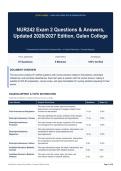
NUR242 Exam 2 Questions & Answers,
Updated 2026/2027 Edition, Galen College
Comprehensive Examination Question Bank • In-Depth Rationales • Concept Mapping
TOTAL QUESTIONS EXAM TOPICS RATIONALES
87 Questions 9 Modules 100% Verified
DOCUMENT OVERVIEW
This document contains 87 verified questions with correct answers related to fluid balance, electrolyte
imbalances, and acid-base disturbances. Each item pairs a question with the correct answer, making it
suitable for NCLEX preparation, course review, and rapid remediation for nursing students preparing for their
exams.
EXAM BLUEPRINT & TOPIC DISTRIBUTION
Systematic breakdown of subject domains and exam coverage.
Topic Module Scope & Core Focus Questions Share (%)
This topic covers the causes, signs and symptoms,
assessments, and management strategies related to fluid
Fluid Overload and Dehydration overload and dehydration. 11 Qs 12.6%
This topic addresses the causes, symptoms, ECG changes,
Electrolyte Imbalances: Calcium and interventions for hypercalcemia and hypocalcemia. 11 Qs 12.6%
Electrolyte Imbalances: This topic focuses on the causes, symptoms, ECG changes,
Potassium and management for hyperkalemia and hypokalemia. 12 Qs 13.8%
This topic explores the causes, symptoms, interventions, and
Electrolyte Imbalances: complications related to hypermagnesemia and
Magnesium hypomagnesemia. 12 Qs 13.8%
This topic examines the causes, assessments, interventions,
and complications associated with hypernatremia and
Electrolyte Imbalances: Sodium hyponatremia. 9 Qs 10.3%
Acid-Base Disorders: Metabolic This topic discusses the signs, lab values, interventions, and
Acidosis complications associated with metabolic acidosis. 8 Qs 9.2%
Acid-Base Disorders: Metabolic This topic covers the causes, signs, lab values, and
Alkalosis interventions related to metabolic alkalosis. 8 Qs 9.2%
Confidential • Student Study Edition • Practice & Review Guide Page 1 of 24
,STUDENT STUDY & MASTERY EDITION PRACTICE & REVIEW GUIDE
Acid-Base Disorders: This topic addresses the causes, signs, lab values, and
Respiratory Acidosis management strategies for respiratory acidosis. 8 Qs 9.2%
Acid-Base Disorders: This topic reviews the causes, signs, lab values, and
Respiratory Alkalosis interventions for respiratory alkalosis. 8 Qs 9.2%
Total Exam Coverage 9 Integrated Topic Modules 87 Qs 100.0%
Confidential • Student Study Edition • Practice & Review Guide Page 2 of 24
, STUDENT STUDY & MASTERY EDITION PRACTICE & REVIEW GUIDE
TOPIC 1: FLUID OVERLOAD AND DEHYDRATION
11 Questions • 12.6% of Exam • This topic covers the causes, signs and symptoms, assessments, and management strategies
related to fluid overload and dehydration.
QUESTION 1
Causes of fluid overload
Correct Answer: •Excessive fluid replacement
•Kidney failure (late phase)
•Heart failure
•Long term corticosteroid therapy
•Syndrome of inappropriate antidiuretic hormone (SIADH)
•Psychiatric disorders with polydipsia
•Water intoxication.
QUESTION 2
S/s fluid overload
Correct Answer: •CV: tachycardia, bounding pulse, HTN, decrease pulse pressure, JVD, weight gain
•Resp: increase and shallow resp; SOB, crackles lung sounds
•Skin: pitting edema, skin pale and cool to touch
•Neuromuscular: LOC, HA, visual disturbance, muscle weakness, paresthesia
•GI: increase motility, enlarge liver.
QUESTION 3
Assessment for fluid overload
Correct Answer: •Assess risk r/t age and diagnosis, history (overhydration, CHF, kidney disease)
•Assess vital signs why: watch for bounding tachycardia, HTN, dysrhythmias, tachypnea
•Assess lung sounds (crackles) , weight, LOC, Observe JVD
•Assess lab values: electrolytes imbalance and signs and symptoms
• Focus Assessment: skin/extremities/ abdomen and sacrum area for edema
•Assess perfusion: edema may impair perfusion to extremities, assess peripheral and central pulses,
capillary refill, skin color, temp, sensory and motor function
•Observe for urine output.
Confidential • Student Study Edition • Practice & Review Guide Page 3 of 24
NUR242 Exam 2 Questions & Answers,
Updated 2026/2027 Edition, Galen College
Comprehensive Examination Question Bank • In-Depth Rationales • Concept Mapping
TOTAL QUESTIONS EXAM TOPICS RATIONALES
87 Questions 9 Modules 100% Verified
DOCUMENT OVERVIEW
This document contains 87 verified questions with correct answers related to fluid balance, electrolyte
imbalances, and acid-base disturbances. Each item pairs a question with the correct answer, making it
suitable for NCLEX preparation, course review, and rapid remediation for nursing students preparing for their
exams.
EXAM BLUEPRINT & TOPIC DISTRIBUTION
Systematic breakdown of subject domains and exam coverage.
Topic Module Scope & Core Focus Questions Share (%)
This topic covers the causes, signs and symptoms,
assessments, and management strategies related to fluid
Fluid Overload and Dehydration overload and dehydration. 11 Qs 12.6%
This topic addresses the causes, symptoms, ECG changes,
Electrolyte Imbalances: Calcium and interventions for hypercalcemia and hypocalcemia. 11 Qs 12.6%
Electrolyte Imbalances: This topic focuses on the causes, symptoms, ECG changes,
Potassium and management for hyperkalemia and hypokalemia. 12 Qs 13.8%
This topic explores the causes, symptoms, interventions, and
Electrolyte Imbalances: complications related to hypermagnesemia and
Magnesium hypomagnesemia. 12 Qs 13.8%
This topic examines the causes, assessments, interventions,
and complications associated with hypernatremia and
Electrolyte Imbalances: Sodium hyponatremia. 9 Qs 10.3%
Acid-Base Disorders: Metabolic This topic discusses the signs, lab values, interventions, and
Acidosis complications associated with metabolic acidosis. 8 Qs 9.2%
Acid-Base Disorders: Metabolic This topic covers the causes, signs, lab values, and
Alkalosis interventions related to metabolic alkalosis. 8 Qs 9.2%
Confidential • Student Study Edition • Practice & Review Guide Page 1 of 24
,STUDENT STUDY & MASTERY EDITION PRACTICE & REVIEW GUIDE
Acid-Base Disorders: This topic addresses the causes, signs, lab values, and
Respiratory Acidosis management strategies for respiratory acidosis. 8 Qs 9.2%
Acid-Base Disorders: This topic reviews the causes, signs, lab values, and
Respiratory Alkalosis interventions for respiratory alkalosis. 8 Qs 9.2%
Total Exam Coverage 9 Integrated Topic Modules 87 Qs 100.0%
Confidential • Student Study Edition • Practice & Review Guide Page 2 of 24
, STUDENT STUDY & MASTERY EDITION PRACTICE & REVIEW GUIDE
TOPIC 1: FLUID OVERLOAD AND DEHYDRATION
11 Questions • 12.6% of Exam • This topic covers the causes, signs and symptoms, assessments, and management strategies
related to fluid overload and dehydration.
QUESTION 1
Causes of fluid overload
Correct Answer: •Excessive fluid replacement
•Kidney failure (late phase)
•Heart failure
•Long term corticosteroid therapy
•Syndrome of inappropriate antidiuretic hormone (SIADH)
•Psychiatric disorders with polydipsia
•Water intoxication.
QUESTION 2
S/s fluid overload
Correct Answer: •CV: tachycardia, bounding pulse, HTN, decrease pulse pressure, JVD, weight gain
•Resp: increase and shallow resp; SOB, crackles lung sounds
•Skin: pitting edema, skin pale and cool to touch
•Neuromuscular: LOC, HA, visual disturbance, muscle weakness, paresthesia
•GI: increase motility, enlarge liver.
QUESTION 3
Assessment for fluid overload
Correct Answer: •Assess risk r/t age and diagnosis, history (overhydration, CHF, kidney disease)
•Assess vital signs why: watch for bounding tachycardia, HTN, dysrhythmias, tachypnea
•Assess lung sounds (crackles) , weight, LOC, Observe JVD
•Assess lab values: electrolytes imbalance and signs and symptoms
• Focus Assessment: skin/extremities/ abdomen and sacrum area for edema
•Assess perfusion: edema may impair perfusion to extremities, assess peripheral and central pulses,
capillary refill, skin color, temp, sensory and motor function
•Observe for urine output.
Confidential • Student Study Edition • Practice & Review Guide Page 3 of 24