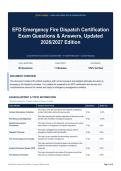
[STUDY GUIDE] • HIGH-YIELD PRACTICE & REVIEW EDITION
EFD Emergency Fire Dispatch Certification
Exam Questions & Answers, Updated
2026/2027 Edition
Comprehensive Examination Question Bank • In-Depth Rationales • Concept Mapping
TOTAL QUESTIONS EXAM TOPICS RATIONALES
90 Questions 11 Modules 100% Verified
DOCUMENT OVERVIEW
This document contains 90 verified questions with correct answers and detailed rationales focusing on
emergency fire dispatch principles. It is suitable for preparation for EFD certification and serves as a
comprehensive resource for review and study in emergency management contexts.
EXAM BLUEPRINT & TOPIC DISTRIBUTION
Systematic breakdown of subject domains and exam coverage.
Topic Module Scope & Core Focus Questions Share (%)
This topic covers the importance and methods of gathering
Incident Information Collection incident information during fire-rescue calls. 9 Qs 10.0%
This topic examines the primary objectives of fire-rescue calls
Fire-Rescue Call Objectives and the roles of EFDs in emergency situations. 9 Qs 10.0%
Quality Improvement This topic focuses on the standards and processes for quality
Procedures improvement in emergency fire dispatch operations. 8 Qs 8.9%
This topic investigates the structured protocols used in
Dispatch Protocols emergency dispatch and their benefits. 8 Qs 8.9%
This topic covers essential fire terminology relevant to
Fire Terminology and Concepts dispatch and incident management. 8 Qs 8.9%
This topic explores the functional areas and principles of the
Incident Command System as applied in emergency
Incident Command System (ICS) scenarios. 8 Qs 8.9%
This topic discusses the principles of fire behavior and their
Fire Behavior Principles relevance to emergency dispatch decisions. 8 Qs 8.9%
Confidential • Student Study Edition • Practice & Review Guide Page 1 of 42
,STUDENT STUDY & MASTERY EDITION PRACTICE & REVIEW GUIDE
This topic addresses the principles and practices of managing
Resource Management resources effectively during emergency responses. 8 Qs 8.9%
Communication with This topic focuses on the communication process between
Responders EFDs and responders during emergencies. 8 Qs 8.9%
Legal and Ethical This topic examines the legal and ethical responsibilities of
Considerations EFDs in their operational duties. 8 Qs 8.9%
This topic emphasizes the importance of scene safety and
Scene Safety and Assessment assessment protocols for EFDs. 8 Qs 8.9%
Total Exam Coverage 11 Integrated Topic Modules 90 Qs 100.0%
Confidential • Student Study Edition • Practice & Review Guide Page 2 of 42
,STUDENT STUDY & MASTERY EDITION PRACTICE & REVIEW GUIDE
TOPIC 1: INCIDENT INFORMATION COLLECTION
9 Questions • 10.0% of Exam • This topic covers the importance and methods of gathering incident information during fire-rescue
calls.
QUESTION 1
What is the primary objective of collecting incident information during a fire-rescue
call?
[A] Collecting scene safety information
[B] Identifying the correct response
[C] Assessing the need for DLS instructions
[D] Collecting incident information
Correct Answer: 4. Assess the need for DLS instructions.
Rationale: Fire-rescue call objectives emphasize the importance of collecting incident information to ensure proper
response and resource allocation.
QUESTION 2
What is the importance of quality improvement procedures in emergency dispatch?
[A] To improve incident response times
[B] To enhance communication with responders
[C] To establish a standard of service, prioritize responses, and reduce exposure and liability
[D] All of the above
Correct Answer: D. All of the above.
Rationale: Quality improvement procedures in emergency dispatch aim to establish a standard of service, prioritize
responses, and reduce exposure and liability.
Confidential • Student Study Edition • Practice & Review Guide Page 3 of 42
, STUDENT STUDY & MASTERY EDITION PRACTICE & REVIEW GUIDE
QUESTION 3
The objectives of a fire-rescue call include all of the following EXCEPT:
[A] Collect incident information
[B] Collect scene safety information
[C] Identify the correct response
[D] Order a pizza for the responding units
Correct Answer: Order a pizza for the responding units.
Rationale: The objectives of a fire-rescue call in Emergency Fire Dispatch Fundamentals are to collect incident information,
collect scene safety information, identify the correct response, and assess the need for DLS instructions, among
others. Ordering a pizza is not a relevant or acceptable objective.
QUESTION 4
A quality improvement process in Emergency Fire Dispatch Fundamentals aims to:
[A] Reduce the frequency of emergency calls
[B] Improve communication with responders at the scene
[C] Enhance the skills and knowledge of EFDs
[D] Increase the response time of emergency services
Correct Answer: Enhance the skills and knowledge of EFDs.
Rationale: Quality improvement processes in Emergency Fire Dispatch Fundamentals focus on enhancing the skills and
knowledge of EFDs, improving communication with responders, and reinforcing EFDs' behaviors, among other
objectives. Reducing the frequency of emergency calls, increasing response time, are not primary objectives.
Confidential • Student Study Edition • Practice & Review Guide Page 4 of 42
EFD Emergency Fire Dispatch Certification
Exam Questions & Answers, Updated
2026/2027 Edition
Comprehensive Examination Question Bank • In-Depth Rationales • Concept Mapping
TOTAL QUESTIONS EXAM TOPICS RATIONALES
90 Questions 11 Modules 100% Verified
DOCUMENT OVERVIEW
This document contains 90 verified questions with correct answers and detailed rationales focusing on
emergency fire dispatch principles. It is suitable for preparation for EFD certification and serves as a
comprehensive resource for review and study in emergency management contexts.
EXAM BLUEPRINT & TOPIC DISTRIBUTION
Systematic breakdown of subject domains and exam coverage.
Topic Module Scope & Core Focus Questions Share (%)
This topic covers the importance and methods of gathering
Incident Information Collection incident information during fire-rescue calls. 9 Qs 10.0%
This topic examines the primary objectives of fire-rescue calls
Fire-Rescue Call Objectives and the roles of EFDs in emergency situations. 9 Qs 10.0%
Quality Improvement This topic focuses on the standards and processes for quality
Procedures improvement in emergency fire dispatch operations. 8 Qs 8.9%
This topic investigates the structured protocols used in
Dispatch Protocols emergency dispatch and their benefits. 8 Qs 8.9%
This topic covers essential fire terminology relevant to
Fire Terminology and Concepts dispatch and incident management. 8 Qs 8.9%
This topic explores the functional areas and principles of the
Incident Command System as applied in emergency
Incident Command System (ICS) scenarios. 8 Qs 8.9%
This topic discusses the principles of fire behavior and their
Fire Behavior Principles relevance to emergency dispatch decisions. 8 Qs 8.9%
Confidential • Student Study Edition • Practice & Review Guide Page 1 of 42
,STUDENT STUDY & MASTERY EDITION PRACTICE & REVIEW GUIDE
This topic addresses the principles and practices of managing
Resource Management resources effectively during emergency responses. 8 Qs 8.9%
Communication with This topic focuses on the communication process between
Responders EFDs and responders during emergencies. 8 Qs 8.9%
Legal and Ethical This topic examines the legal and ethical responsibilities of
Considerations EFDs in their operational duties. 8 Qs 8.9%
This topic emphasizes the importance of scene safety and
Scene Safety and Assessment assessment protocols for EFDs. 8 Qs 8.9%
Total Exam Coverage 11 Integrated Topic Modules 90 Qs 100.0%
Confidential • Student Study Edition • Practice & Review Guide Page 2 of 42
,STUDENT STUDY & MASTERY EDITION PRACTICE & REVIEW GUIDE
TOPIC 1: INCIDENT INFORMATION COLLECTION
9 Questions • 10.0% of Exam • This topic covers the importance and methods of gathering incident information during fire-rescue
calls.
QUESTION 1
What is the primary objective of collecting incident information during a fire-rescue
call?
[A] Collecting scene safety information
[B] Identifying the correct response
[C] Assessing the need for DLS instructions
[D] Collecting incident information
Correct Answer: 4. Assess the need for DLS instructions.
Rationale: Fire-rescue call objectives emphasize the importance of collecting incident information to ensure proper
response and resource allocation.
QUESTION 2
What is the importance of quality improvement procedures in emergency dispatch?
[A] To improve incident response times
[B] To enhance communication with responders
[C] To establish a standard of service, prioritize responses, and reduce exposure and liability
[D] All of the above
Correct Answer: D. All of the above.
Rationale: Quality improvement procedures in emergency dispatch aim to establish a standard of service, prioritize
responses, and reduce exposure and liability.
Confidential • Student Study Edition • Practice & Review Guide Page 3 of 42
, STUDENT STUDY & MASTERY EDITION PRACTICE & REVIEW GUIDE
QUESTION 3
The objectives of a fire-rescue call include all of the following EXCEPT:
[A] Collect incident information
[B] Collect scene safety information
[C] Identify the correct response
[D] Order a pizza for the responding units
Correct Answer: Order a pizza for the responding units.
Rationale: The objectives of a fire-rescue call in Emergency Fire Dispatch Fundamentals are to collect incident information,
collect scene safety information, identify the correct response, and assess the need for DLS instructions, among
others. Ordering a pizza is not a relevant or acceptable objective.
QUESTION 4
A quality improvement process in Emergency Fire Dispatch Fundamentals aims to:
[A] Reduce the frequency of emergency calls
[B] Improve communication with responders at the scene
[C] Enhance the skills and knowledge of EFDs
[D] Increase the response time of emergency services
Correct Answer: Enhance the skills and knowledge of EFDs.
Rationale: Quality improvement processes in Emergency Fire Dispatch Fundamentals focus on enhancing the skills and
knowledge of EFDs, improving communication with responders, and reinforcing EFDs' behaviors, among other
objectives. Reducing the frequency of emergency calls, increasing response time, are not primary objectives.
Confidential • Student Study Edition • Practice & Review Guide Page 4 of 42