[STUDY GUIDE] • HIGH-YIELD PRACTICE & REVIEW EDITION
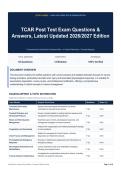
TCAR Post Test Exam Questions &
Answers, Latest Updated 2026/2027 Edition
Comprehensive Examination Question Bank • In-Depth Rationales • Concept Mapping
TOTAL QUESTIONS EXAM TOPICS RATIONALES
83 Questions 12 Modules 100% Verified
DOCUMENT OVERVIEW
This document contains 83 verified questions with correct answers and detailed rationales focused on trauma
biology principles, particularly traumatic brain injury and associated physiological responses. It is suitable for
examination preparation, course review, and professional certification, offering a comprehensive
understanding of critical concepts in trauma management.
EXAM BLUEPRINT & TOPIC DISTRIBUTION
Systematic breakdown of subject domains and exam coverage.
Topic Module Scope & Core Focus Questions Share (%)
Traumatic Brain Injury Explores the physiological mechanisms and forces
Mechanisms contributing to traumatic brain injuries. 7 Qs 8.4%
Cerebral Perfusion and Covers concepts related to cerebral perfusion pressure and
Intracranial Pressure management of intracranial hypertension. 7 Qs 8.4%
Shock and Hemodynamic Examines types of shock, physiological responses, and
Management management strategies in trauma scenarios. 7 Qs 8.4%
Analyzes the coagulopathy and related physiological changes
Coagulation and Hemostasis in trauma patients. 7 Qs 8.4%
Details the management of chest injuries, including
Chest Trauma and Management diagnostics and treatment protocols. 7 Qs 8.4%
Pre-hospital and Emergency Focuses on initial trauma assessment and interventions in
Response emergency settings. 7 Qs 8.4%
Neurological Assessment and Covers assessment tools and rehabilitation strategies
Rehabilitation following neurological trauma. 7 Qs 8.4%
Investigates the complications arising from trauma, including
Trauma-Induced Complications infection and systemic responses. 7 Qs 8.4%
Confidential • Student Study Edition • Practice & Review Guide Page 1 of 44
,STUDENT STUDY & MASTERY EDITION PRACTICE & REVIEW GUIDE
Discusses indications and management strategies for surgical
Surgical Interventions in Trauma interventions in trauma cases. 7 Qs 8.4%
Examines imaging modalities used in the diagnosis and
Advanced Imaging Techniques management of traumatic injuries. 7 Qs 8.4%
Pharmacological Management in Looks into pharmacologic strategies for managing pain,
Trauma sedation, and other trauma-related conditions. 7 Qs 8.4%
Analyzes biomechanical concepts related to protective
Impact Protection Systems measures against traumatic injuries. 6 Qs 7.2%
Total Exam Coverage 12 Integrated Topic Modules 83 Qs 100.0%
Confidential • Student Study Edition • Practice & Review Guide Page 2 of 44
,STUDENT STUDY & MASTERY EDITION PRACTICE & REVIEW GUIDE
TOPIC 1: TRAUMATIC BRAIN INJURY MECHANISMS
7 Questions • 8.4% of Exam • Explores the physiological mechanisms and forces contributing to traumatic brain injuries.
QUESTION 1
In high-velocity blunt head trauma, diffuse axonal injury (DAI) is primarily caused by
which biomechanical force?
[A] Direct impact causing focal contusion
[B] Rotational acceleration leading to shear strain of axons
[C] Penetrating projectile creating cavitation
[D] Compression of the skull against the spine
Correct Answer: Rotational acceleration leading to shear strain of axons.
Rationale: DAI results from rapid rotational forces that generate shearing stresses on white-matter tracts, causing axonal
stretching and disconnection, unlike focal contusions or penetrating injuries.
QUESTION 2
According to the latest Brain Trauma Foundation guidelines, at what intracranial
pressure (ICP) threshold should clinicians initiate aggressive medical therapy in a
sedated adult with severe TBI?
[A] ICP > 15 mmHg for more than 5 minutes
[B] ICP > 20 mmHg sustained for > 5 minutes
[C] ICP > 25 mmHg sustained for > 10 minutes
[D] ICP > 30 mmHg for any duration
Correct Answer: ICP > 20 mmHg sustained for > 5 minutes.
Rationale: Current guidelines recommend initiating tiered therapy when ICP exceeds 20 mmHg for more than 5 minutes
despite adequate sedation and analgesia, as this level is associated with increased risk of secondary injury.
Confidential • Student Study Edition • Practice & Review Guide Page 3 of 44
, STUDENT STUDY & MASTERY EDITION PRACTICE & REVIEW GUIDE
QUESTION 3
Which component of the secondary injury cascade after traumatic brain injury is
directly responsible for excitotoxic neuronal death?
[A] Free-radical generation leading to lipid peroxidation
[B] Glutamate-mediated calcium influx through NMDA receptors
[C] Mitochondrial ATP depletion causing necrosis
[D] Blood-brain barrier disruption allowing inflammatory cell infiltration
Correct Answer: Glutamate-mediated calcium influx through NMDA receptors.
Rationale: Excess extracellular glutamate overstimulates NMDA receptors, causing massive calcium influx, which triggers
enzymatic cascades leading to excitotoxic neuronal death, a key element of secondary injury.
QUESTION 4
In a patient with refractory intracranial hypertension (ICP > 25 mmHg) despite first-line
measures, which hyperosmolar therapy has the most rapid onset of ICP reduction while
preserving cerebral perfusion pressure (CPP) in severe neuro-trauma?
[A] Mannitol 0.25 g/kg bolus
[B] Hypertonic saline 3% (150 mL bolus)
[C] Urea 1 g/kg infusion
[D] Glycerol 1 g/kg bolus
Correct Answer: Hypertonic saline 3% (150 mL bolus)
Rationale: Hypertonic saline produces an immediate osmotic gradient, rapidly lowering ICP while increasing intravascular
volume, thereby better maintaining CPP than mannitol, which can cause diuresis and reduce CPP.
Confidential • Student Study Edition • Practice & Review Guide Page 4 of 44
TCAR Post Test Exam Questions &
Answers, Latest Updated 2026/2027 Edition
Comprehensive Examination Question Bank • In-Depth Rationales • Concept Mapping
TOTAL QUESTIONS EXAM TOPICS RATIONALES
83 Questions 12 Modules 100% Verified
DOCUMENT OVERVIEW
This document contains 83 verified questions with correct answers and detailed rationales focused on trauma
biology principles, particularly traumatic brain injury and associated physiological responses. It is suitable for
examination preparation, course review, and professional certification, offering a comprehensive
understanding of critical concepts in trauma management.
EXAM BLUEPRINT & TOPIC DISTRIBUTION
Systematic breakdown of subject domains and exam coverage.
Topic Module Scope & Core Focus Questions Share (%)
Traumatic Brain Injury Explores the physiological mechanisms and forces
Mechanisms contributing to traumatic brain injuries. 7 Qs 8.4%
Cerebral Perfusion and Covers concepts related to cerebral perfusion pressure and
Intracranial Pressure management of intracranial hypertension. 7 Qs 8.4%
Shock and Hemodynamic Examines types of shock, physiological responses, and
Management management strategies in trauma scenarios. 7 Qs 8.4%
Analyzes the coagulopathy and related physiological changes
Coagulation and Hemostasis in trauma patients. 7 Qs 8.4%
Details the management of chest injuries, including
Chest Trauma and Management diagnostics and treatment protocols. 7 Qs 8.4%
Pre-hospital and Emergency Focuses on initial trauma assessment and interventions in
Response emergency settings. 7 Qs 8.4%
Neurological Assessment and Covers assessment tools and rehabilitation strategies
Rehabilitation following neurological trauma. 7 Qs 8.4%
Investigates the complications arising from trauma, including
Trauma-Induced Complications infection and systemic responses. 7 Qs 8.4%
Confidential • Student Study Edition • Practice & Review Guide Page 1 of 44
,STUDENT STUDY & MASTERY EDITION PRACTICE & REVIEW GUIDE
Discusses indications and management strategies for surgical
Surgical Interventions in Trauma interventions in trauma cases. 7 Qs 8.4%
Examines imaging modalities used in the diagnosis and
Advanced Imaging Techniques management of traumatic injuries. 7 Qs 8.4%
Pharmacological Management in Looks into pharmacologic strategies for managing pain,
Trauma sedation, and other trauma-related conditions. 7 Qs 8.4%
Analyzes biomechanical concepts related to protective
Impact Protection Systems measures against traumatic injuries. 6 Qs 7.2%
Total Exam Coverage 12 Integrated Topic Modules 83 Qs 100.0%
Confidential • Student Study Edition • Practice & Review Guide Page 2 of 44
,STUDENT STUDY & MASTERY EDITION PRACTICE & REVIEW GUIDE
TOPIC 1: TRAUMATIC BRAIN INJURY MECHANISMS
7 Questions • 8.4% of Exam • Explores the physiological mechanisms and forces contributing to traumatic brain injuries.
QUESTION 1
In high-velocity blunt head trauma, diffuse axonal injury (DAI) is primarily caused by
which biomechanical force?
[A] Direct impact causing focal contusion
[B] Rotational acceleration leading to shear strain of axons
[C] Penetrating projectile creating cavitation
[D] Compression of the skull against the spine
Correct Answer: Rotational acceleration leading to shear strain of axons.
Rationale: DAI results from rapid rotational forces that generate shearing stresses on white-matter tracts, causing axonal
stretching and disconnection, unlike focal contusions or penetrating injuries.
QUESTION 2
According to the latest Brain Trauma Foundation guidelines, at what intracranial
pressure (ICP) threshold should clinicians initiate aggressive medical therapy in a
sedated adult with severe TBI?
[A] ICP > 15 mmHg for more than 5 minutes
[B] ICP > 20 mmHg sustained for > 5 minutes
[C] ICP > 25 mmHg sustained for > 10 minutes
[D] ICP > 30 mmHg for any duration
Correct Answer: ICP > 20 mmHg sustained for > 5 minutes.
Rationale: Current guidelines recommend initiating tiered therapy when ICP exceeds 20 mmHg for more than 5 minutes
despite adequate sedation and analgesia, as this level is associated with increased risk of secondary injury.
Confidential • Student Study Edition • Practice & Review Guide Page 3 of 44
, STUDENT STUDY & MASTERY EDITION PRACTICE & REVIEW GUIDE
QUESTION 3
Which component of the secondary injury cascade after traumatic brain injury is
directly responsible for excitotoxic neuronal death?
[A] Free-radical generation leading to lipid peroxidation
[B] Glutamate-mediated calcium influx through NMDA receptors
[C] Mitochondrial ATP depletion causing necrosis
[D] Blood-brain barrier disruption allowing inflammatory cell infiltration
Correct Answer: Glutamate-mediated calcium influx through NMDA receptors.
Rationale: Excess extracellular glutamate overstimulates NMDA receptors, causing massive calcium influx, which triggers
enzymatic cascades leading to excitotoxic neuronal death, a key element of secondary injury.
QUESTION 4
In a patient with refractory intracranial hypertension (ICP > 25 mmHg) despite first-line
measures, which hyperosmolar therapy has the most rapid onset of ICP reduction while
preserving cerebral perfusion pressure (CPP) in severe neuro-trauma?
[A] Mannitol 0.25 g/kg bolus
[B] Hypertonic saline 3% (150 mL bolus)
[C] Urea 1 g/kg infusion
[D] Glycerol 1 g/kg bolus
Correct Answer: Hypertonic saline 3% (150 mL bolus)
Rationale: Hypertonic saline produces an immediate osmotic gradient, rapidly lowering ICP while increasing intravascular
volume, thereby better maintaining CPP than mannitol, which can cause diuresis and reduce CPP.
Confidential • Student Study Edition • Practice & Review Guide Page 4 of 44