[STUDY GUIDE] • HIGH-YIELD PRACTICE & REVIEW EDITION
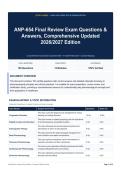
ANP-654 Final Review Exam Questions &
Answers, Comprehensive Updated
2026/2027 Edition
Comprehensive Examination Question Bank • In-Depth Rationales • Concept Mapping
TOTAL QUESTIONS EXAM TOPICS RATIONALES
100 Questions 12 Modules 100% Verified
DOCUMENT OVERVIEW
This document contains 100 verified questions with correct answers and detailed rationales focusing on
pharmacological principles and clinical practices. It is suitable for exam preparation, course review, and
certification study, providing a comprehensive resource for understanding key pharmacological concepts and
their applications in healthcare.
EXAM BLUEPRINT & TOPIC DISTRIBUTION
Systematic breakdown of subject domains and exam coverage.
Topic Module Scope & Core Focus Questions Share (%)
This topic covers the diagnosis and management of various
Coagulation Disorders bleeding and clotting disorders. 10 Qs 10.0%
This topic focuses on platelet physiology and the implications
Platelet Function and Disorders of thrombocytopenia and platelet disorders. 9 Qs 9.0%
This topic addresses the pharmacological treatment and
Anticoagulant Therapy mechanisms of action of anticoagulants. 9 Qs 9.0%
This topic examines the pharmacological management of
Renal Pharmacology renal conditions and related complications. 8 Qs 8.0%
This topic explores medications used in the treatment of
Pulmonary Pharmacology respiratory disorders and their mechanisms. 8 Qs 8.0%
This topic covers medications affecting cardiovascular health,
Cardiovascular Pharmacology including antihypertensives and inotropes. 8 Qs 8.0%
This topic addresses pharmacological therapies for endocrine
Endocrine Pharmacology disorders and their effects. 8 Qs 8.0%
Confidential • Student Study Edition • Practice & Review Guide Page 1 of 51
,STUDENT STUDY & MASTERY EDITION PRACTICE & REVIEW GUIDE
This topic discusses medications used for gastrointestinal
Gastrointestinal Pharmacology disorders and their therapeutic effects. 8 Qs 8.0%
This topic focuses on medications for neurological conditions
Neurological Pharmacology and their mechanisms of action. 8 Qs 8.0%
This topic covers medications affecting blood disorders and
Hematological Pharmacology their therapeutic implications. 8 Qs 8.0%
This topic explores the role of genetics in medication therapy
Pharmacogenomics and personalized medicine. 8 Qs 8.0%
This topic involves the use of imaging and diagnostic tests in
Diagnostics and Imaging conjunction with pharmacological treatments. 8 Qs 8.0%
Total Exam Coverage 12 Integrated Topic Modules 100 Qs 100.0%
Confidential • Student Study Edition • Practice & Review Guide Page 2 of 51
,STUDENT STUDY & MASTERY EDITION PRACTICE & REVIEW GUIDE
TOPIC 1: COAGULATION DISORDERS
10 Questions • 10.0% of Exam • This topic covers the diagnosis and management of various bleeding and clotting disorders.
QUESTION 1
A patient with a history of bleeding disorders is being evaluated for a suspected
coagulopathy. Which of the following laboratory values would be most indicative of this
patient's coagulation status?
[A] Normal PT and aPTT
[B] Prolonged PT and aPTT
[C] Low platelet count
[D] Elevated D-dimer
Correct Answer: B.
Rationale: Advanced Assessment & Diagnostic Reasoning requires critical evaluation of laboratory values to determine
coagulation status. A prolonged PT and aPTT would indicate a coagulopathy, whereas a normal PT and aPTT would
suggest normal coagulation. A low platelet count would indicate thrombocytopenia, and an elevated D-dimer would indicate
fibrin degradation, but these are not as specific for coagulopathy as prolonged PT and aPTT.
QUESTION 2
In the diagnosis of deep vein thrombosis (DVT), which of the following is the most
accurate indicator of a clot?
[A] Elevated D-dimer
[B] Ultrasound findings
[C] Physical examination
[D] Patient history
Correct Answer: B.
Rationale: Advanced Assessment & Diagnostic Reasoning requires the ability to evaluate the accuracy of diagnostic
indicators. Ultrasound findings, such as a non-compressible vein, are the most accurate indicator of a clot, whereas an
elevated D-dimer is nonspecific and can be elevated in many conditions. Physical examination and patient history may
suggest DVT, but are not as accurate as ultrasound findings.
Confidential • Student Study Edition • Practice & Review Guide Page 3 of 51
, STUDENT STUDY & MASTERY EDITION PRACTICE & REVIEW GUIDE
QUESTION 3
A patient with a suspected coagulopathy is being evaluated for a possible bleeding
disorder. Which of the following laboratory values would be most indicative of a
primary hemostasis disorder?
[A] Prolonged PT and aPTT
[B] Normal PT and aPTT
[C] Platelet plug formation abnormality
[D] Elevated D-dimer
Correct Answer: C.
Rationale: Advanced Assessment & Diagnostic Reasoning requires critical evaluation of laboratory values to determine the
presence of a primary hemostasis disorder. A platelet plug formation abnormality would indicate a defect in primary
hemostasis, whereas a prolonged PT and aPTT would indicate a coagulation factor deficiency, and an elevated Ddimer
would indicate fibrin degradation.
QUESTION 4
A patient with a history of recent surgery is being evaluated for a suspected
coagulopathy. Which of the following interventions would be most effective in treating
the underlying coagulopathy?
[A] Administering platelets
[B] Administering coagulation factors
[C] Administering fibrinogen
[D] Maintaining a stable blood pressure
Correct Answer: C.
Rationale: Advanced Assessment & Diagnostic Reasoning requires the ability to evaluate the most effective interventions
for a suspected coagulopathy. Administering fibrinogen would be the most effective intervention in treating the underlying
coagulopathy, whereas administering platelets, coagulation factors, or maintaining a stable blood pressure may be helpful,
but are not as effective.
Cardiovascular Disorders (15 Questions)
Confidential • Student Study Edition • Practice & Review Guide Page 4 of 51
ANP-654 Final Review Exam Questions &
Answers, Comprehensive Updated
2026/2027 Edition
Comprehensive Examination Question Bank • In-Depth Rationales • Concept Mapping
TOTAL QUESTIONS EXAM TOPICS RATIONALES
100 Questions 12 Modules 100% Verified
DOCUMENT OVERVIEW
This document contains 100 verified questions with correct answers and detailed rationales focusing on
pharmacological principles and clinical practices. It is suitable for exam preparation, course review, and
certification study, providing a comprehensive resource for understanding key pharmacological concepts and
their applications in healthcare.
EXAM BLUEPRINT & TOPIC DISTRIBUTION
Systematic breakdown of subject domains and exam coverage.
Topic Module Scope & Core Focus Questions Share (%)
This topic covers the diagnosis and management of various
Coagulation Disorders bleeding and clotting disorders. 10 Qs 10.0%
This topic focuses on platelet physiology and the implications
Platelet Function and Disorders of thrombocytopenia and platelet disorders. 9 Qs 9.0%
This topic addresses the pharmacological treatment and
Anticoagulant Therapy mechanisms of action of anticoagulants. 9 Qs 9.0%
This topic examines the pharmacological management of
Renal Pharmacology renal conditions and related complications. 8 Qs 8.0%
This topic explores medications used in the treatment of
Pulmonary Pharmacology respiratory disorders and their mechanisms. 8 Qs 8.0%
This topic covers medications affecting cardiovascular health,
Cardiovascular Pharmacology including antihypertensives and inotropes. 8 Qs 8.0%
This topic addresses pharmacological therapies for endocrine
Endocrine Pharmacology disorders and their effects. 8 Qs 8.0%
Confidential • Student Study Edition • Practice & Review Guide Page 1 of 51
,STUDENT STUDY & MASTERY EDITION PRACTICE & REVIEW GUIDE
This topic discusses medications used for gastrointestinal
Gastrointestinal Pharmacology disorders and their therapeutic effects. 8 Qs 8.0%
This topic focuses on medications for neurological conditions
Neurological Pharmacology and their mechanisms of action. 8 Qs 8.0%
This topic covers medications affecting blood disorders and
Hematological Pharmacology their therapeutic implications. 8 Qs 8.0%
This topic explores the role of genetics in medication therapy
Pharmacogenomics and personalized medicine. 8 Qs 8.0%
This topic involves the use of imaging and diagnostic tests in
Diagnostics and Imaging conjunction with pharmacological treatments. 8 Qs 8.0%
Total Exam Coverage 12 Integrated Topic Modules 100 Qs 100.0%
Confidential • Student Study Edition • Practice & Review Guide Page 2 of 51
,STUDENT STUDY & MASTERY EDITION PRACTICE & REVIEW GUIDE
TOPIC 1: COAGULATION DISORDERS
10 Questions • 10.0% of Exam • This topic covers the diagnosis and management of various bleeding and clotting disorders.
QUESTION 1
A patient with a history of bleeding disorders is being evaluated for a suspected
coagulopathy. Which of the following laboratory values would be most indicative of this
patient's coagulation status?
[A] Normal PT and aPTT
[B] Prolonged PT and aPTT
[C] Low platelet count
[D] Elevated D-dimer
Correct Answer: B.
Rationale: Advanced Assessment & Diagnostic Reasoning requires critical evaluation of laboratory values to determine
coagulation status. A prolonged PT and aPTT would indicate a coagulopathy, whereas a normal PT and aPTT would
suggest normal coagulation. A low platelet count would indicate thrombocytopenia, and an elevated D-dimer would indicate
fibrin degradation, but these are not as specific for coagulopathy as prolonged PT and aPTT.
QUESTION 2
In the diagnosis of deep vein thrombosis (DVT), which of the following is the most
accurate indicator of a clot?
[A] Elevated D-dimer
[B] Ultrasound findings
[C] Physical examination
[D] Patient history
Correct Answer: B.
Rationale: Advanced Assessment & Diagnostic Reasoning requires the ability to evaluate the accuracy of diagnostic
indicators. Ultrasound findings, such as a non-compressible vein, are the most accurate indicator of a clot, whereas an
elevated D-dimer is nonspecific and can be elevated in many conditions. Physical examination and patient history may
suggest DVT, but are not as accurate as ultrasound findings.
Confidential • Student Study Edition • Practice & Review Guide Page 3 of 51
, STUDENT STUDY & MASTERY EDITION PRACTICE & REVIEW GUIDE
QUESTION 3
A patient with a suspected coagulopathy is being evaluated for a possible bleeding
disorder. Which of the following laboratory values would be most indicative of a
primary hemostasis disorder?
[A] Prolonged PT and aPTT
[B] Normal PT and aPTT
[C] Platelet plug formation abnormality
[D] Elevated D-dimer
Correct Answer: C.
Rationale: Advanced Assessment & Diagnostic Reasoning requires critical evaluation of laboratory values to determine the
presence of a primary hemostasis disorder. A platelet plug formation abnormality would indicate a defect in primary
hemostasis, whereas a prolonged PT and aPTT would indicate a coagulation factor deficiency, and an elevated Ddimer
would indicate fibrin degradation.
QUESTION 4
A patient with a history of recent surgery is being evaluated for a suspected
coagulopathy. Which of the following interventions would be most effective in treating
the underlying coagulopathy?
[A] Administering platelets
[B] Administering coagulation factors
[C] Administering fibrinogen
[D] Maintaining a stable blood pressure
Correct Answer: C.
Rationale: Advanced Assessment & Diagnostic Reasoning requires the ability to evaluate the most effective interventions
for a suspected coagulopathy. Administering fibrinogen would be the most effective intervention in treating the underlying
coagulopathy, whereas administering platelets, coagulation factors, or maintaining a stable blood pressure may be helpful,
but are not as effective.
Cardiovascular Disorders (15 Questions)
Confidential • Student Study Edition • Practice & Review Guide Page 4 of 51